Question 1
Dividing the price by the net weight, what is the unit price of the small box of cereal, measured in cents per ounce?
Enter a number.
cents per ounce


Teachers who sign in can assign LessonRally activities to their Google Classroom classes: students open them in Classroom and answer online, and their grades go to the teacher's Classroom gradebook. Practice lets you try it first, the way students see it.
Free for teachers. Sign in to assign activities to your Google Classroom classes.
 (opens in a new tab)
2 pages · Student copy, no answers
Print worksheet (opens in a new tab)Answer keyPremiumStudents find unit prices in cents per ounce for two sizes of cereal and two sizes of peanut butter, then compare the packages using the numbers. In one case the bigger package costs less per ounce and in the other the smaller one does, and a coupon changes the comparison again. A comparison shopping activity with matching terms such as unit price and net weight.
Learning goal: Calculate unit prices to compare packages of different sizes, and explain why a bigger package does not always cost less per unit.
The estimate is halfway between the two middle scores of four readability formulas. Their scores run from 7.6 to 9.5.
Adapted from common readability formulas (Flesch-Kincaid, Gunning Fog, Coleman-Liau and ARI, plus SMOG for long texts), which look at sentence length and word length. Answer choices count toward word length only. Grades below the estimate will likely find the text harder, grades above it easier. It does not measure ideas, background knowledge or images.
Topic: Personal Finance Chosen by LessonRally
Question types: number answer, matching, multiple choice.
The questions as students see them, without the answers.
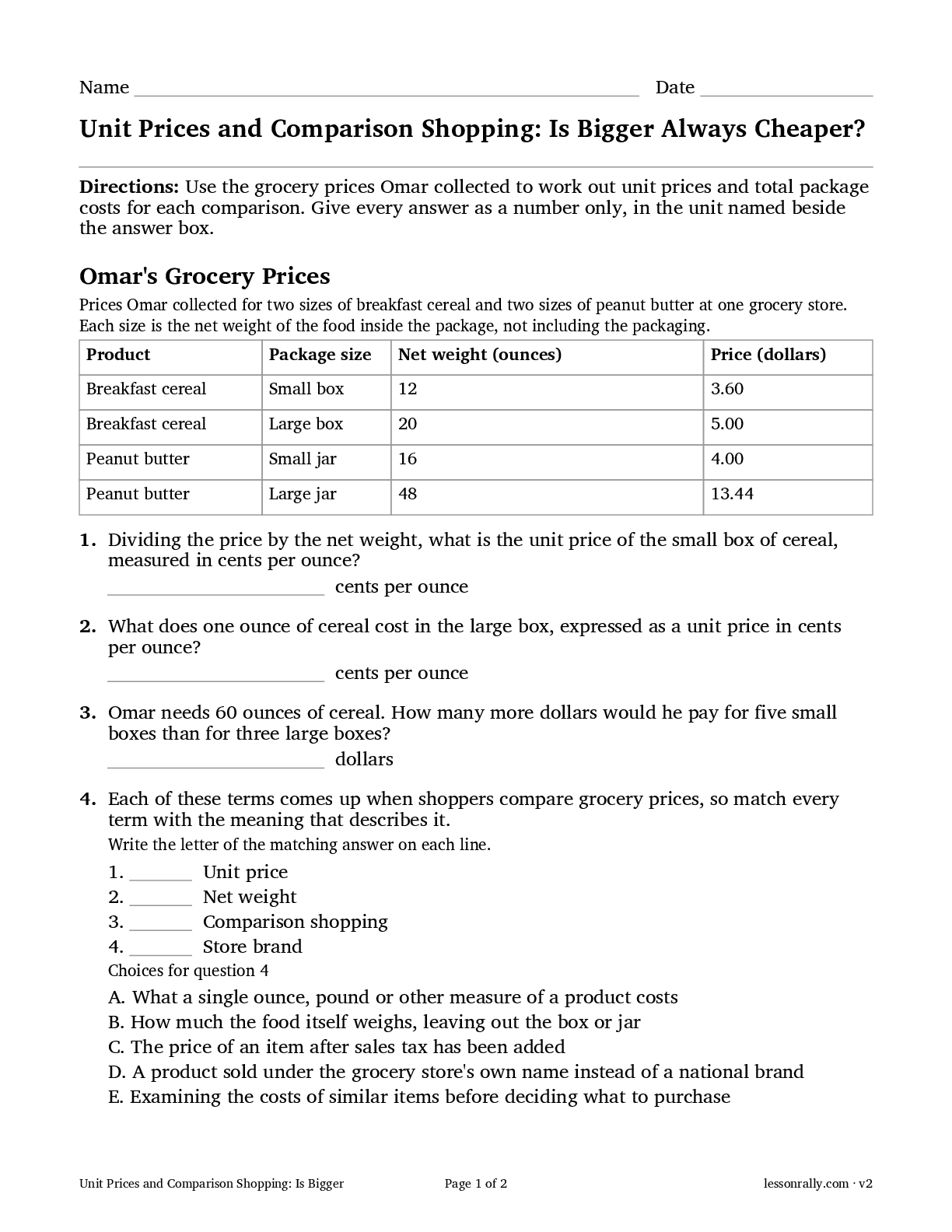
Use the grocery prices Omar collected to work out unit prices and total package costs for each comparison. Give every answer as a number only, in the unit named beside the answer box.
| Product | Package size | Net weight (ounces) | Price (dollars) |
|---|---|---|---|
| Breakfast cereal | Small box | 12 | 3.60 |
| Breakfast cereal | Large box | 20 | 5.00 |
| Peanut butter | Small jar | 16 | 4.00 |
| Peanut butter | Large jar | 48 | 13.44 |
Dividing the price by the net weight, what is the unit price of the small box of cereal, measured in cents per ounce?
Enter a number.
cents per ounce
What does one ounce of cereal cost in the large box, expressed as a unit price in cents per ounce?
Enter a number.
cents per ounce
Omar needs 60 ounces of cereal. How many more dollars would he pay for five small boxes than for three large boxes?
Enter a number.
dollars
Each of these terms comes up when shoppers compare grocery prices, so match every term with the meaning that describes it.
Match each item to an option.
Items
Options
When the two peanut butter jars are compared by unit price, which jar costs less per ounce, and by how much?
Choose one answer.
To get 48 ounces of peanut butter altogether, how many dollars would Omar save by purchasing three small jars instead of one large jar?
Enter a number.
dollars
Considering the cereal comparison and the peanut butter comparison together, what do Omar's results demonstrate about package sizes?
Choose one answer.
A store coupon takes $1.20 off one small box of cereal. With the coupon, what is that box's unit price in cents per ounce?
Enter a number.
cents per ounce
No reviews yet.
Reviews come from teachers who assigned this activity to a class.
Have a topic of your own? Make a printable worksheet and online quiz, free.
Create an activityMade by Greg Ostlund · LessonRally (AI-assisted)
Made by Greg Ostlund · LessonRally (AI-assisted)
Made by Greg Ostlund · LessonRally (AI-assisted)
Made by Greg Ostlund · LessonRally (AI-assisted)