Question 1
Adding up every planned expense line except savings, what is the total amount Keisha planned to spend in March? Type your answer without a comma.
Enter a number.
dollars


Teachers who sign in can assign LessonRally activities to their Google Classroom classes: students open them in Classroom and answer online, and their grades go to the teacher's Classroom gradebook. Practice lets you try it first, the way students see it.
Free for teachers. Sign in to assign activities to your Google Classroom classes.
 (opens in a new tab)
2 pages · Student copy, no answers
Print worksheet (opens in a new tab)Answer keyPremiumStudents read a monthly budget to total planned spending, find what is left over after savings, and compare planned with actual spending line by line. They sort a need from a want, match budgeting terms such as fixed expense and surplus, and weigh a rent and bus pass decision using the numbers.
Learning goal: Read a monthly budget to find total spending, savings and what is left over, compare planned with actual amounts, and use the numbers to weigh a budget choice.
The estimate is halfway between the two middle scores of four readability formulas. Their scores run from 7.7 to 9.2.
Adapted from common readability formulas (Flesch-Kincaid, Gunning Fog, Coleman-Liau and ARI, plus SMOG for long texts), which look at sentence length and word length. Answer choices count toward word length only. Grades below the estimate will likely find the text harder, grades above it easier. It does not measure ideas, background knowledge or images.
Topic: Personal Finance Chosen by LessonRally
Question types: number answer, multiple choice, matching, select all that apply.
The questions as students see them, without the answers.
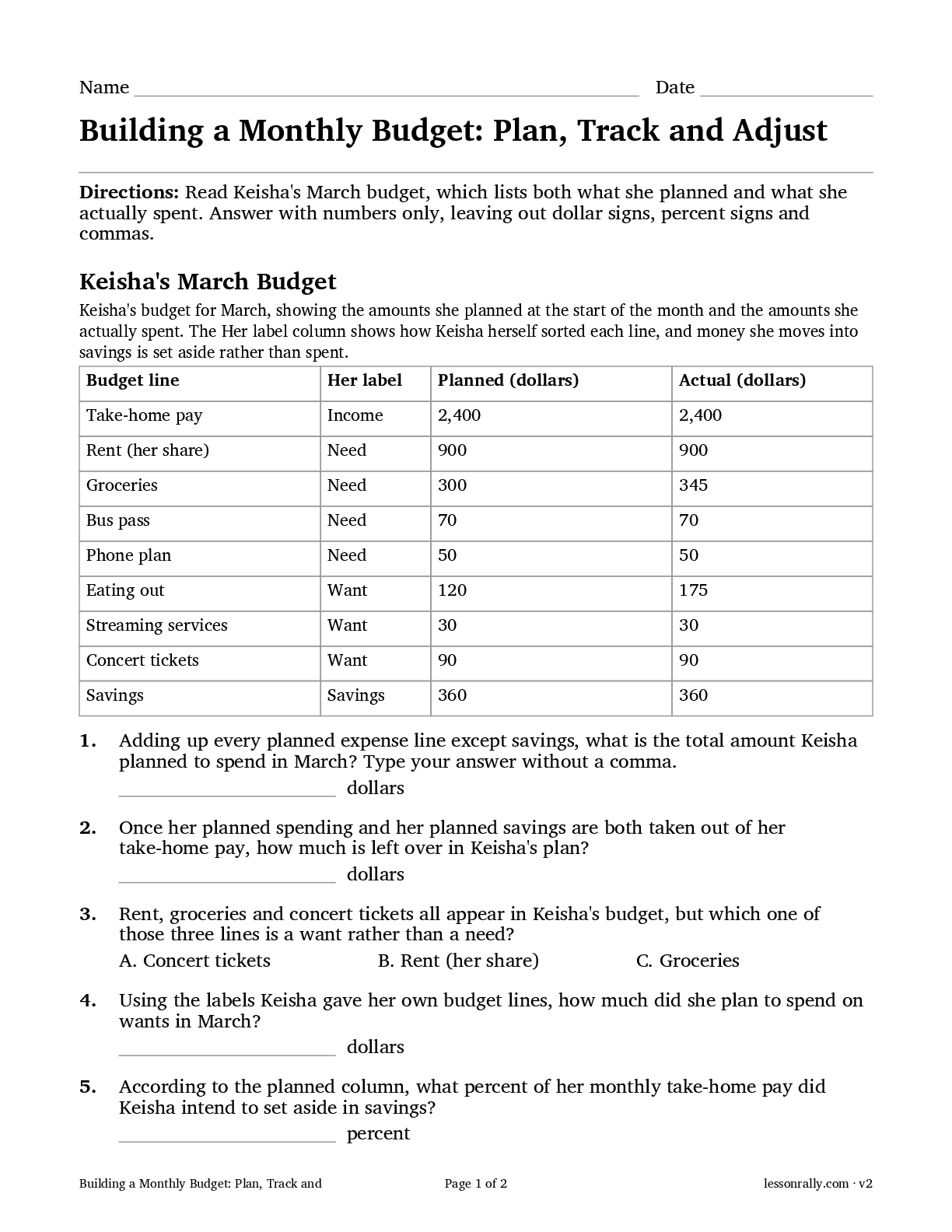
Read Keisha's March budget, which lists both what she planned and what she actually spent. Answer with numbers only, leaving out dollar signs, percent signs and commas.
| Budget line | Her label | Planned (dollars) | Actual (dollars) |
|---|---|---|---|
| Take-home pay | Income | 2,400 | 2,400 |
| Rent (her share) | Need | 900 | 900 |
| Groceries | Need | 300 | 345 |
| Bus pass | Need | 70 | 70 |
| Phone plan | Need | 50 | 50 |
| Eating out | Want | 120 | 175 |
| Streaming services | Want | 30 | 30 |
| Concert tickets | Want | 90 | 90 |
| Savings | Savings | 360 | 360 |
Adding up every planned expense line except savings, what is the total amount Keisha planned to spend in March? Type your answer without a comma.
Enter a number.
dollars
Once her planned spending and her planned savings are both taken out of her take-home pay, how much is left over in Keisha's plan?
Enter a number.
dollars
Rent, groceries and concert tickets all appear in Keisha's budget, but which one of those three lines is a want rather than a need?
Choose one answer.
Using the labels Keisha gave her own budget lines, how much did she plan to spend on wants in March?
Enter a number.
dollars
According to the planned column, what percent of her monthly take-home pay did Keisha intend to set aside in savings?
Enter a number.
percent
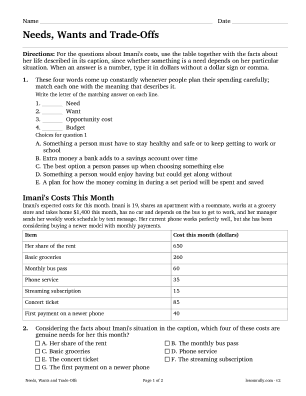
Match each budgeting word with the meaning it has when someone plans a month of spending.
Match each item to an option.
Items
Options
Which two budget lines did Keisha go over in March, spending more than she had planned?
Choose 2 answers.
By how many dollars did Keisha's actual spending on eating out go over the amount she had planned for it?
Enter a number.
dollars
Using the actual column, how much of Keisha's take-home pay was left over in March after all her spending and her savings?
Enter a number.
dollars
Keisha could move to a room with a rent share of $780 a month, but it is farther from work, so her bus pass would cost $130 a month instead of $70. Counting only rent and the bus pass, which costs her less each month, staying where she is or moving, and by how much?
Choose one answer.
No reviews yet.
Reviews come from teachers who assigned this activity to a class.
Have a topic of your own? Make a printable worksheet and online quiz, free.
Create an activityMade by Greg Ostlund · LessonRally (AI-assisted)
Made by Greg Ostlund · LessonRally (AI-assisted)
Made by Greg Ostlund · LessonRally (AI-assisted)
Made by Greg Ostlund · LessonRally (AI-assisted)