Question 1
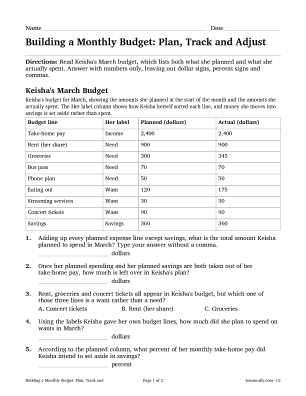
These four words come up constantly whenever people plan their spending carefully; match each one with the meaning that describes it.
Match each item to an option.
Items
- Need
- Want
- Opportunity cost
- Budget
Options


Teachers who sign in can assign LessonRally activities to their Google Classroom classes: students open them in Classroom and answer online, and their grades go to the teacher's Classroom gradebook. Practice lets you try it first, the way students see it.
Free for teachers. Sign in to assign activities to your Google Classroom classes.
 (opens in a new tab)
2 pages · Student copy, no answers
Print worksheet (opens in a new tab)Answer keyPremiumStudents use a short case about Imani, a 19-year-old who works and rides the bus, to sort her monthly costs into needs and wants, find what is left of her pay, and see why a phone or a car can be a need for one person and a want for another. They also name an opportunity cost and weigh a trade-off using numbers.
Learning goal: Tell needs from wants based on a person's situation, identify the opportunity cost of a choice, and use numbers to weigh a trade-off.
The estimate is halfway between the two middle scores of four readability formulas. Their scores run from 7.9 to 11.8.
Adapted from common readability formulas (Flesch-Kincaid, Gunning Fog, Coleman-Liau and ARI, plus SMOG for long texts), which look at sentence length and word length. Answer choices count toward word length only. Grades below the estimate will likely find the text harder, grades above it easier. It does not measure ideas, background knowledge or images.
Topic: Personal Finance Chosen by LessonRally
Question types: matching, select all that apply, number answer, multiple choice.
The questions as students see them, without the answers.
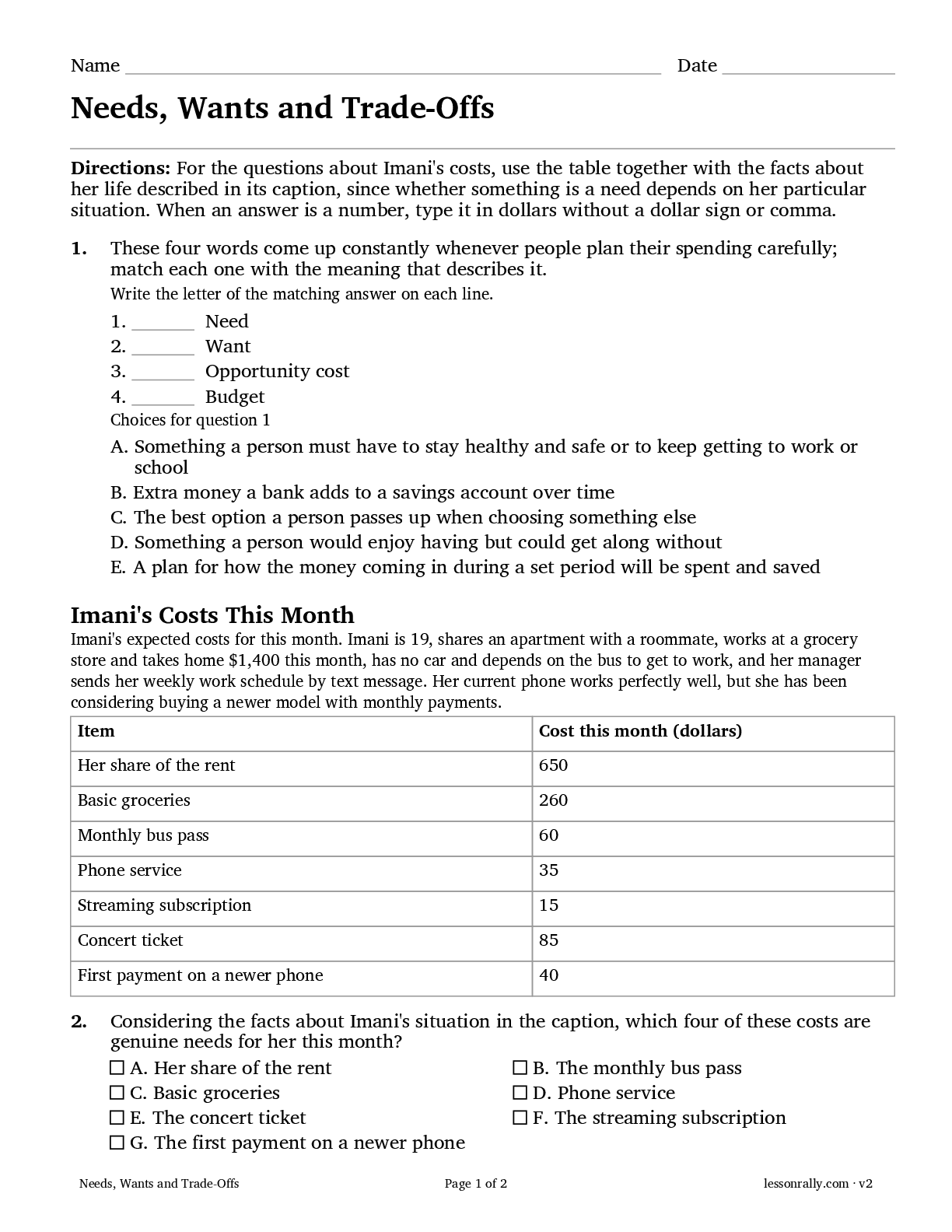
For the questions about Imani's costs, use the table together with the facts about her life described in its caption, since whether something is a need depends on her particular situation. When an answer is a number, type it in dollars without a dollar sign or comma.
These four words come up constantly whenever people plan their spending carefully; match each one with the meaning that describes it.
Match each item to an option.
Items
Options
| Item | Cost this month (dollars) |
|---|---|
| Her share of the rent | 650 |
| Basic groceries | 260 |
| Monthly bus pass | 60 |
| Phone service | 35 |
| Streaming subscription | 15 |
| Concert ticket | 85 |
| First payment on a newer phone | 40 |
Considering the facts about Imani's situation in the caption, which four of these costs are genuine needs for her this month?
Choose 4 answers.
After paying for her share of the rent, basic groceries, the bus pass and phone service, how much of her $1,400 take-home pay does Imani have remaining this month?
Enter a number.
dollars
If Imani decided to pay for all seven costs listed in the table this month, how much of her $1,400 take-home pay would remain?
Enter a number.
dollars
Imani decides to skip the concert this month so she can put its $85 into her emergency savings instead; which statement best describes her choice?
Choose one answer.
Owen lives in a small town without any buses and drives 25 miles to his job, while Imani lives near a bus line and rides it to work. Which statement best explains why a car could be a necessity for Owen but only a want for Imani?
Choose one answer.
Imani has one free Saturday, and her top two choices are working an additional shift or attending a friend's birthday party. If she chooses the party, what is her opportunity cost?
Choose one answer.
Imani's additional shift would have lasted 6 hours at a pay rate of $16 an hour. How much pay does she give up by choosing the party instead?
Enter a number.
dollars
For the next 6 months, Imani could continue buying the $60 monthly bus pass, or she could make a one-time purchase of a $250 used bicycle and a $30 lock and ride to work instead. Counting only these costs, which option costs less over the 6 months, and by how much?
Choose one answer.
Which statement about including wants in a personal budget is accurate?
Choose one answer.
No reviews yet.
Reviews come from teachers who assigned this activity to a class.
Have a topic of your own? Make a printable worksheet and online quiz, free.
Create an activityMade by Greg Ostlund · LessonRally (AI-assisted)
Made by Greg Ostlund · LessonRally (AI-assisted)
Made by Greg Ostlund · LessonRally (AI-assisted)
Made by Greg Ostlund · LessonRally (AI-assisted)