Question 1
Match each Spanish family word to its meaning in English.
Match each item to an option.
Items
- el abuelo
- la tía
- el primo
- la hermana
- el hijo
- la nieta
Options


Teachers who sign in can assign LessonRally activities to their Google Classroom classes: students open them in Classroom and answer online, and their grades go to the teacher's Classroom gradebook. Practice lets you try it first, the way students see it.
Free for teachers. Sign in to assign activities to your Google Classroom classes.
 (opens in a new tab)
2 pages · Student copy, no answers
Print worksheet (opens in a new tab)Answer keyPremiumStudents match Spanish family words to their meanings, then use them in sentences and short exchanges with the possessive adjectives mi, tu, su and nuestro. When a question asks for a possessive adjective, it says whose family it is, so students practice choosing the right possessive and making it agree with the family member, as in mis hermanos and nuestra abuela.
Learning goal: Name family members in Spanish and use mi, tu, su and nuestro in forms that agree with the family member, as in mis hermanos and nuestra abuela.
Topics: Family Vocabulary, Spanish Adjectives and Articles Chosen by LessonRally
Question types: matching, fill in the blank, multiple choice.
The questions as students see them, without the answers.
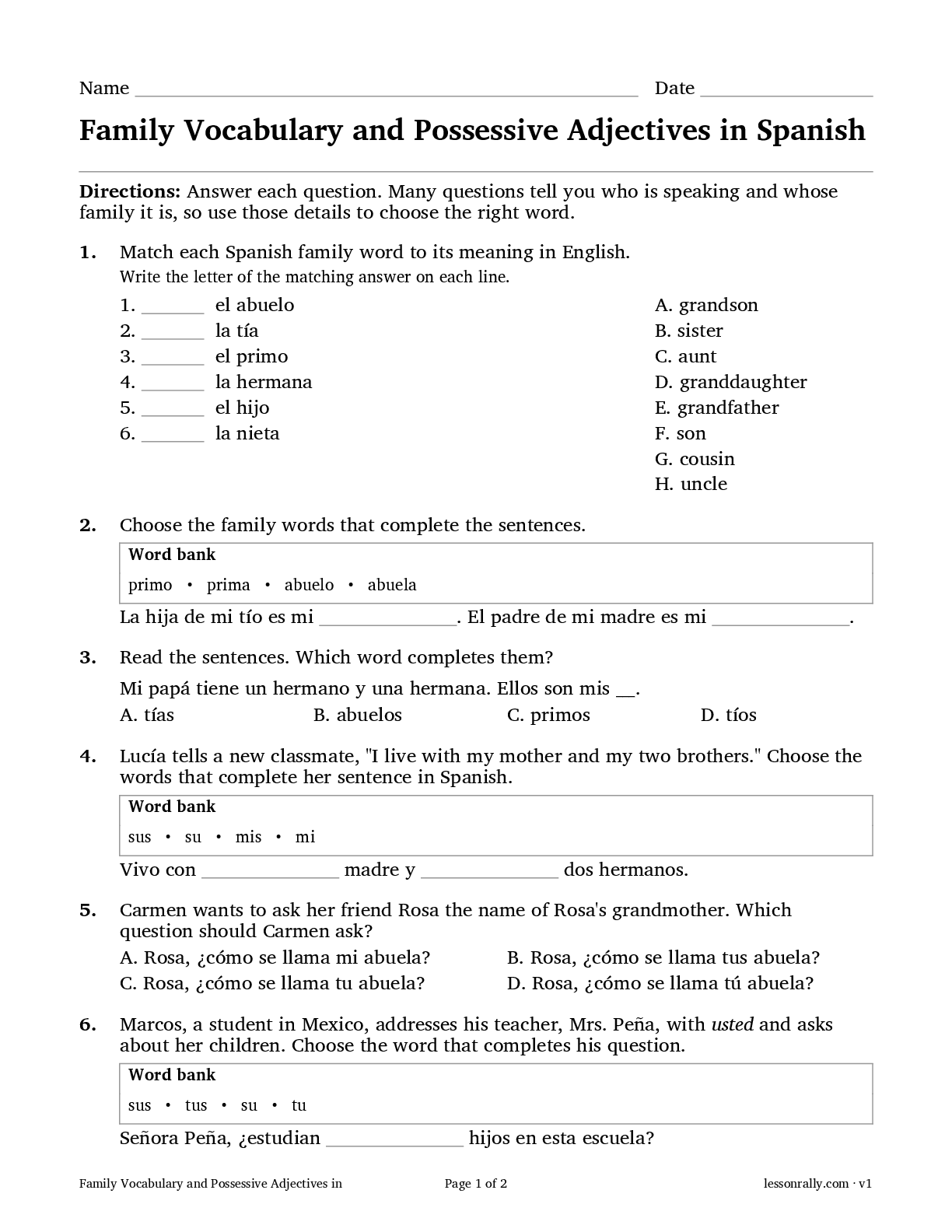
Answer each question. Many questions tell you who is speaking and whose family it is, so use those details to choose the right word.
Match each Spanish family word to its meaning in English.
Match each item to an option.
Items
Options
Choose the family words that complete the sentences.
Fill in each blank.
La hija de mi tío es mi blank 1. El padre de mi madre es mi blank 2.
Word bank
Read the sentences. Which word completes them?
Mi papá tiene un hermano y una hermana. Ellos son mis ___.
Choose one answer.
Lucía tells a new classmate, "I live with my mother and my two brothers." Choose the words that complete her sentence in Spanish.
Fill in each blank.
Vivo con blank 1 madre y blank 2 dos hermanos.
Word bank
Carmen wants to ask her friend Rosa the name of Rosa's grandmother. Which question should Carmen ask?
Choose one answer.
Marcos, a student in Mexico, addresses his teacher, Mrs. Peña, with usted and asks about her children. Choose the word that completes his question.
Fill in each blank.
Señora Peña, ¿estudian blank 1 hijos en esta escuela?
Word bank
Sofía and her friend Elena use tú with each other. They are talking about their classmate Pablo. Sofía says: "Su hermana se llama Inés." Whose sister is Inés?
Choose one answer.
Marta and Jorge have one son, Luis. Which sentence correctly says "Their son is named Luis"?
Choose one answer.
Mateo and his brother Andrés are talking about their family. Pick the forms of nuestro that complete what they say.
Fill in each blank.
En Guadalajara vive blank 1 abuela. En Chicago viven blank 2 tíos.
Word bank
Diego asks his friend Lola about her grandparents, and Lola answers about her own family. Choose the words that complete their conversation.
Fill in each blank.
Diego: Lola, ¿dónde viven blank 1 abuelos? Lola: Viven en Texas, con blank 2 tía Gloria.
Word bank
No reviews yet.
Reviews come from teachers who assigned this activity to a class.
Have a topic of your own? Make a printable worksheet and online quiz, free.
Create an activityMade by Elena Brisaval · LessonRally (AI-assisted)
Made by Elena Brisaval · LessonRally (AI-assisted)
Made by Elena Brisaval · LessonRally (AI-assisted)
Made by Elena Brisaval · LessonRally (AI-assisted)