Question 1
Match each daily routine verb to its meaning in English.
Match each item to an option.
Items
- levantarse
- ducharse
- vestirse
- acostarse
- despertarse
- cepillarse los dientes
Options


Teachers who sign in can assign LessonRally activities to their Google Classroom classes: students open them in Classroom and answer online, and their grades go to the teacher's Classroom gradebook. Practice lets you try it first, the way students see it.
Free for teachers. Sign in to assign activities to your Google Classroom classes.
 (opens in a new tab)
2 pages · Student copy, no answers
Print worksheet (opens in a new tab)Answer keyPremiumStudents match daily routine verbs such as levantarse, ducharse, vestirse and acostarse to their meanings, then complete sentences with the reflexive pronoun that matches the subject, as in me levanto and se levanta. They also attach a pronoun to an infinitive, as in voy a ducharme, and describe a morning routine in order.
Learning goal: Describe a daily routine in Spanish with reflexive verbs such as levantarse, ducharse, vestirse and acostarse, using the pronoun that matches the subject: me, te, se or nos.
Topics: Spanish Reflexive Verbs, Daily Routine, Spanish Stem-Changing Verbs Chosen by LessonRally
Question types: matching, multiple choice, fill in the blank.
The questions as students see them, without the answers.
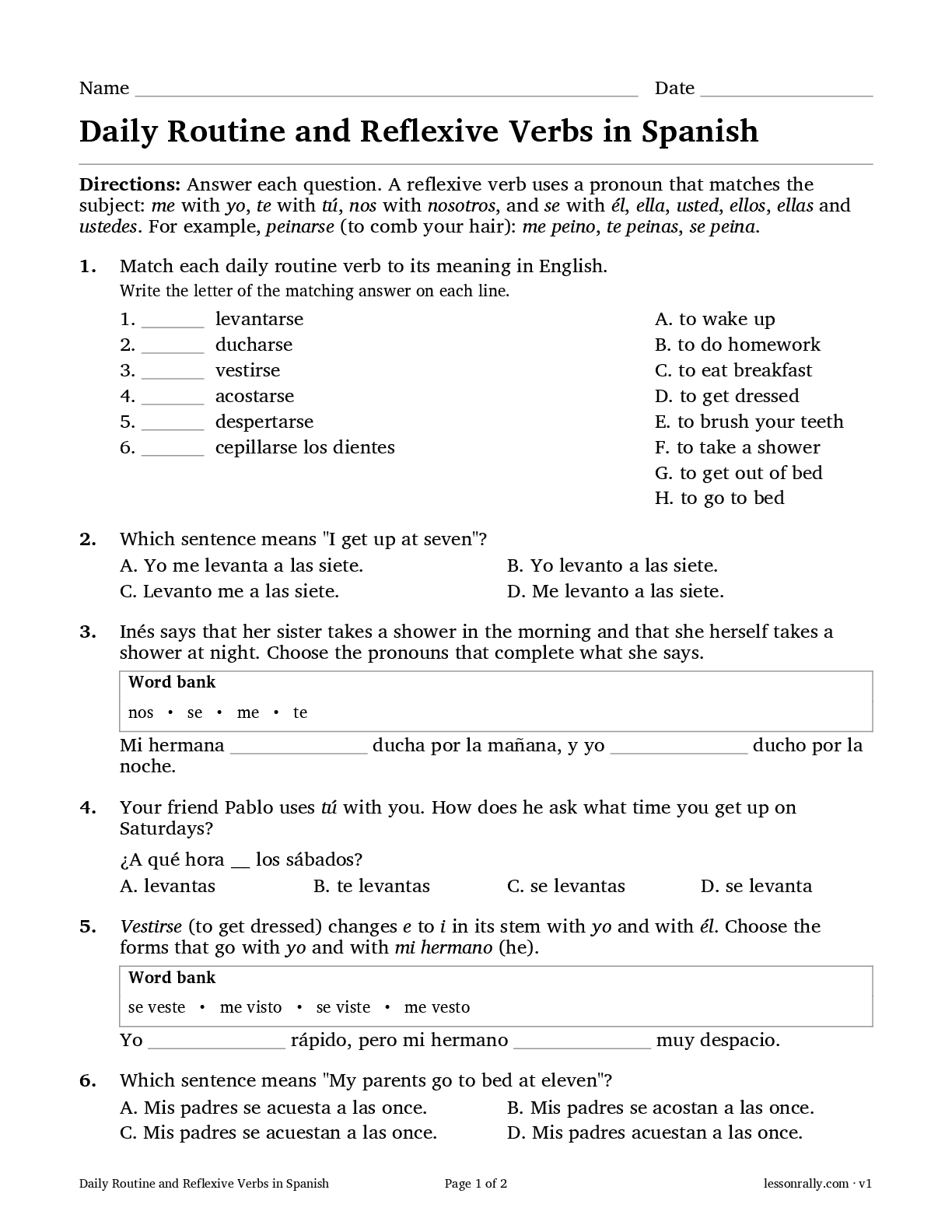
Answer each question. A reflexive verb uses a pronoun that matches the subject: me with yo, te with tú, nos with nosotros, and se with él, ella, usted, ellos, ellas and ustedes. For example, peinarse (to comb your hair): me peino, te peinas, se peina.
Match each daily routine verb to its meaning in English.
Match each item to an option.
Items
Options
Which sentence means "I get up at seven"?
Choose one answer.
Inés says that her sister takes a shower in the morning and that she herself takes a shower at night. Choose the pronouns that complete what she says.
Fill in each blank.
Mi hermana blank 1 ducha por la mañana, y yo blank 2 ducho por la noche.
Word bank
Your friend Pablo uses tú with you. How does he ask what time you get up on Saturdays?
¿A qué hora ___ los sábados?
Choose one answer.
Vestirse (to get dressed) changes e to i in its stem with yo and with él. Choose the forms that go with yo and with mi hermano (he).
Fill in each blank.
Yo blank 1 rápido, pero mi hermano blank 2 muy despacio.
Word bank
Which sentence means "My parents go to bed at eleven"?
Choose one answer.
Carlos says that tomorrow he is going to take a shower early. Choose the word that completes what he says.
Fill in each blank.
Mañana voy a blank 1 temprano.
Word bank
Marta and her brother brush their teeth after lunch. Choose the words that complete what Marta says.
Fill in each blank.
Después del almuerzo, mi hermano y yo blank 1 blank 2 los dientes.
Word bank
You use usted with your neighbor, Señora López. How do you ask her what time she wakes up?
Señora López, ¿a qué hora ___ usted?
Choose one answer.
Andrés says, "First I wake up, then I get out of bed, and after that I take a shower." Choose the words that complete his sentence in Spanish, in that order.
Fill in each blank.
Primero blank 1, luego blank 2 y después blank 3.
Word bank
No reviews yet.
Reviews come from teachers who assigned this activity to a class.
Have a topic of your own? Make a printable worksheet and online quiz, free.
Create an activityMade by Elena Brisaval · LessonRally (AI-assisted)
Made by Elena Brisaval · LessonRally (AI-assisted)
Made by Elena Brisaval · LessonRally (AI-assisted)
Made by Elena Brisaval · LessonRally (AI-assisted)