Question 1
Match each subject to the preterite form of hablar (to speak) that tells what people did yesterday (ayer).
Match each item to an option.
Items
- yo
- tú
- él, ella, usted
- nosotros, nosotras
- ellos, ellas, ustedes
Options


Teachers who sign in can assign LessonRally activities to their Google Classroom classes: students open them in Classroom and answer online, and their grades go to the teacher's Classroom gradebook. Practice lets you try it first, the way students see it.
Free for teachers. Sign in to assign activities to your Google Classroom classes.
 (opens in a new tab)
2 pages · Student copy, no answers
Print worksheet (opens in a new tab)Answer keyPremiumStudents practice the preterite of regular -ar verbs to tell what people did, with the endings -é, -aste, -ó, -amos and -aron and time words such as ayer, anoche and la semana pasada. They tell habló from hablo by its accent and use a time word to show when a nosotros form such as hablamos is in the past.
Learning goal: Use the preterite of regular -ar verbs with the endings -é, -aste, -ó, -amos and -aron to tell what people did, with time words such as ayer and anoche and the accents that set habló apart from hablo.
Topic: Spanish Preterite Tense Chosen by LessonRally
Question types: matching, multiple choice, fill in the blank.
The questions as students see them, without the answers.
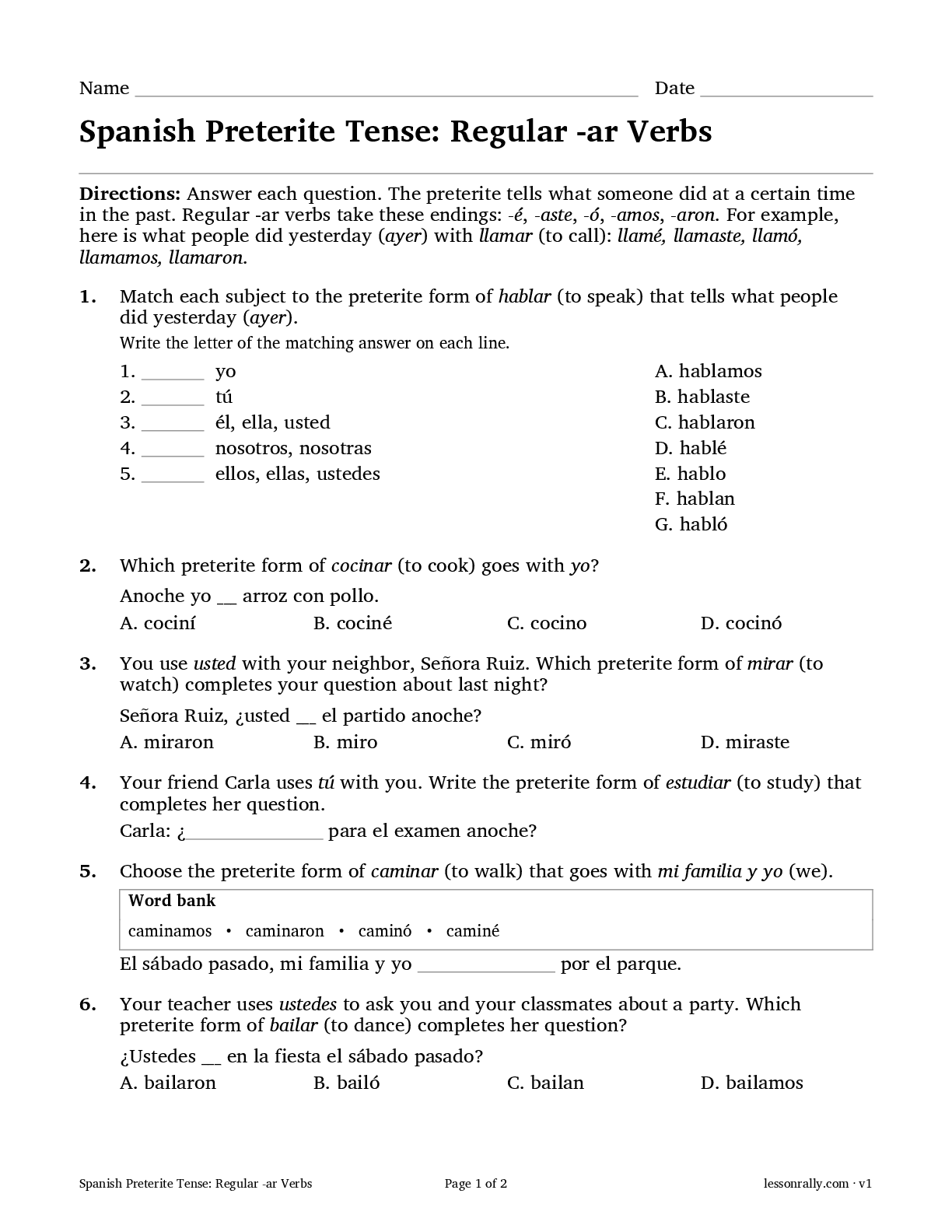
Answer each question. The preterite tells what someone did at a certain time in the past. Regular -ar verbs take these endings: -é, -aste, -ó, -amos, -aron. For example, here is what people did yesterday (ayer) with llamar (to call): llamé, llamaste, llamó, llamamos, llamaron.
Match each subject to the preterite form of hablar (to speak) that tells what people did yesterday (ayer).
Match each item to an option.
Items
Options
Which preterite form of cocinar (to cook) goes with yo?
Anoche yo ___ arroz con pollo.
Choose one answer.
You use usted with your neighbor, Señora Ruiz. Which preterite form of mirar (to watch) completes your question about last night?
Señora Ruiz, ¿usted ___ el partido anoche?
Choose one answer.
Your friend Carla uses tú with you. Write the preterite form of estudiar (to study) that completes her question.
Fill in each blank.
Carla: ¿blank 1 para el examen anoche?
Choose the preterite form of caminar (to walk) that goes with mi familia y yo (we).
Fill in each blank.
El sábado pasado, mi familia y yo blank 1 por el parque.
Word bank
Your teacher uses ustedes to ask you and your classmates about a party. Which preterite form of bailar (to dance) completes her question?
¿Ustedes ___ en la fiesta el sábado pasado?
Choose one answer.
Which sentence means "Yesterday my dad worked at home"?
Choose one answer.
Choose the preterite forms of comprar (to buy) that go with yo and with mi mamá (she).
Fill in each blank.
Ayer yo blank 1 un cuaderno, y mi mamá blank 2 unos lápices.
Word bank
Nadamos (we swim, we swam) is the same in the present and the preterite. Which time word makes this sentence tell about the past?
___, mis amigos y yo nadamos en el lago.
Choose one answer.
Pablo tells about last weekend. Choose the preterite forms of visitar with yo, preparar with mi abuela (she) and cantar with todos nosotros (we), in that order.
Fill in each blank.
El fin de semana pasado, yo blank 1 a mis abuelos. Mi abuela blank 2 una cena deliciosa, y después todos nosotros blank 3 juntos.
Word bank
No reviews yet.
Reviews come from teachers who assigned this activity to a class.
Have a topic of your own? Make a printable worksheet and online quiz, free.
Create an activityMade by Elena Brisaval · LessonRally (AI-assisted)
Made by Elena Brisaval · LessonRally (AI-assisted)
Made by Elena Brisaval · LessonRally (AI-assisted)
Made by Elena Brisaval · LessonRally (AI-assisted)