The Gilded Age: Industry, Immigration and the Great Labor Strikes

10 questions · 16 points · Grade 11 · English · Preview the 10 questions

Made by Monica Ellison · LessonRally (AI-assisted)

Digital classroom activity

What is a digital classroom activity?

Teachers who sign in can assign LessonRally activities to their Google Classroom classes: students open them in Classroom and answer online, and their grades go to the teacher's Classroom gradebook. Practice lets you try it first, the way students see it.

Free for teachers. Sign in to assign activities to your Google Classroom classes.

Printable worksheet

Students read a passage about the Gilded Age, from the growth of railroads, steel and oil to the new immigrants and the Chinese Exclusion Act, and study a table of major labor strikes from 1877 to 1894. They combine the passage and the table to explain why workers struck, how employers, courts and governments responded, and why most strikes failed, and they weigh how Americans viewed business leaders such as Carnegie and Rockefeller.

Learning goal: Combine a passage and a table of strikes to explain how industrial growth, immigration and labor conflict shaped the Gilded Age, and how government responses affected the outcomes of major strikes.

Estimated reading level 10.5

  1. Grade 8Hard
  2. Grade 9Stretch
  3. Grade 10On level
  4. Grade 11Easier
  5. Grade 12Easy
About this estimate

The estimate is the middle score of five readability formulas. Their scores run from 8.5 to 10.7.

  • Flesch-Kincaid GradeSentence length and syllables per word8.5
  • Gunning Fog Middle scoreSentence length and words of three or more syllables10.5
  • Coleman-LiauLetters per word and sentences per 100 words10.7
  • Automated Readability IndexCharacters per word and words per sentence9.7
  • SMOGWords of three or more syllables, for texts of 30 sentences or more10.6
Flesch Reading Ease
61.8 on a 0 to 100 scale where higher is easier: standard. Not part of the estimate.
Text measured
1,209 words, 56 sentences

Adapted from common readability formulas (Flesch-Kincaid, Gunning Fog, Coleman-Liau and ARI, plus SMOG for long texts), which look at sentence length and word length. Answer choices count toward word length only. Grades below the estimate will likely find the text harder, grades above it easier. It does not measure ideas, background knowledge or images.

Common Core

Closest anchor: CCRA.R.7 Integrate and evaluate content presented in diverse media and formats, including visually and quantitatively, as well as in words.Anchor Standards for ReadingShow 1 matched standardHide matched standard

Matched standard

  • RH.11-12.7

    Integrate and evaluate multiple sources of information presented in diverse formats and media (e.g., visually, quantitatively, as well as in words) in order to address a question or solve a problem.

    Student preview question 6

Matched independently by two AI models from this activity's questions.

© Copyright 2010. National Governors Association Center for Best Practices and Council of Chief State School Officers. All rights reserved.

Topic: Industrialization and the Gilded Age Chosen by LessonRally

Question types: multiple choice, fill in the blank, matching, select all that apply.

Student preview

The questions as students see them, without the answers.

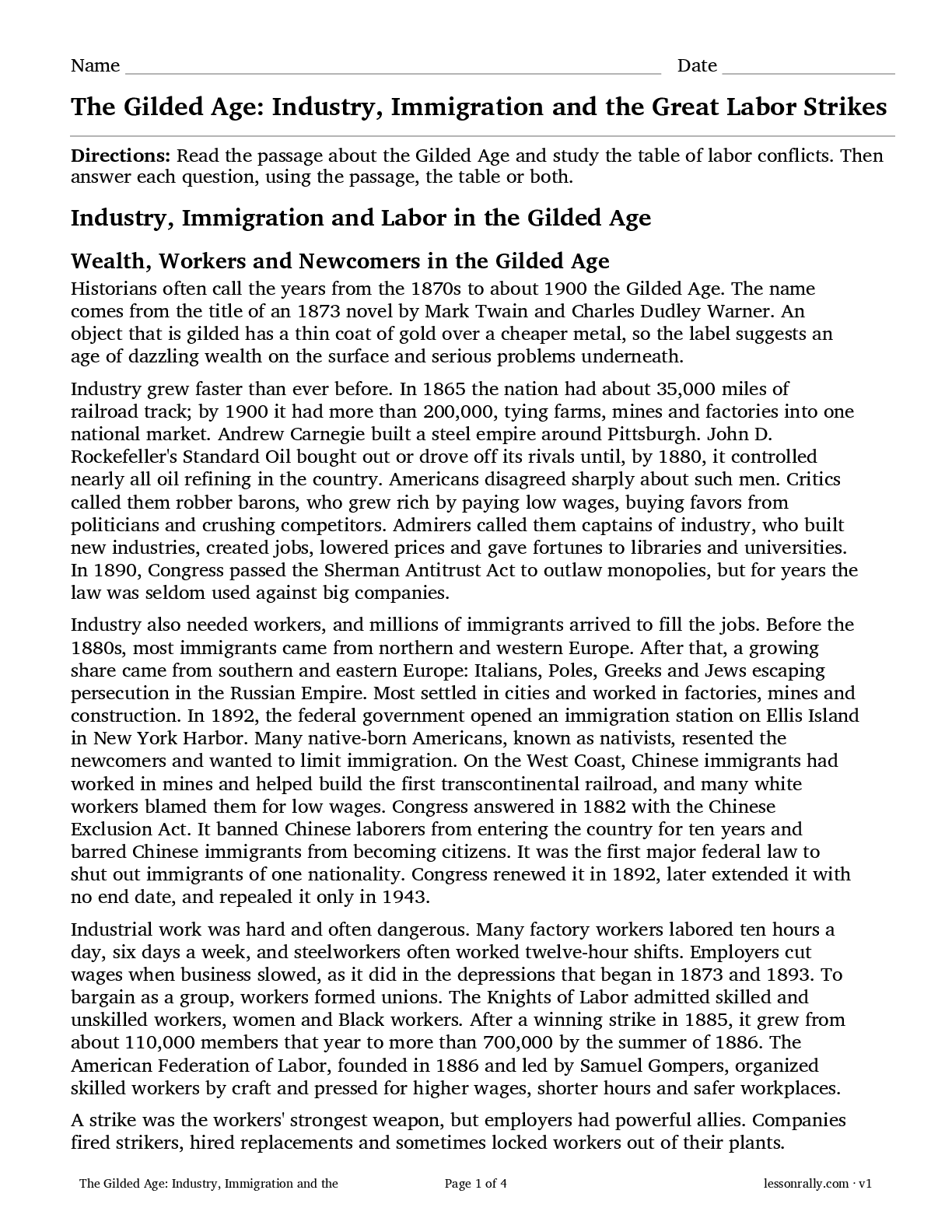
Read the passage about the Gilded Age and study the table of labor conflicts. Then answer each question, using the passage, the table or both.

Industry, Immigration and Labor in the Gilded Age

Wealth, Workers and Newcomers in the Gilded Age

Historians often call the years from the 1870s to about 1900 the Gilded Age. The name comes from the title of an 1873 novel by Mark Twain and Charles Dudley Warner. An object that is gilded has a thin coat of gold over a cheaper metal, so the label suggests an age of dazzling wealth on the surface and serious problems underneath.

Industry grew faster than ever before. In 1865 the nation had about 35,000 miles of railroad track; by 1900 it had more than 200,000, tying farms, mines and factories into one national market. Andrew Carnegie built a steel empire around Pittsburgh. John D. Rockefeller's Standard Oil bought out or drove off its rivals until, by 1880, it controlled nearly all oil refining in the country. Americans disagreed sharply about such men. Critics called them robber barons, who grew rich by paying low wages, buying favors from politicians and crushing competitors. Admirers called them captains of industry, who built new industries, created jobs, lowered prices and gave fortunes to libraries and universities. In 1890, Congress passed the Sherman Antitrust Act to outlaw monopolies, but for years the law was seldom used against big companies.

Industry also needed workers, and millions of immigrants arrived to fill the jobs. Before the 1880s, most immigrants came from northern and western Europe. After that, a growing share came from southern and eastern Europe: Italians, Poles, Greeks and Jews escaping persecution in the Russian Empire. Most settled in cities and worked in factories, mines and construction. In 1892, the federal government opened an immigration station on Ellis Island in New York Harbor. Many native-born Americans, known as nativists, resented the newcomers and wanted to limit immigration. On the West Coast, Chinese immigrants had worked in mines and helped build the first transcontinental railroad, and many white workers blamed them for low wages. Congress answered in 1882 with the Chinese Exclusion Act. It banned Chinese laborers from entering the country for ten years and barred Chinese immigrants from becoming citizens. It was the first major federal law to shut out immigrants of one nationality. Congress renewed it in 1892, later extended it with no end date, and repealed it only in 1943.

Industrial work was hard and often dangerous. Many factory workers labored ten hours a day, six days a week, and steelworkers often worked twelve-hour shifts. Employers cut wages when business slowed, as it did in the depressions that began in 1873 and 1893. To bargain as a group, workers formed unions. The Knights of Labor admitted skilled and unskilled workers, women and Black workers. After a winning strike in 1885, it grew from about 110,000 members that year to more than 700,000 by the summer of 1886. The American Federation of Labor, founded in 1886 and led by Samuel Gompers, organized skilled workers by craft and pressed for higher wages, shorter hours and safer workplaces.

A strike was the workers' strongest weapon, but employers had powerful allies. Companies fired strikers, hired replacements and sometimes locked workers out of their plants. Governors sent state militias, presidents sent federal troops, and courts issued injunctions, orders that forbade strikes or boycotts. The table shows several of the era's best-known conflicts. In 1886, a bomb exploded at a labor rally in Chicago's Haymarket Square, and many Americans came to link unions with violence. That same year the Knights lost a large railroad strike, and within a few years the union had lost most of its members. Most large strikes of the era ended in defeat for workers. Still, these struggles forced Americans to debate the rights of workers, and many reforms of the next era grew out of that debate.


Major labor conflicts of the Gilded Age, 1877 to 1894
YearConflict and placeIndustry and causeWhat happenedOutcome
1877Great Railroad Strike: began in Martinsburg, West Virginia, and spread to Baltimore, Pittsburgh, Chicago and other citiesRailroads; a 10 percent pay cut during a depressionStrikers stopped trains. State militias and federal troops sent by President Hayes clashed with strikers and crowds, and dozens of people were killed.Put down within weeks; the strikers gained little.
1885Strike against Jay Gould's railroads, among them the Wabash in the MidwestRailroads; pay cutsThe Knights of Labor led the strike, backed by other railroad workers and by towns along the lines.A win for workers: Gould restored the earlier pay and took the strikers back.
1886Great Southwest railroad strike, in Texas, Missouri and three other statesRailroads; the firing of a Knights of Labor memberKnights of Labor members struck Gould's Southwest railroads. Strikers stopped trains, and clashes broke out with armed guards and strikebreakers.Federal court orders and lost public support broke the strike that spring.
1886Haymarket affair, ChicagoMany industries; a national campaign for an eight-hour workdayOn May 4, at a rally protesting a police shooting of strikers the day before, someone threw a bomb at police. Seven officers and an unknown number of civilians died.Eight anarchists were convicted and four were hanged, though the bomber was never identified.
1892Homestead strike, Homestead, PennsylvaniaSteel; Carnegie Steel's plan to cut pay and break the unionThe company locked out its workers and hired 300 Pinkerton guards. A gun battle on July 6 left about ten people dead, and the governor sent the state militia.The mill reopened with nonunion workers, and the union was beaten by November.
1894Pullman strike: began in Pullman, Illinois, near Chicago, and spread to railroads across the countryRailroad cars and railroads; pay cuts of about one-fourth while rents in the company town stayed highThe American Railway Union, led by Eugene V. Debs, refused to handle trains with Pullman cars. A federal court ordered the boycott to stop, and President Cleveland sent federal troops.Dozens died in clashes. Debs was jailed, the boycott collapsed in July, and the union was defeated.

Question 1

How does the passage present the labels robber barons and captains of industry?

Choose one answer.

  • As opposing judgments Americans made about the same business leaders
  • As terms that union leaders used to describe the strikers in the table
  • As official titles that Congress gave Carnegie and Rockefeller in 1890
  • As names for two separate groups of businessmen, one honest and one dishonest

Question 2

The passage says employers cut wages when business slowed, as in the depression that began in 1893. Which conflict in the table grew out of a pay cut made after that depression began?

Choose one answer.

  • The strike against Jay Gould's railroads in 1885
  • The Pullman strike of 1894
  • The Great Railroad Strike of 1877
  • The Homestead strike of 1892

Question 3

Which terms from the passage complete these sentences about the era's name and its critics of immigration? Choose from the word bank.

Fill in each blank.

The era's name hints that its wealth was only a thin, blank 1 surface over deep problems. Americans who wanted to limit immigration because they resented the newcomers were called blank 2.

Word bank

  • gilded
  • militias
  • monopolies
  • nativists
  • injunctions

Question 4

According to the passage, what did the Chinese Exclusion Act of 1882 do?

Choose one answer.

  • It required railroads in the West to pay Chinese workers the same wages as others.
  • It opened a station on Ellis Island to receive immigrants arriving from China.
  • It banned Chinese laborers from entering and barred Chinese immigrants from citizenship.
  • It set yearly limits on immigrants from southern and eastern Europe.

Question 5

The passage says governors sent state militias and presidents sent federal troops. In which conflict does the table show soldiers sent by a governor but no federal troops?

Choose one answer.

  • The Homestead strike of 1892
  • The Haymarket affair of 1886
  • The Great Railroad Strike of 1877
  • The Pullman strike of 1894

Question 6

The passage and the table give the years of these events. Match each event to First, Second or Third to show the order in which they happened.

Match each item to an option.

Items

  1. Congress passes the Sherman Antitrust Act
  2. Congress passes the Chinese Exclusion Act
  3. The Knights of Labor win a strike against Jay Gould's railroads

Options

  1. Third
  2. First
  3. Second

Question 7

Using the passage and the table, what was one effect of the Haymarket bombing?

Choose one answer.

  • Many Americans came to link unions with violence.
  • Congress passed the Sherman Antitrust Act to protect unions.
  • The Knights of Labor won an eight-hour day for all workers.
  • Carnegie Steel agreed to recognize the union at Homestead.

Question 8

Match each person to the role the passage or the table gives him.

Match each item to an option.

Items

  1. Andrew Carnegie
  2. John D. Rockefeller
  3. Samuel Gompers
  4. Eugene V. Debs

Options

  1. Led a federation of skilled workers' craft unions
  2. Built a steel empire around Pittsburgh
  3. Opened the immigration station on Ellis Island
  4. Led railroad workers who refused to handle Pullman cars
  5. Controlled nearly all oil refining through Standard Oil

Question 9

The passage describes court injunctions as one government response to labor disputes. Which two conflicts does the table say involved court orders?

Choose 2 answers.

  • The Great Southwest railroad strike of 1886
  • The Great Railroad Strike of 1877
  • The Homestead strike of 1892
  • The Pullman strike of 1894
  • The strike against Jay Gould's railroads in 1885

Question 10

Which conclusion do the passage and the table, taken together, support best?

Choose one answer.

  • Most strikes ended when employers raised wages to win their workers back.
  • Governments usually stayed neutral and left strikes to employers and workers.
  • Unions grew steadily from 1877 to 1894 and suffered no serious setbacks along the way.
  • Workers won some strikes, but most large ones failed, often after courts or soldiers stepped in.

Reviews

No reviews yet.

Reviews come from teachers who assigned this activity to a class.

Sign in to write a review

Have a topic of your own? Make a printable worksheet and online quiz, free.

Create an activity

Answer key

Answer keys come with Premium

Print this worksheet with the correct answers marked. The key includes any explanations, sample answers, and rubrics supplied with the activity.

Answer keys aren't public: only teachers with Premium and the people who can edit an activity can download one, so students can't get a ready-to-print key from this page.

Premium includes:

  • No ads for you, and no ads for your students on the assignments you post.
  • Answer keys for printable worksheets, with the correct answers marked and any explanations, sample answers, and rubrics.
  • Create with AI: up to 100 activities a year (5 during the free trial), with every answer checked before you see the draft.

$29 a year, plus sales tax where it applies.

New Premium teachers can try it free for 7 days. A card or other payment method is needed to start. Unless you cancel before the trial ends, you are charged then and the plan renews every year.

Already have Premium or edit this activity? Sign in