Logical Fallacies: Spot the Flaw in the Reasoning

8 questions · 8 points · Grades 11–12 · English · Preview the 8 questions

Made by Julian Corvell · LessonRally (AI-assisted)

Digital classroom activity

What is a digital classroom activity?

Teachers who sign in can assign LessonRally activities to their Google Classroom classes: students open them in Classroom and answer online, and their grades go to the teacher's Classroom gradebook. Practice lets you try it first, the way students see it.

Free for teachers. Sign in to assign activities to your Google Classroom classes.

Printable worksheet

Students read eight original letters to the editor about a proposed skate park and name the logical fallacy in each writer's reasoning: slippery slope, ad hominem, straw man, false cause, false dilemma and hasty generalization. Each letter commits one clear fallacy, and the last questions ask students to test an argument and to compare the reasoning on both sides.

Learning goal: Identify common logical fallacies in short arguments and explain why each line of reasoning fails to support its conclusion.

Estimated reading level 10.1

  1. Grade 8Hard
  2. Grade 9Stretch
  3. Grade 10On level
  4. Grade 11Easier
  5. Grade 12Easy
About this estimate

The estimate is the middle score of five readability formulas. Their scores run from 8.5 to 11.6.

  • Flesch-Kincaid GradeSentence length and syllables per word8.5
  • Gunning FogSentence length and words of three or more syllables11.6
  • Coleman-Liau Middle scoreLetters per word and sentences per 100 words10.1
  • Automated Readability IndexCharacters per word and words per sentence9.7
  • SMOGWords of three or more syllables, for texts of 30 sentences or more10.4
Flesch Reading Ease
66.2 on a 0 to 100 scale where higher is easier: standard. Not part of the estimate.
Text measured
1,117 words, 40 sentences

Adapted from common readability formulas (Flesch-Kincaid, Gunning Fog, Coleman-Liau and ARI, plus SMOG for long texts), which look at sentence length and word length. Answer choices count toward word length only. Grades below the estimate will likely find the text harder, grades above it easier. It does not measure ideas, background knowledge or images.

Common Core

Closest anchor: CCRA.R.8 Delineate and evaluate the argument and specific claims in a text, including the validity of the reasoning as well as the relevance and sufficiency of the evidence.Anchor Standards for ReadingShow 1 matched standardHide matched standard

Matched standard

  • RI.11-12.8

    Delineate and evaluate the reasoning in seminal U.S. texts, including the application of constitutional principles and use of legal reasoning (e.g., in U.S. Supreme Court majority opinions and dissents) and the premises, purposes, and arguments in works of public advocacy (e.g., The Federalist, presidential addresses).

    Student preview questions 1, 2, 3, 4, 5, 6, 7, 8

Matched independently by two AI models from this activity's questions.

© Copyright 2010. National Governors Association Center for Best Practices and Council of Chief State School Officers. All rights reserved.

Topic: Author's Claims and Evidence Chosen by LessonRally

Question types: multiple choice, select all that apply.

Student preview

The questions as students see them, without the answers.

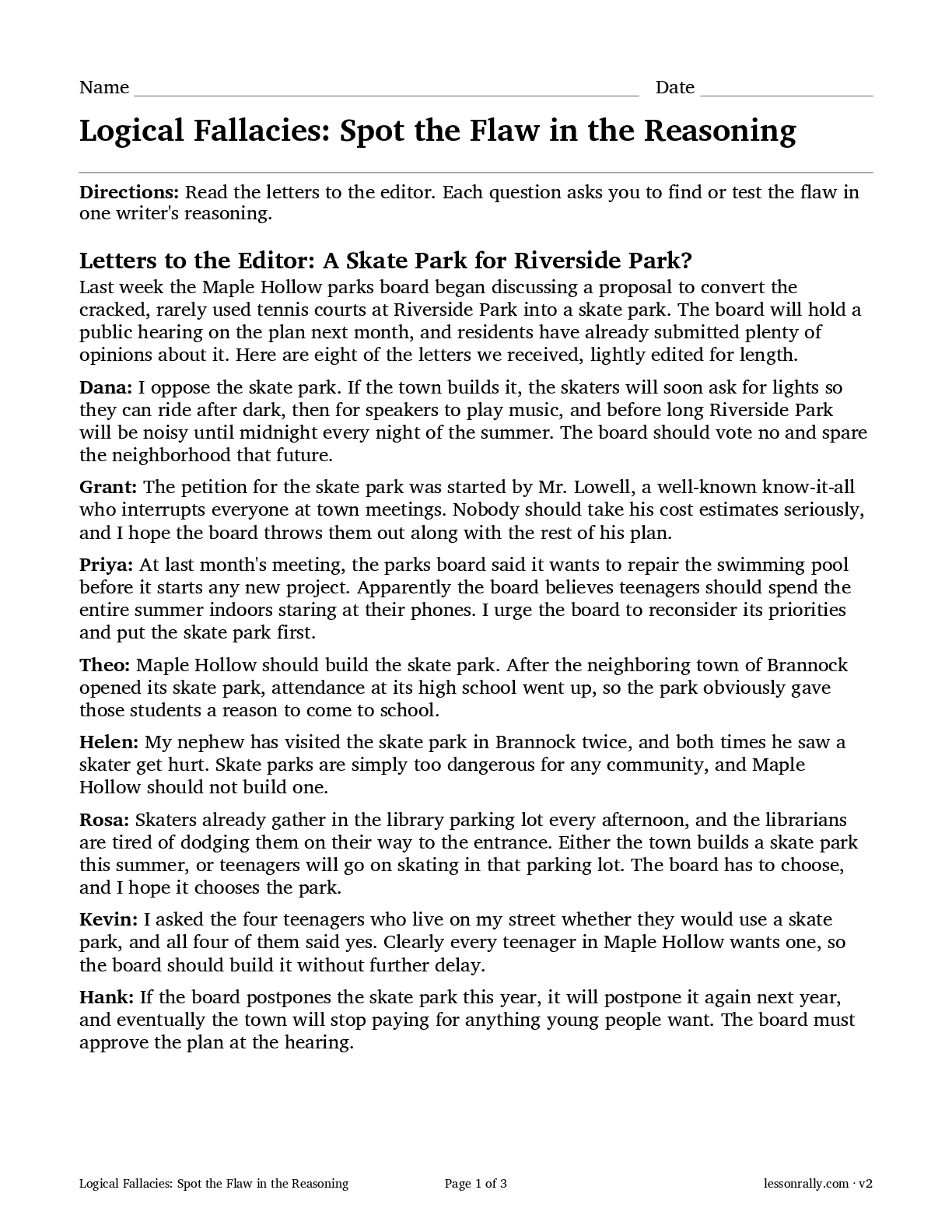
Read the letters to the editor. Each question asks you to find or test the flaw in one writer's reasoning.

Letters to the Editor: A Skate Park for Riverside Park?

Last week the Maple Hollow parks board began discussing a proposal to convert the cracked, rarely used tennis courts at Riverside Park into a skate park. The board will hold a public hearing on the plan next month, and residents have already submitted plenty of opinions about it. Here are eight of the letters we received, lightly edited for length.

Dana: I oppose the skate park. If the town builds it, the skaters will soon ask for lights so they can ride after dark, then for speakers to play music, and before long Riverside Park will be noisy until midnight every night of the summer. The board should vote no and spare the neighborhood that future.

Grant: The petition for the skate park was started by Mr. Lowell, a well-known know-it-all who interrupts everyone at town meetings. Nobody should take his cost estimates seriously, and I hope the board throws them out along with the rest of his plan.

Priya: At last month's meeting, the parks board said it wants to repair the swimming pool before it starts any new project. Apparently the board believes teenagers should spend the entire summer indoors staring at their phones. I urge the board to reconsider its priorities and put the skate park first.

Theo: Maple Hollow should build the skate park. After the neighboring town of Brannock opened its skate park, attendance at its high school went up, so the park obviously gave those students a reason to come to school.

Helen: My nephew has visited the skate park in Brannock twice, and both times he saw a skater get hurt. Skate parks are simply too dangerous for any community, and Maple Hollow should not build one.

Rosa: Skaters already gather in the library parking lot every afternoon, and the librarians are tired of dodging them on their way to the entrance. Either the town builds a skate park this summer, or teenagers will go on skating in that parking lot. The board has to choose, and I hope it chooses the park.

Kevin: I asked the four teenagers who live on my street whether they would use a skate park, and all four of them said yes. Clearly every teenager in Maple Hollow wants one, so the board should build it without further delay.

Hank: If the board postpones the skate park this year, it will postpone it again next year, and eventually the town will stop paying for anything young people want. The board must approve the plan at the hearing.


Question 1

Dana writes, "If the town builds it, the skaters will soon ask for lights so they can ride after dark, then for speakers to play music, and before long Riverside Park will be noisy until midnight every night of the summer." Which flaw does this reasoning contain?

Choose one answer.

  • False dilemma: offering only two options when others exist
  • Hasty generalization: drawing a conclusion about a whole group from too few examples
  • Slippery slope: claiming that one step will set off a chain of worse results, without showing that each step would follow
  • Ad hominem: attacking the person who made an argument instead of the argument itself

Question 2

Grant writes, "The petition for the skate park was started by Mr. Lowell, a well-known know-it-all who interrupts everyone at town meetings. Nobody should take his cost estimates seriously, and I hope the board throws them out along with the rest of his plan." What is wrong with the way Grant responds to the petition?

Choose one answer.

  • False dilemma: offering only two options when others exist
  • Slippery slope: claiming that one step will set off a chain of worse results, without showing that each step would follow
  • Ad hominem: attacking the person who made an argument instead of the argument itself
  • False cause: assuming that one event caused another just because it came first

Question 3

Priya writes, "At last month's meeting, the parks board said it wants to repair the swimming pool before it starts any new project. Apparently the board believes teenagers should spend the entire summer indoors staring at their phones." How does Priya's reasoning go wrong?

Choose one answer.

  • Slippery slope: claiming that one step will set off a chain of worse results, without showing that each step would follow
  • False cause: assuming that one event caused another just because it came first
  • Straw man: misrepresenting an opponent's position so that it is easier to attack
  • False dilemma: offering only two options when others exist

Question 4

Theo writes, "After the neighboring town of Brannock opened its skate park, attendance at its high school went up, so the park obviously gave those students a reason to come to school." Which fallacy is at the center of Theo's argument?

Choose one answer.

  • False dilemma: offering only two options when others exist
  • Ad hominem: attacking the person who made an argument instead of the argument itself
  • False cause: assuming that one event caused another just because it came first
  • Straw man: misrepresenting an opponent's position so that it is easier to attack

Question 5

Rosa writes, "Either the town builds a skate park this summer, or teenagers will go on skating in that parking lot." What flaw does this sentence contain?

Choose one answer.

  • Ad hominem: attacking the person who made an argument instead of the argument itself
  • Slippery slope: claiming that one step will set off a chain of worse results, without showing that each step would follow
  • False dilemma: offering only two options when others exist
  • Straw man: misrepresenting an opponent's position so that it is easier to attack

Question 6

Hank writes, "If the board postpones the skate park this year, it will postpone it again next year, and eventually the town will stop paying for anything young people want." Which question would most directly test this reasoning?

Choose one answer.

  • Has Hank ever been late paying his own town taxes, or fined for anything else?
  • What shows that one delay would lead to another, and then to cuts for young people?
  • Does Hank live close enough to Riverside Park to use the skate park himself?
  • Would the skate park cost the town more than repairing the swimming pool would?

Question 7

Which two letters reach a conclusion about a large group from only a few examples?

Choose 2 answers.

  • Grant's letter
  • Kevin's letter
  • Rosa's letter
  • Helen's letter
  • Dana's letter

Question 8

Taken together, what do the eight letters show about the reasoning on each side of the skate park debate?

Choose one answer.

  • The writers who mention Brannock reason more carefully than the others.
  • Writers on both sides of the question rely on flawed reasoning.
  • Only the writers who oppose the skate park rely on flawed reasoning.
  • Only the writers who support the skate park rely on flawed reasoning.

Reviews

No reviews yet.

Reviews come from teachers who assigned this activity to a class.

Sign in to write a review

Have a topic of your own? Make a printable worksheet and online quiz, free.

Create an activity

Answer key

Answer keys come with Premium

Print this worksheet with the correct answers marked. The key includes any explanations, sample answers, and rubrics supplied with the activity.

Answer keys aren't public: only teachers with Premium and the people who can edit an activity can download one, so students can't get a ready-to-print key from this page.

Premium includes:

  • No ads for you, and no ads for your students on the assignments you post.
  • Answer keys for printable worksheets, with the correct answers marked and any explanations, sample answers, and rubrics.
  • Create with AI: up to 100 activities a year (5 during the free trial), with every answer checked before you see the draft.

$29 a year, plus sales tax where it applies.

New Premium teachers can try it free for 7 days. A card or other payment method is needed to start. Unless you cancel before the trial ends, you are charged then and the plan renews every year.

Already have Premium or edit this activity? Sign in