The Civil Rights Movement: Timeline of Key Events and Laws, 1954 to 1965

8 questions · 11 points · Grade 11 · English · Preview the 8 questions

Made by Monica Ellison · LessonRally (AI-assisted)

Digital classroom activity

What is a digital classroom activity?

Teachers who sign in can assign LessonRally activities to their Google Classroom classes: students open them in Classroom and answer online, and their grades go to the teacher's Classroom gradebook. Practice lets you try it first, the way students see it.

Free for teachers. Sign in to assign activities to your Google Classroom classes.

Printable worksheet

Students read a short passage on the strategies of the civil rights movement and the violent resistance it met, then study a timeline of real events from Brown v. Board of Education in 1954 to the Voting Rights Act of 1965. They combine the passage and the timeline to put events in order, measure how long change took, and explain how protests, violence and national attention led to federal civil rights and voting laws.

Learning goal: Combine a passage and a timeline to explain how the civil rights movement's protests and court cases, and the violence they met, led to federal civil rights and voting laws between 1954 and 1965.

Estimated reading level 11.0

  1. Grade 9Hard
  2. Grade 10Stretch
  3. Grade 11On level
  4. Grade 12Easier
About this estimate

The estimate is the middle score of five readability formulas. Their scores run from 8.8 to 11.4.

  • Flesch-Kincaid GradeSentence length and syllables per word8.8
  • Gunning FogSentence length and words of three or more syllables11.4
  • Coleman-Liau Middle scoreLetters per word and sentences per 100 words11.0
  • Automated Readability IndexCharacters per word and words per sentence9.5
  • SMOGWords of three or more syllables, for texts of 30 sentences or more11.2
Flesch Reading Ease
58.3 on a 0 to 100 scale where higher is easier: fairly difficult. Not part of the estimate.
Text measured
942 words, 44 sentences

Adapted from common readability formulas (Flesch-Kincaid, Gunning Fog, Coleman-Liau and ARI, plus SMOG for long texts), which look at sentence length and word length. Answer choices count toward word length only. Grades below the estimate will likely find the text harder, grades above it easier. It does not measure ideas, background knowledge or images.

Topic: Civil Rights Movement Chosen by LessonRally

Question types: multiple choice, matching, fill in the blank, select all that apply.

Student preview

The questions as students see them, without the answers.

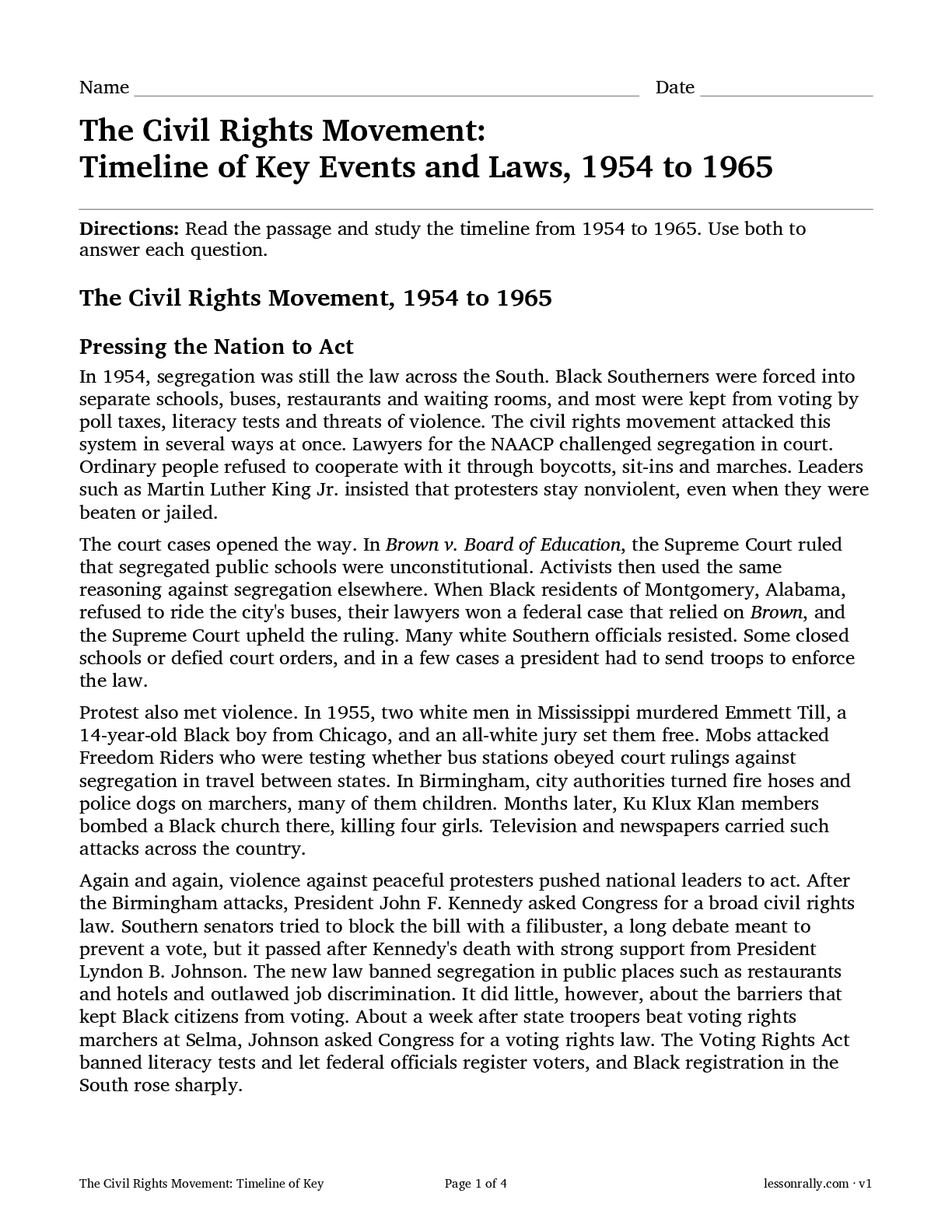
Read the passage and study the timeline from 1954 to 1965. Use both to answer each question.

The Civil Rights Movement, 1954 to 1965

Pressing the Nation to Act

In 1954, segregation was still the law across the South. Black Southerners were forced into separate schools, buses, restaurants and waiting rooms, and most were kept from voting by poll taxes, literacy tests and threats of violence. The civil rights movement attacked this system in several ways at once. Lawyers for the NAACP challenged segregation in court. Ordinary people refused to cooperate with it through boycotts, sit-ins and marches. Leaders such as Martin Luther King Jr. insisted that protesters stay nonviolent, even when they were beaten or jailed.

The court cases opened the way. In Brown v. Board of Education, the Supreme Court ruled that segregated public schools were unconstitutional. Activists then used the same reasoning against segregation elsewhere. When Black residents of Montgomery, Alabama, refused to ride the city's buses, their lawyers won a federal case that relied on Brown, and the Supreme Court upheld the ruling. Many white Southern officials resisted. Some closed schools or defied court orders, and in a few cases a president had to send troops to enforce the law.

Protest also met violence. In 1955, two white men in Mississippi murdered Emmett Till, a 14-year-old Black boy from Chicago, and an all-white jury set them free. Mobs attacked Freedom Riders who were testing whether bus stations obeyed court rulings against segregation in travel between states. In Birmingham, city authorities turned fire hoses and police dogs on marchers, many of them children. Months later, Ku Klux Klan members bombed a Black church there, killing four girls. Television and newspapers carried such attacks across the country.

Again and again, violence against peaceful protesters pushed national leaders to act. After the Birmingham attacks, President John F. Kennedy asked Congress for a broad civil rights law. Southern senators tried to block the bill with a filibuster, a long debate meant to prevent a vote, but it passed after Kennedy's death with strong support from President Lyndon B. Johnson. The new law banned segregation in public places such as restaurants and hotels and outlawed job discrimination. It did little, however, about the barriers that kept Black citizens from voting. About a week after state troopers beat voting rights marchers at Selma, Johnson asked Congress for a voting rights law. The Voting Rights Act banned literacy tests and let federal officials register voters, and Black registration in the South rose sharply.


Timeline: Key events of the civil rights movement, 1954 to 1965
DateEvent
May 1954In Brown v. Board of Education, the Supreme Court rules that segregated public schools are unconstitutional.
August to September 1955Emmett Till, 14, is murdered while visiting relatives in Mississippi. His mother holds an open-casket funeral in Chicago, and an all-white jury acquits the two men charged.
December 1955Rosa Parks is arrested in Montgomery, Alabama, for refusing to give up her bus seat to a white passenger. The Montgomery bus boycott begins four days later.
November to December 1956The Supreme Court upholds a ruling that Alabama's bus segregation laws are unconstitutional. The boycott ends after 381 days.
September 1957Arkansas's governor uses the state National Guard to keep nine Black students out of Central High School in Little Rock. President Eisenhower sends federal troops to protect them.
February 1960Four Black college students sit in at a whites-only lunch counter in Greensboro, North Carolina. Sit-ins soon spread to dozens of Southern cities.
May 1961Freedom Riders travel by bus through the South to test court rulings against segregated interstate travel. A mob burns one of their buses near Anniston, Alabama.
November 1961Federal rules banning segregation in interstate bus stations take effect.
April to May 1963In the Birmingham campaign, city authorities use fire hoses and police dogs on marchers, many of them children. In May, business leaders agree to desegregate store lunch counters and restrooms.
June 1963President Kennedy asks Congress for a broad civil rights law.
August 1963About 250,000 people join the March on Washington for Jobs and Freedom. Martin Luther King Jr. speaks at the Lincoln Memorial.
September 1963Ku Klux Klan members bomb the 16th Street Baptist Church in Birmingham, killing four Black girls.
November 1963President Kennedy is assassinated, and Lyndon B. Johnson becomes president.
January 1964The 24th Amendment is ratified, banning poll taxes in federal elections.
July 1964President Johnson signs the Civil Rights Act of 1964.
March 1965At the Edmund Pettus Bridge in Selma, Alabama, state troopers attack voting rights marchers. Later that month, thousands march from Selma to Montgomery.
August 1965President Johnson signs the Voting Rights Act of 1965.

Question 1

The passage says the Montgomery protesters' lawyers won a case that relied on Brown v. Board of Education. Using the timeline, about how long after Brown did the Supreme Court uphold the ruling against Alabama's bus segregation?

Choose one answer.

  • About two and a half years
  • About five and a half years
  • About one year
  • About six months

Question 2

These events appear in the passage, the timeline or both. Use the timeline's dates to label each one First, Second or Third.

Match each item to an option.

Items

  1. Mobs attack Freedom Riders who are testing bus stations
  2. Birmingham authorities turn fire hoses and dogs on marchers
  3. Students sit in at a whites-only lunch counter in Greensboro

Options

  1. First
  2. Second
  3. Third

Question 3

The passage says that in a few cases a president had to send troops to enforce the law. Which timeline event is an example?

Choose one answer.

  • June 1963: President Kennedy asks Congress for a civil rights law
  • August 1963: about 250,000 people join the March on Washington
  • September 1957: federal troops protect nine students in Little Rock
  • February 1960: sit-ins spread to dozens of Southern cities

Question 4

Fill in each blank about the Montgomery protest and the movement's methods. One answer comes from the timeline and one from the passage.

Fill in each blank.

Black residents of Montgomery kept up a blank 1 of the city's buses for 381 days. Leaders such as Martin Luther King Jr. asked protesters to stay blank 2 even when they were beaten or jailed.

Word bank

  • nonviolent
  • boycott
  • filibuster
  • unconstitutional
  • segregated

Question 5

According to the passage, the Civil Rights Act did little about barriers to voting. Which later event in the timeline removed some of those barriers?

Choose one answer.

  • November 1963: President Kennedy is assassinated
  • March 1965: state troopers attack marchers in Selma
  • August 1965: President Johnson signs the Voting Rights Act
  • January 1964: the 24th Amendment bans poll taxes in federal elections

Question 6

The passage says violence against peaceful protesters pushed national leaders to act. Which two timeline events led a president to ask Congress for a new law, according to the passage?

Choose 2 answers.

  • August to September 1955: Emmett Till is murdered in Mississippi
  • April to May 1963: Birmingham authorities use fire hoses and dogs on marchers
  • September 1963: Klan members bomb the 16th Street Baptist Church
  • March 1965: state troopers attack voting rights marchers in Selma
  • May 1961: a mob burns a Freedom Riders' bus near Anniston

Question 7

The passage describes mobs attacking Freedom Riders. According to the timeline, what happened about six months after a mob burned their bus near Anniston?

Choose one answer.

  • Black residents of Montgomery began their boycott of the city's buses.
  • Federal rules banning segregation in interstate bus stations took effect.
  • About 250,000 people gathered for the March on Washington.
  • Four college students held a sit-in at a lunch counter in Greensboro.

Question 8

Using the passage and the timeline, which statement about how the Civil Rights Act became law is accurate?

Choose one answer.

  • Kennedy asked for it in June 1963, Southern senators tried to block it, and it became law in July 1964.
  • The Supreme Court wrote the bill after the Brown decision and sent it to Congress to approve.
  • Congress passed the bill in 1963, but President Johnson vetoed it and signed it only in 1965.
  • Northern senators held up the bill with a filibuster until Southern senators forced a vote late in 1963.

Reviews

No reviews yet.

Reviews come from teachers who assigned this activity to a class.

Sign in to write a review

Have a topic of your own? Make a printable worksheet and online quiz, free.

Create an activity

Answer key

Answer keys come with Premium

Print this worksheet with the correct answers marked. The key includes any explanations, sample answers, and rubrics supplied with the activity.

Answer keys aren't public: only teachers with Premium and the people who can edit an activity can download one, so students can't get a ready-to-print key from this page.

Premium includes:

  • No ads for you, and no ads for your students on the assignments you post.
  • Answer keys for printable worksheets, with the correct answers marked and any explanations, sample answers, and rubrics.
  • Create with AI: up to 100 activities a year (5 during the free trial), with every answer checked before you see the draft.

$29 a year, plus sales tax where it applies.

New Premium teachers can try it free for 7 days. A card or other payment method is needed to start. Unless you cancel before the trial ends, you are charged then and the plan renews every year.

Already have Premium or edit this activity? Sign in