Question 1
Find the value of this expression.
(9 + 6) × 4
Enter a number.


Teachers who sign in can assign LessonRally activities to their Google Classroom classes: students open them in Classroom and answer online, and their grades go to the teacher's Classroom gradebook. Practice lets you try it first, the way students see it.
Free for teachers. Sign in to assign activities to your Google Classroom classes.
 (opens in a new tab)
2 pages · Student copy, no answers
Print worksheet (opens in a new tab)Answer keyPremiumStudents evaluate numerical expressions that use parentheses, and one that also uses brackets. They choose the first step, work an expression step by step, compare values with and without parentheses, find the equation that parentheses make true, and select equal expressions. One question asks who is right when two students disagree about adding before subtracting. Order of operations practice with whole numbers.
Learning goal: Evaluate numerical expressions that use parentheses and brackets by following the order of operations.
© Copyright 2010. National Governors Association Center for Best Practices and Council of Chief State School Officers. All rights reserved.
Topic: Order of Operations Chosen by LessonRally
Question types: number answer, multiple choice, fill in the blank, select all that apply.
The questions as students see them, without the answers.
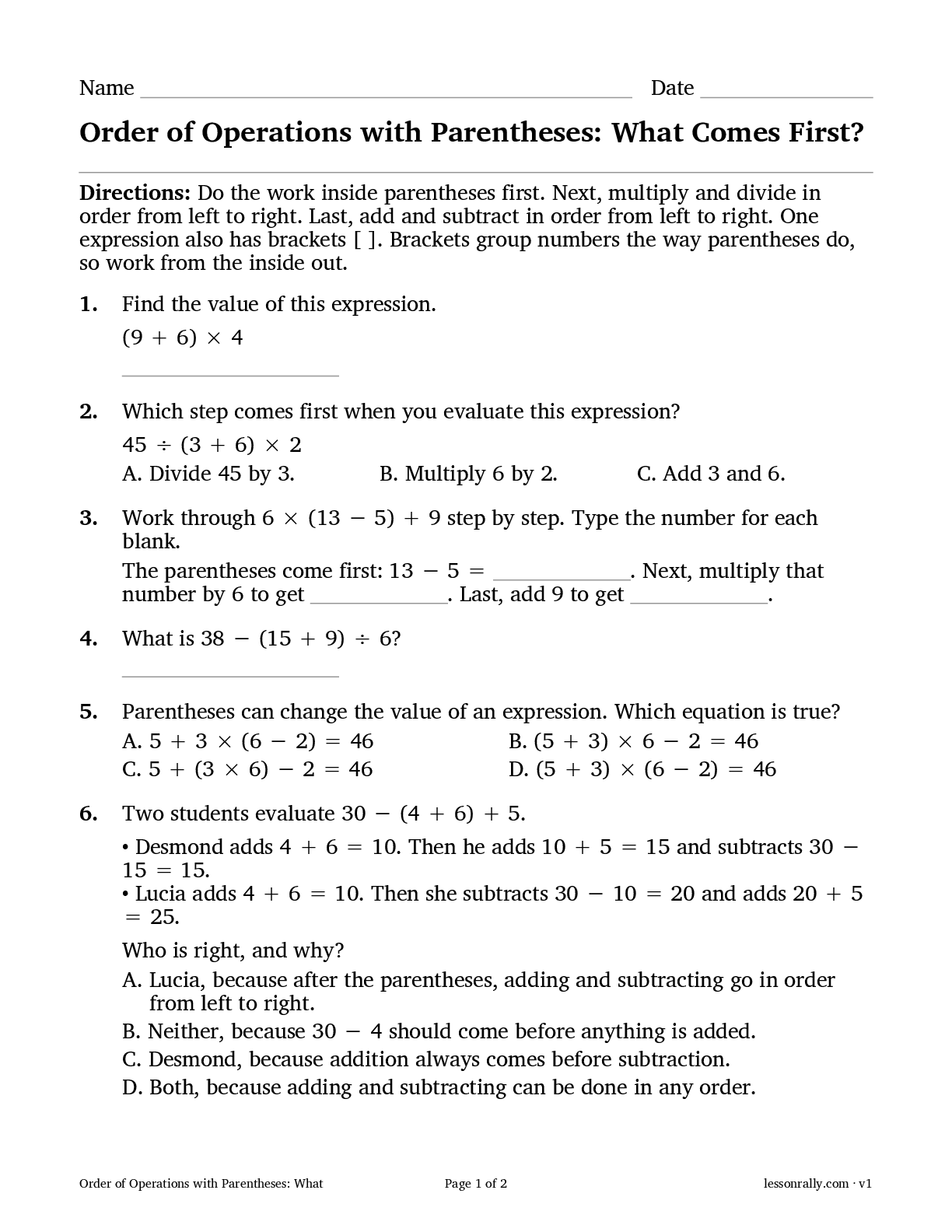
Do the work inside parentheses first. Next, multiply and divide in order from left to right. Last, add and subtract in order from left to right. One expression also has brackets [ ]. Brackets group numbers the way parentheses do, so work from the inside out.
Find the value of this expression.
(9 + 6) × 4
Enter a number.
Which step comes first when you evaluate this expression?
45 ÷ (3 + 6) × 2
Choose one answer.
Work through 6 × (13 − 5) + 9 step by step. Type the number for each blank.
Fill in each blank.
The parentheses come first: 13 − 5 = blank 1. Next, multiply that number by 6 to get blank 2. Last, add 9 to get blank 3.
What is 38 − (15 + 9) ÷ 6?
Enter a number.
Parentheses can change the value of an expression. Which equation is true?
Choose one answer.
Two students evaluate 30 − (4 + 6) + 5.
Who is right, and why?
Choose one answer.
The expressions 7 + 3 × 8 and (7 + 3) × 8 use the same numbers and signs. How much greater is the value of (7 + 3) × 8 than the value of 7 + 3 × 8?
Enter a number.
Which expressions have the same value as 5 × (2 + 6)? Select the two that do.
Choose 2 answers.
This expression has brackets around a part that has parentheses. Work from the inside out to find its value.
4 × [18 − (5 + 6)]
Enter a number.
Camila buys 4 notebooks and 4 pens. Each notebook costs $3, and each pen costs $2. She pays with a $50 bill. The expression 50 − 4 × (3 + 2) gives her change in dollars. How much change does Camila get?
Enter a number.
dollars
No reviews yet.
Reviews come from teachers who assigned this activity to a class.
Have a topic of your own? Make a printable worksheet and online quiz, free.
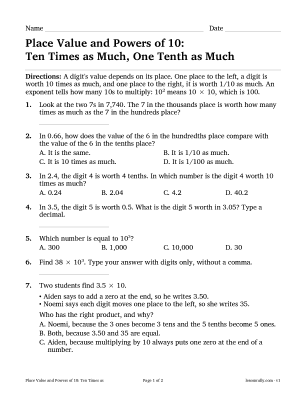
Create an activityCommon Core 5.NBT.A.2
Made by Hannah Yoon · LessonRally (AI-assisted)
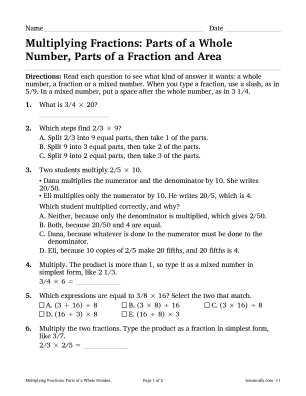
Common Core 5.NF.B.4a
Made by Hannah Yoon · LessonRally (AI-assisted)
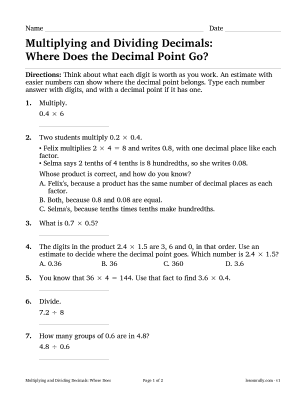
Common Core 5.NBT.B.7
Made by Hannah Yoon · LessonRally (AI-assisted)
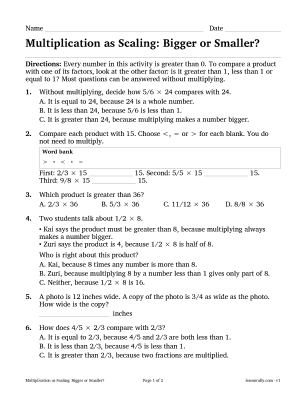
Common Core 5.NF.B.5a
Made by Hannah Yoon · LessonRally (AI-assisted)