Central Ideas That Build on One Another

9 questions · 9 points · Grades 11–12 · English · Preview the 9 questions

Made by Julian Corvell · LessonRally (AI-assisted)

Digital classroom activity

What is a digital classroom activity?

Teachers who sign in can assign LessonRally activities to their Google Classroom classes: students open them in Classroom and answer online, and their grades go to the teacher's Classroom gradebook. Practice lets you try it first, the way students see it.

Free for teachers. Sign in to assign activities to your Google Classroom classes.

Printable worksheet

Students read an original reflective essay about a small town's old railroad depot and determine its two central ideas: that the building holds the town's shared memory, and that it was saved because people began using it again. Questions trace how each central idea develops and how the two ideas interact and build on one another; a final question asks which objective summary of the essay is accurate.

Learning goal: Determine two central ideas of an essay and analyze how they develop and build on one another over the course of the text, then recognize an accurate, objective summary.

Estimated reading level 9.8

  1. Grade 7Hard
  2. Grade 8Stretch
  3. Grade 9On level
  4. Grade 10Easier
  5. Grade 11Easy
About this estimate

The estimate is the middle score of five readability formulas. Their scores run from 8.6 to 11.1.

  • Flesch-Kincaid GradeSentence length and syllables per word8.6
  • Gunning FogSentence length and words of three or more syllables11.1
  • Coleman-Liau Middle scoreLetters per word and sentences per 100 words9.8
  • Automated Readability IndexCharacters per word and words per sentence9.3
  • SMOGWords of three or more syllables, for texts of 30 sentences or more10.8
Flesch Reading Ease
64.0 on a 0 to 100 scale where higher is easier: standard. Not part of the estimate.
Text measured
1,268 words, 37 sentences

Adapted from common readability formulas (Flesch-Kincaid, Gunning Fog, Coleman-Liau and ARI, plus SMOG for long texts), which look at sentence length and word length. Answer choices count toward word length only. Grades below the estimate will likely find the text harder, grades above it easier. It does not measure ideas, background knowledge or images.

Common Core

Closest anchor: CCRA.R.2 Determine central ideas or themes of a text and analyze their development; summarize the key supporting details and ideas.Anchor Standards for ReadingShow 1 matched standardHide matched standard

Matched standard

  • RI.11-12.2

    Determine two or more central ideas of a text and analyze their development over the course of the text, including how they interact and build on one another to provide a complex analysis; provide an objective summary of the text.

    Student preview questions 1, 8, 9

Matched independently by two AI models from this activity's questions.

© Copyright 2010. National Governors Association Center for Best Practices and Council of Chief State School Officers. All rights reserved.

Topics: Main Idea and Key Details, Summarizing, Citing Text Evidence Chosen by LessonRally

Question types: multiple choice, select all that apply.

Student preview

The questions as students see them, without the answers.

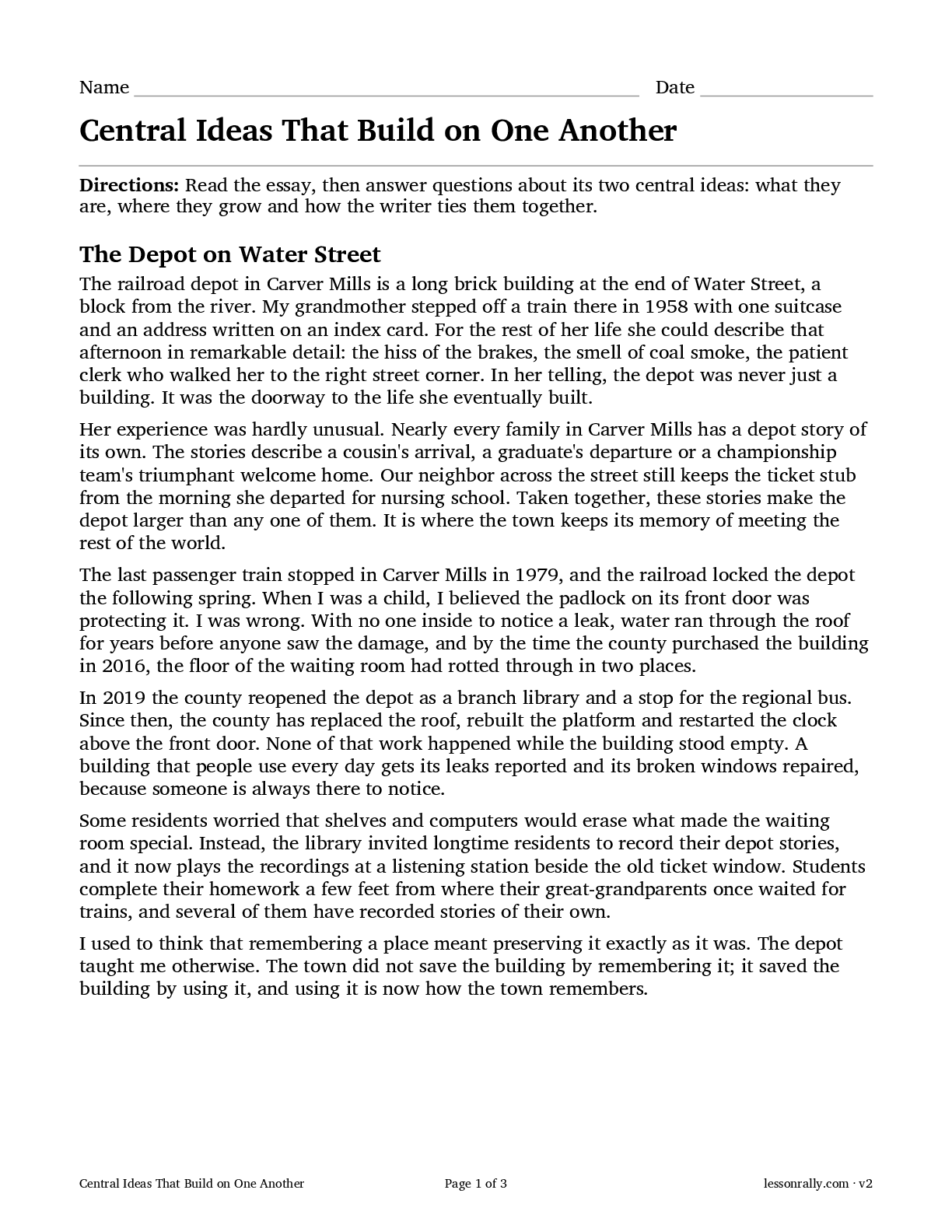
Read the essay, then answer questions about its two central ideas: what they are, where they grow and how the writer ties them together.

The Depot on Water Street

The railroad depot in Carver Mills is a long brick building at the end of Water Street, a block from the river. My grandmother stepped off a train there in 1958 with one suitcase and an address written on an index card. For the rest of her life she could describe that afternoon in remarkable detail: the hiss of the brakes, the smell of coal smoke, the patient clerk who walked her to the right street corner. In her telling, the depot was never just a building. It was the doorway to the life she eventually built.

Her experience was hardly unusual. Nearly every family in Carver Mills has a depot story of its own. The stories describe a cousin's arrival, a graduate's departure or a championship team's triumphant welcome home. Our neighbor across the street still keeps the ticket stub from the morning she departed for nursing school. Taken together, these stories make the depot larger than any one of them. It is where the town keeps its memory of meeting the rest of the world.

The last passenger train stopped in Carver Mills in 1979, and the railroad locked the depot the following spring. When I was a child, I believed the padlock on its front door was protecting it. I was wrong. With no one inside to notice a leak, water ran through the roof for years before anyone saw the damage, and by the time the county purchased the building in 2016, the floor of the waiting room had rotted through in two places.

In 2019 the county reopened the depot as a branch library and a stop for the regional bus. Since then, the county has replaced the roof, rebuilt the platform and restarted the clock above the front door. None of that work happened while the building stood empty. A building that people use every day gets its leaks reported and its broken windows repaired, because someone is always there to notice.

Some residents worried that shelves and computers would erase what made the waiting room special. Instead, the library invited longtime residents to record their depot stories, and it now plays the recordings at a listening station beside the old ticket window. Students complete their homework a few feet from where their great-grandparents once waited for trains, and several of them have recorded stories of their own.

I used to think that remembering a place meant preserving it exactly as it was. The depot taught me otherwise. The town did not save the building by remembering it; it saved the building by using it, and using it is now how the town remembers.


Question 1

Which choice identifies the two central ideas that the depot essay develops side by side, each one strengthening the other?

Choose one answer.

  • The depot holds the town's shared memory, and it was saved because people began to use it again.
  • The county replaced the depot's roof, and the library now plays recorded stories beside the old ticket window.
  • The last passenger train stopped in Carver Mills in 1979, and the county reopened the depot as a library in 2019.
  • The writer's grandmother arrived with one suitcase, and the waiting room floor later rotted through in two places.

Question 2

How does the opening paragraph first introduce the idea that the depot holds memories for the people of Carver Mills?

Choose one answer.

  • By describing the water damage that spread through the abandoned waiting room
  • By recording the years when the depot originally opened and eventually closed
  • By retelling the grandmother's story of arriving there by train in 1958
  • By quoting a county official who explains the building's architectural history

Question 3

Which sentence from the essay widens the idea of memory from a single family to the entire community?

Choose one answer.

  • "In 2019 the county reopened the depot as a branch library and a stop for the regional bus."
  • "Nearly every family in Carver Mills has a depot story of its own."
  • "The last passenger train stopped in Carver Mills in 1979, and the railroad locked the depot the following spring."
  • "The railroad depot in Carver Mills is a long brick building at the end of Water Street, a block from the river."

Question 4

The writer recalls, "When I was a child, I believed the padlock on its front door was protecting it." According to the essay, why was that childhood belief mistaken?

Choose one answer.

  • With no one inside to notice, a leaking roof damaged the building for years.
  • The padlock was broken, so anyone could wander inside whenever they wanted.
  • The railroad removed the roof before the county purchased the building.
  • The padlock prevented county workers from entering to repair the leaking roof.

Question 5

Which two sentences develop the idea that the depot has survived because people are using it again?

Choose 2 answers.

  • "For the rest of her life she could describe that afternoon in remarkable detail: the hiss of the brakes, the smell of coal smoke, the patient clerk who walked her to the right street corner."
  • "Since then, the county has replaced the roof, rebuilt the platform and restarted the clock above the front door."
  • "It is where the town keeps its memory of meeting the rest of the world."
  • "A building that people use every day gets its leaks reported and its broken windows repaired, because someone is always there to notice."
  • "The railroad depot in Carver Mills is a long brick building at the end of Water Street, a block from the river."

Question 6

"Some residents worried that shelves and computers would erase what made the waiting room special." How does the essay respond to this worry?

Choose one answer.

  • It reports that the library eventually moved its shelves to a newer building farther up Water Street.
  • It agrees that the waiting room lost its history once the library's shelves and computers arrived.
  • It argues that the waiting room was never especially remarkable in the first place.
  • It shows the library collecting residents' recorded stories and playing them for visitors.

Question 7

Why does the writer mention students who do homework "a few feet from where their great-grandparents once waited for trains"?

Choose one answer.

  • To emphasize that the waiting room still requires additional repairs
  • To suggest that students prefer the library to their own high school
  • To show new memories forming in the same place as the old ones
  • To demonstrate that passenger trains still stop at the depot every day

Question 8

How does the final paragraph bring the essay's two central ideas together into a single conclusion?

Choose one answer.

  • It describes the final passenger train departing from Carver Mills in 1979.
  • It argues that using the depot is now the way the town remembers it.
  • It demands that the waiting room be restored exactly as it appeared in 1958.
  • It encourages readers to record their own depot stories for the library.

Question 9

Which choice gives the most accurate objective summary of the essay about the Carver Mills depot?

Choose one answer.

  • The Carver Mills depot holds many families' memories; after decaying while locked, it was reopened as a library, and the writer argues that using it keeps those memories alive.
  • The writer's grandmother arrived at the Carver Mills depot by train in 1958, carrying one suitcase and an address on an index card.
  • In a moving essay, the writer shows how the beloved depot decayed while locked and was rightly reopened as a library that keeps the town's memories alive.
  • The Carver Mills depot holds many families' memories; after decaying while locked, it was reopened as a railroad museum, and the writer argues that its exhibits keep those memories alive.

Reviews

No reviews yet.

Reviews come from teachers who assigned this activity to a class.

Sign in to write a review

Have a topic of your own? Make a printable worksheet and online quiz, free.

Create an activity

Answer key

Answer keys come with Premium

Print this worksheet with the correct answers marked. The key includes any explanations, sample answers, and rubrics supplied with the activity.

Answer keys aren't public: only teachers with Premium and the people who can edit an activity can download one, so students can't get a ready-to-print key from this page.

Premium includes:

  • No ads for you, and no ads for your students on the assignments you post.
  • Answer keys for printable worksheets, with the correct answers marked and any explanations, sample answers, and rubrics.
  • Create with AI: up to 100 activities a year (5 during the free trial), with every answer checked before you see the draft.

$29 a year, plus sales tax where it applies.

New Premium teachers can try it free for 7 days. A card or other payment method is needed to start. Unless you cancel before the trial ends, you are charged then and the plan renews every year.

Already have Premium or edit this activity? Sign in