Question 1
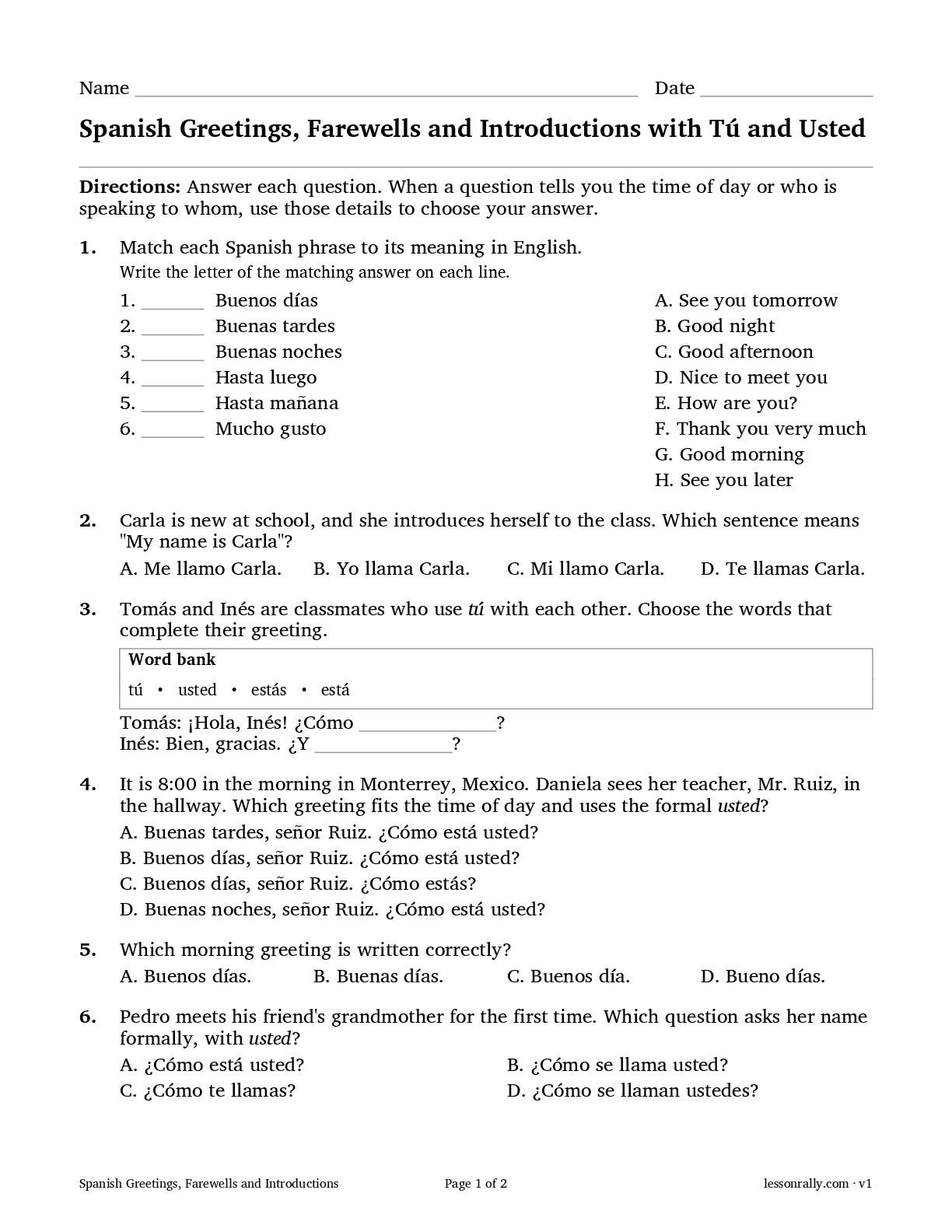
Match each Spanish phrase to its meaning in English.
Match each item to an option.
Items
- Buenos días
- Buenas tardes
- Buenas noches
- Hasta luego
- Hasta mañana
- Mucho gusto
Options


Teachers who sign in can assign LessonRally activities to their Google Classroom classes: students open them in Classroom and answer online, and their grades go to the teacher's Classroom gradebook. Practice lets you try it first, the way students see it.
Free for teachers. Sign in to assign activities to your Google Classroom classes.
 (opens in a new tab)
2 pages · Student copy, no answers
Print worksheet (opens in a new tab)Answer keyPremiumStudents match Spanish greetings, farewells and introductions to their meanings, then choose the right greeting, farewell or introduction in short exchanges. Practice formal and informal Spanish (tú and usted), greetings for the time of day, introducing yourself with me llamo, and introducing others with te presento a.
Learning goal: Choose Spanish greetings, farewells and introductions that fit the time of day and the person, using tú with classmates and friends and usted to show respect.
Topic: Greetings and Introductions Chosen by LessonRally
Question types: matching, multiple choice, fill in the blank.
The questions as students see them, without the answers.
Answer each question. When a question tells you the time of day or who is speaking to whom, use those details to choose your answer.
Match each Spanish phrase to its meaning in English.
Match each item to an option.
Items
Options
Carla is new at school, and she introduces herself to the class. Which sentence means "My name is Carla"?
Choose one answer.
Tomás and Inés are classmates who use tú with each other. Choose the words that complete their greeting.
Fill in each blank.
Tomás: ¡Hola, Inés! ¿Cómo blank 1? Inés: Bien, gracias. ¿Y blank 2?
Word bank
It is 8:00 in the morning in Monterrey, Mexico. Daniela sees her teacher, Mr. Ruiz, in the hallway. Which greeting fits the time of day and uses the formal usted?
Choose one answer.
Which morning greeting is written correctly?
Choose one answer.
Pedro meets his friend's grandmother for the first time. Which question asks her name formally, with usted?
Choose one answer.
Raúl meets Ana, a new girl in his class. Choose the words that complete what they say to each other.
Fill in each blank.
Raúl: blank 1, Ana. Ana: blank 2, Raúl.
Word bank
Raquel, a student in Mexico, answers her teacher, Mrs. Paz, using the formal usted. Choose the words that complete Raquel's answer.
Fill in each blank.
Señora Paz: Buenas tardes, Raquel. ¿Cómo estás? Raquel: Muy blank 1, gracias. ¿Y blank 2?
Word bank
Carlos introduces his cousin Elena to his friend Marcos, and the two friends use tú with each other. What should Carlos say to Marcos?
Choose one answer.
It is 9:30 at night. Javier is leaving his friend Camila's house, and they will see each other at school the next morning. Which line says good night and tells Camila he will see her tomorrow?
Choose one answer.
No reviews yet.
Reviews come from teachers who assigned this activity to a class.
Have a topic of your own? Make a printable worksheet and online quiz, free.
Create an activityMade by Elena Brisaval · LessonRally (AI-assisted)
Made by Elena Brisaval · LessonRally (AI-assisted)
Made by Elena Brisaval · LessonRally (AI-assisted)
Made by Elena Brisaval · LessonRally (AI-assisted)