Teachers who sign in can assign LessonRally activities to their Google Classroom classes: students open them in Classroom and answer online, and their grades go to the teacher's Classroom gradebook. Practice lets you try it first, the way students see it.
Students read short situations about fake prizes, overpayment checks and demands for gift cards, decide what each person should do, and use numbers to see how much a fake check scam can cost. They also learn the warning signs of a money scam and how to protect and recover their identity, including reporting identity theft at IdentityTheft.gov.
Learning goal: Recognize common money scams and their warning signs, choose safe responses, and know how to protect personal information and report identity theft.
Estimated reading level8.9
Grade 6Hard
Grade 7Stretch
Grade 8On level
Grade 9Easier
Grade 10Easy
About this estimate
The estimate is halfway between the two middle scores of four readability formulas. Their scores run from 8.5 to 11.2.
Flesch-Kincaid Grade Middle scoreSentence length and syllables per word8.8
Gunning FogSentence length and words of three or more syllables11.2
Coleman-LiauLetters per word and sentences per 100 words8.5
Automated Readability Index Middle scoreCharacters per word and words per sentence9.0
Grade 181216
Flesch Reading Ease
66.1 on a 0 to 100 scale where higher is easier: standard. Not part of the estimate.
Text measured
973 words, 20 sentences
Adapted from common readability formulas (Flesch-Kincaid, Gunning Fog, Coleman-Liau and ARI, plus SMOG for long texts), which look at sentence length and word length. Answer choices count toward word length only. Grades below the estimate will likely find the text harder, grades above it easier. It does not measure ideas, background knowledge or images.
Question types: select all that apply, matching, multiple choice.
Student preview
The questions as students see them, without the answers.
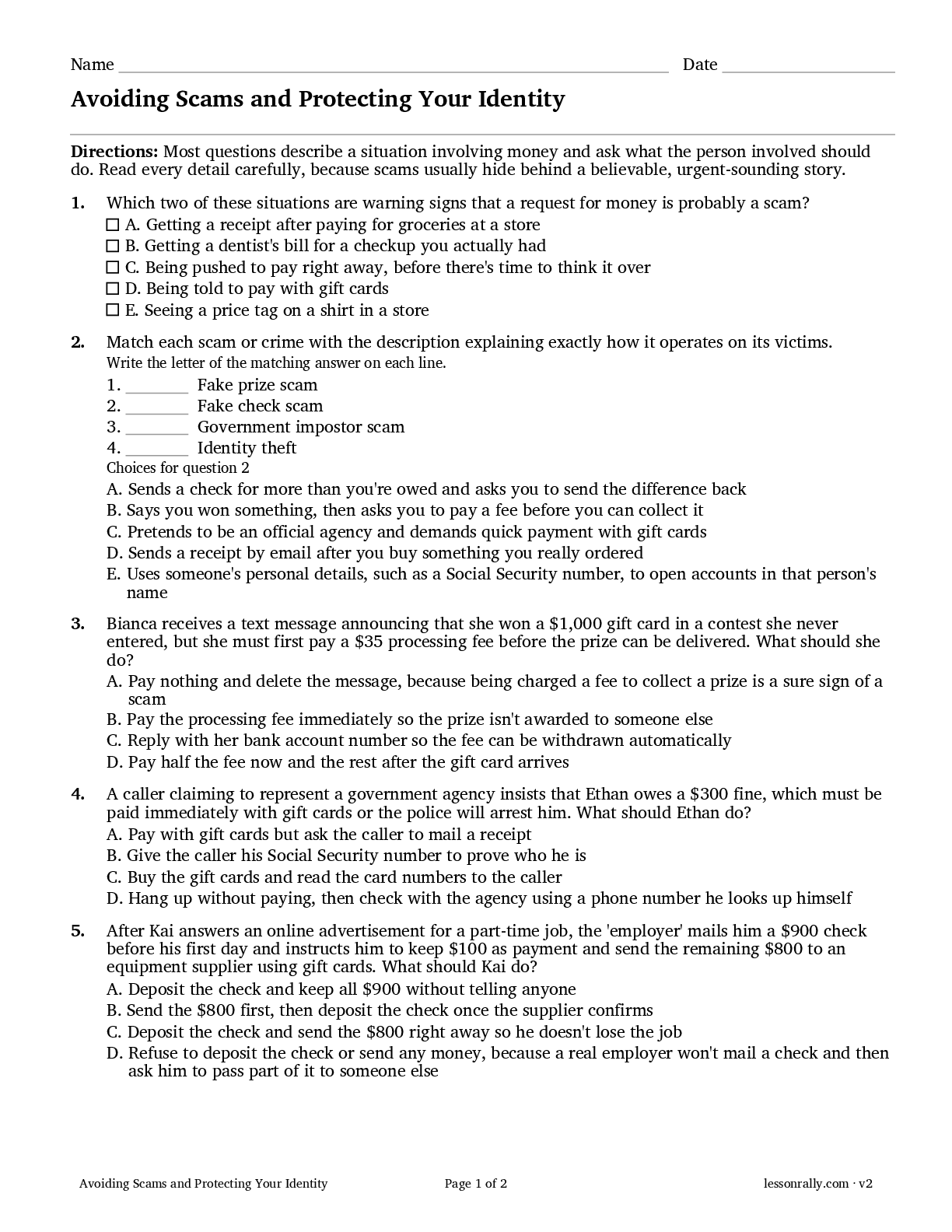
Most questions describe a situation involving money and ask what the person involved should do. Read every detail carefully, because scams usually hide behind a believable, urgent-sounding story.
Question 1
Which two of these situations are warning signs that a request for money is probably a scam?
Choose 2 answers.
Being pushed to pay right away, before there's time to think it over
Being told to pay with gift cards
Getting a receipt after paying for groceries at a store
Seeing a price tag on a shirt in a store
Getting a dentist's bill for a checkup you actually had
Question 2
Match each scam or crime with the description explaining exactly how it operates on its victims.
Match each item to an option.
Items
Fake prize scam
Fake check scam
Government impostor scam
Identity theft
Options
Pretends to be an official agency and demands quick payment with gift cards
Sends a check for more than you're owed and asks you to send the difference back
Uses someone's personal details, such as a Social Security number, to open accounts in that person's name
Sends a receipt by email after you buy something you really ordered
Says you won something, then asks you to pay a fee before you can collect it
Question 3
Bianca receives a text message announcing that she won a $1,000 gift card in a contest she never entered, but she must first pay a $35 processing fee before the prize can be delivered. What should she do?
Choose one answer.
Reply with her bank account number so the fee can be withdrawn automatically
Pay nothing and delete the message, because being charged a fee to collect a prize is a sure sign of a scam
Pay the processing fee immediately so the prize isn't awarded to someone else
Pay half the fee now and the rest after the gift card arrives
Question 4
A caller claiming to represent a government agency insists that Ethan owes a $300 fine, which must be paid immediately with gift cards or the police will arrest him. What should Ethan do?
Choose one answer.
Hang up without paying, then check with the agency using a phone number he looks up himself
Buy the gift cards and read the card numbers to the caller
Give the caller his Social Security number to prove who he is
Pay with gift cards but ask the caller to mail a receipt
Question 5
After Kai answers an online advertisement for a part-time job, the 'employer' mails him a $900 check before his first day and instructs him to keep $100 as payment and send the remaining $800 to an equipment supplier using gift cards. What should Kai do?
Choose one answer.
Refuse to deposit the check or send any money, because a real employer won't mail a check and then ask him to pass part of it to someone else
Send the $800 first, then deposit the check once the supplier confirms
Deposit the check and send the $800 right away so he doesn't lose the job
Deposit the check and keep all $900 without telling anyone
Lena's Online Sale
The details of an online sale Lena is arranging with a buyer she has never met in person.
Sale detail
Amount (dollars)
Keyboard's selling price
120
Amount on the buyer's check
520
Money the buyer asks Lena to send back
400
Question 6
The buyer, explaining that the overpayment was an accident, asks Lena to deposit the check immediately and return the extra money right away. What should Lena do?
Choose one answer.
Deposit the check and send the extra money as soon as it shows up in her account
Ship the keyboard first and sort out the extra money later
Refuse the check and send nothing back, since a request to return an overpayment is a sign of a fake check scam
Send the extra money with gift cards so the buyer gets it faster
Question 7
Lena is considering two plans in case the buyer is a scammer: under Plan A she would deposit the check, send the buyer $400 in gift cards and ship the keyboard, while under Plan B she would return the check, send no money and keep the keyboard. Counting the keyboard at its $120 selling price, if the check turns out to be fake, which plan leaves Lena better off, and by how much?
Choose one answer.
Plan B, by $520
Plan A, by $400
Plan B, by $120
Plan B, by $400
Question 8
Suppose Lena deposited the check and the full $520 appeared in her account the following day; why wouldn't that prove the check is genuine?
Choose one answer.
Deposited money can appear before the bank finishes verifying the check, and if the check proves fake, even weeks later, the bank reverses the deposit.
Banks show money only from checks they have already confirmed.
A check that clears in one day is always genuine.
Money that appears in an account can never be taken back.
Question 9
While reviewing his credit report, Noah discovers a credit card account that he never opened. Which step follows the Federal Trade Commission's advice for responding to identity theft?
Choose one answer.
Post about it online with his Social Security number so the bank can find the thief
Ignore it, since the card isn't in his wallet
Report it at IdentityTheft.gov, the FTC's site, to get an identity theft report and a recovery plan
Pay off the card's balance so it doesn't hurt his credit
Question 10
Someone steals Yusuf's wallet, which contained his Social Security card. Which step would make it considerably harder for a thief to open new credit accounts in his name?
Choose one answer.
Place a free credit freeze with the nationwide credit reporting companies
Wait until a bill in his name shows up before doing anything
Apply for several new credit cards before the thief can
Close his savings account and keep his money in cash at home
Question 11
Why is it a valuable habit for Camila to carefully review her bank and credit card statements every month, even when nothing seems unusual?
Choose one answer.
It raises her credit score each time she reads them.
Banks require customers to review statements before every purchase.
It stops scammers from ever calling her.
Spotting unfamiliar charges she didn't make lets her report them to her bank or card company quickly.