Teachers who sign in can assign LessonRally activities to their Google Classroom classes: students open them in Classroom and answer online, and their grades go to the teacher's Classroom gradebook. Practice lets you try it first, the way students see it.
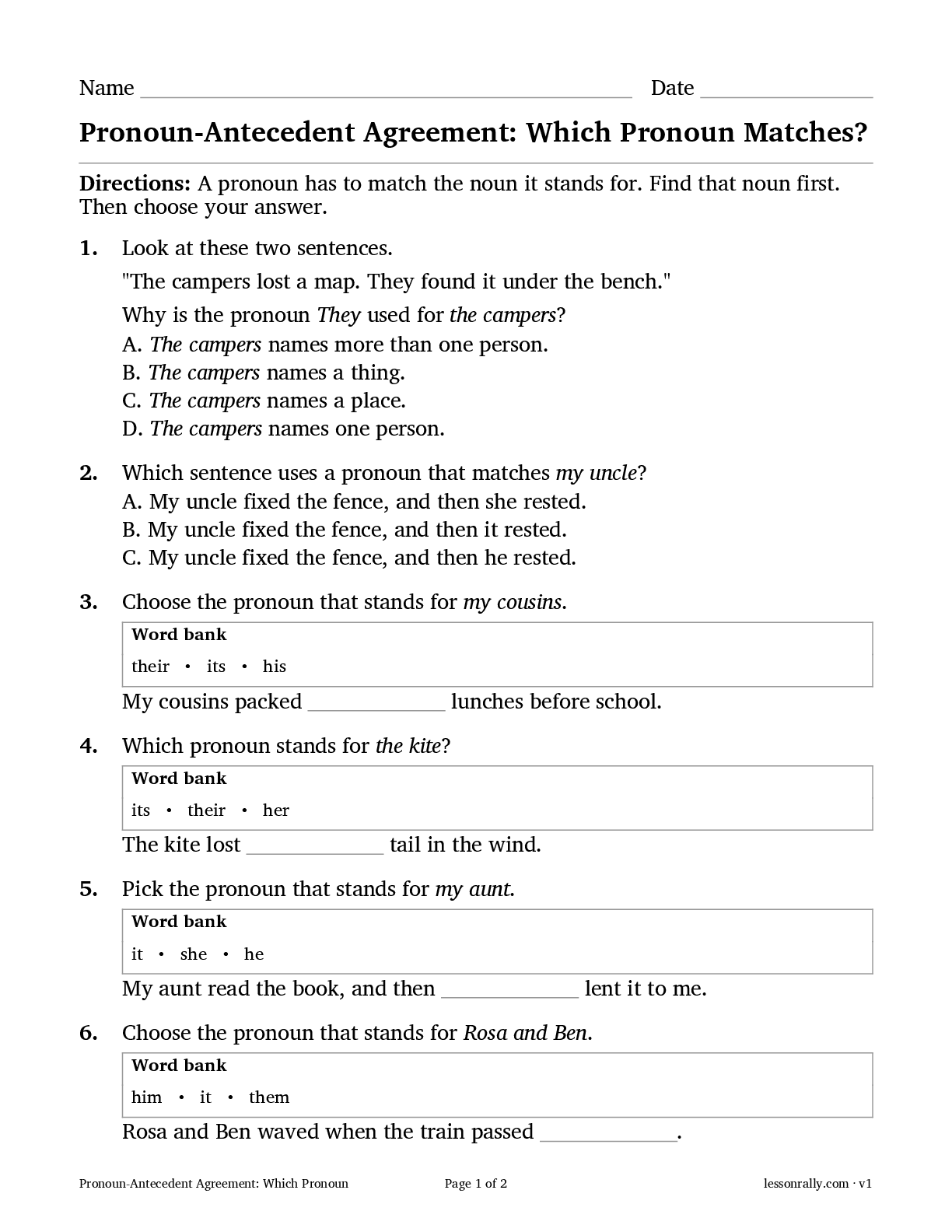
Students choose the pronoun that agrees with the noun it stands for: one or more than one, a person or a thing. Practice with pronoun and antecedent agreement using pronouns such as he, she, it, they, his, her, its and their.
Learning goal: Choose the pronoun that agrees with the noun it stands for, whether that noun names one or more than one.
Estimated reading level2.6
KKindergartenHard
Grade 1Stretch
Grade 2On level
Grade 3Easier
Grade 4Easy
About this estimate
The estimate is halfway between the two middle scores of four readability formulas. Their scores run from 1.6 to 4.7.
Flesch-Kincaid GradeSentence length and syllables per word1.6
Gunning Fog Middle scoreSentence length and words of three or more syllables3.3
Coleman-LiauLetters per word and sentences per 100 words4.7
Automated Readability Index Middle scoreCharacters per word and words per sentence1.9
Grade 181216
Flesch Reading Ease
97.5 on a 0 to 100 scale where higher is easier: very easy. Not part of the estimate.
Text measured
273 words, 26 sentences
Adapted from common readability formulas (Flesch-Kincaid, Gunning Fog, Coleman-Liau and ARI, plus SMOG for long texts), which look at sentence length and word length. Answer choices count toward word length only. Grades below the estimate will likely find the text harder, grades above it easier. It does not measure ideas, background knowledge or images.
Common Core
Press Ctrl+C or Command+C to copy.
Closest anchor:CCRA.L.1Demonstrate command of the conventions of standard English grammar and usage when writing or speaking.Anchor Standards for LanguageShow 1 matched standardHide matched standard