Commas in Addresses: Streets, Cities and States

10 questions · 13 points · Grade 3 · English · Preview the 10 questions

Made by Sophia Howard · LessonRally (AI-assisted)

Digital classroom activity

What is a digital classroom activity?

Teachers who sign in can assign LessonRally activities to their Google Classroom classes: students open them in Classroom and answer online, and their grades go to the teacher's Classroom gradebook. Practice lets you try it first, the way students see it.

Free for teachers. Sign in to assign activities to your Google Classroom classes.
Printable worksheet

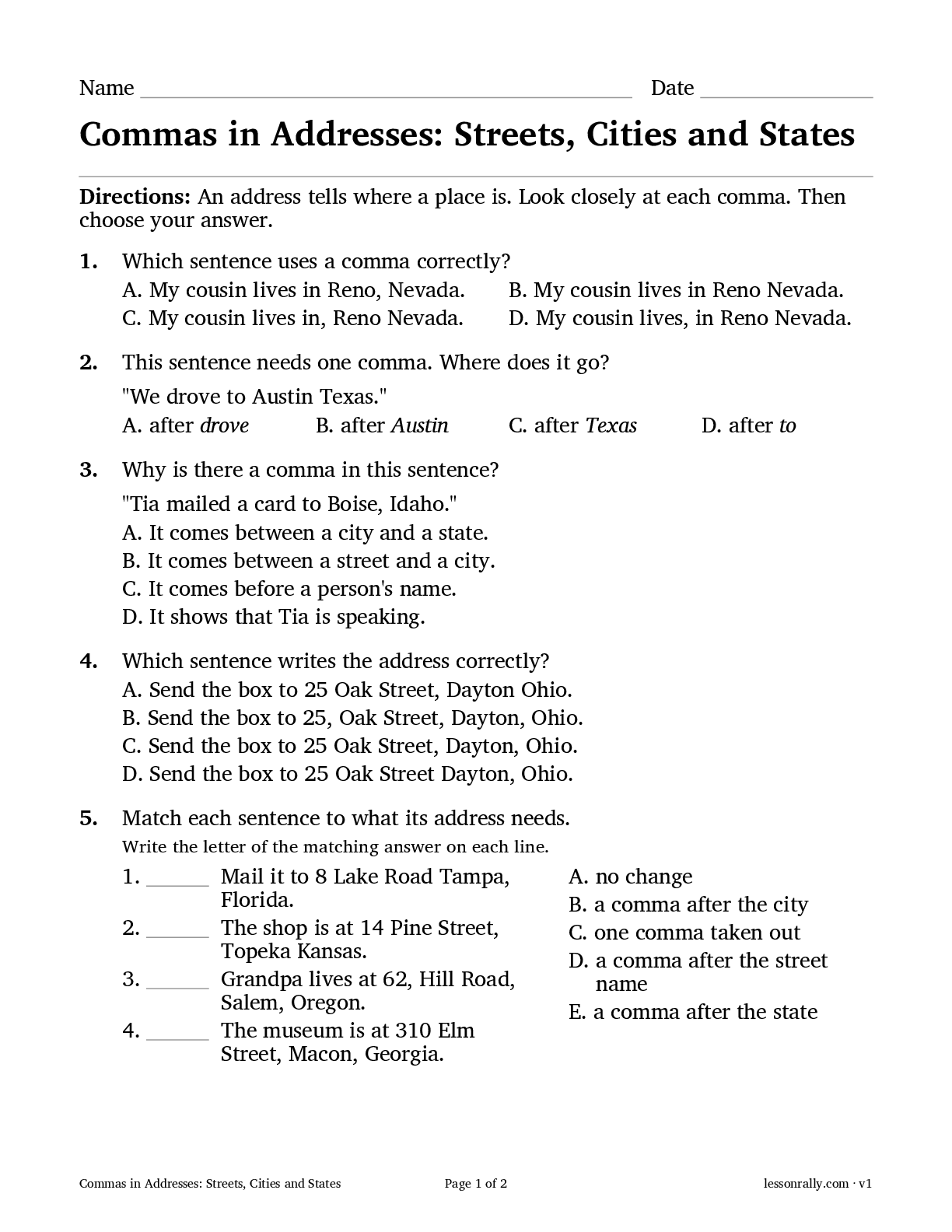
Students decide where each comma belongs in an address: between the street and the city, and between the city and the state. Punctuation practice with commas in addresses written inside sentences.

Learning goal: Use a comma between the street and the city and between the city and the state when writing an address.

Estimated reading level 3.2

  1. Grade 1Hard
  2. Grade 2Stretch
  3. Grade 3On level
  4. Grade 4Easier
  5. Grade 5Easy
About this estimate

The estimate is halfway between the two middle scores of four readability formulas. Their scores run from 0.9 to 4.4.

  • Flesch-Kincaid Grade Middle scoreSentence length and syllables per word3.3
  • Gunning FogSentence length and words of three or more syllables4.4
  • Coleman-Liau Middle scoreLetters per word and sentences per 100 words3.0
  • Automated Readability IndexCharacters per word and words per sentence0.9
Flesch Reading Ease
82.6 on a 0 to 100 scale where higher is easier: easy. Not part of the estimate.
Text measured
442 words, 24 sentences

Adapted from common readability formulas (Flesch-Kincaid, Gunning Fog, Coleman-Liau and ARI, plus SMOG for long texts), which look at sentence length and word length. Answer choices count toward word length only. Grades below the estimate will likely find the text harder, grades above it easier. It does not measure ideas, background knowledge or images.

Common Core

Closest anchor: CCRA.L.2 Demonstrate command of the conventions of standard English capitalization, punctuation, and spelling when writing.Anchor Standards for LanguageShow 1 matched standardHide matched standard

Matched standard

  • L.3.2b

    Use commas in addresses.

    Student preview questions 1, 2, 3, 4, 5, 6, 7, 8, 9, 10

Matched independently by two AI models from this activity's questions.

© Copyright 2010. National Governors Association Center for Best Practices and Council of Chief State School Officers. All rights reserved.

Question types: multiple choice, matching.

Student preview

The questions as students see them, without the answers.

An address tells where a place is. Look closely at each comma. Then choose your answer.

Question 1

Which sentence uses a comma correctly?

Choose one answer.

  • My cousin lives in Reno, Nevada.
  • My cousin lives in Reno Nevada.
  • My cousin lives in, Reno Nevada.
  • My cousin lives, in Reno Nevada.

Question 2

This sentence needs one comma. Where does it go?

"We drove to Austin Texas."

Choose one answer.

  • after Austin
  • after to
  • after Texas
  • after drove

Question 3

Why is there a comma in this sentence?

"Tia mailed a card to Boise, Idaho."

Choose one answer.

  • It comes between a street and a city.
  • It shows that Tia is speaking.
  • It comes before a person's name.
  • It comes between a city and a state.

Question 4

Which sentence writes the address correctly?

Choose one answer.

  • Send the box to 25 Oak Street Dayton, Ohio.
  • Send the box to 25 Oak Street, Dayton Ohio.
  • Send the box to 25, Oak Street, Dayton, Ohio.
  • Send the box to 25 Oak Street, Dayton, Ohio.

Question 5

Match each sentence to what its address needs.

Match each item to an option.

Items

  1. Mail it to 8 Lake Road Tampa, Florida.
  2. The shop is at 14 Pine Street, Topeka Kansas.
  3. Grandpa lives at 62, Hill Road, Salem, Oregon.
  4. The museum is at 310 Elm Street, Macon, Georgia.

Options

  1. a comma after the state
  2. a comma after the city
  3. one comma taken out
  4. a comma after the street name
  5. no change

Question 6

This address needs two commas. Where do they go?

"Ship the kite to 40 Bell Lane Akron Ohio."

Choose one answer.

  • after Akron and after Ohio
  • after Bell and after Akron
  • after Lane and after Akron
  • after 40 and after Lane

Question 7

Fargo is a city in North Dakota. Which sentence is correct?

Choose one answer.

  • My pen pal lives in Fargo, North Dakota.
  • My pen pal lives in Fargo North, Dakota.
  • My pen pal lives in Fargo, North, Dakota.

Question 8

Three of these sentences are correct. Which one has a comma mistake?

Choose one answer.

  • Zoe lives at 7 Fern Street, Provo, Utah.
  • The bank is at 12 Park Road, Mesa Arizona.
  • Bring it to 3 Bay Street, Juneau, Alaska.
  • Her aunt moved to Tulsa, Oklahoma.

Question 9

Nora says this sentence needs a comma after in.

"We stayed in Miami Florida."

Is Nora right?

Choose one answer.

  • No. The sentence needs no comma.
  • No. The comma goes after Florida.
  • Yes. A comma goes before the name of a city.
  • No. The comma goes after Miami, between the city and the state.

Question 10

This longer sentence has one comma in the wrong place.

"Mia sent her best poem to 18 Lark, Avenue Bangor, Maine."

How should the sentence be fixed?

Choose one answer.

  • Take out the comma after Bangor.
  • Move the comma after Lark so it comes after poem.
  • Add a comma after 18.
  • Move the comma after Lark so it comes after Avenue.

Reviews

No reviews yet.

Reviews come from teachers who assigned this activity to a class.

Sign in to write a review

Have a topic of your own? Make a printable worksheet and online quiz, free.

Create an activity

Answer key

Answer keys come with Premium

Print this worksheet with the correct answers marked. The key includes any explanations, sample answers, and rubrics supplied with the activity.

Answer keys aren't public: only teachers with Premium and the people who can edit an activity can download one, so students can't get a ready-to-print key from this page.

Premium includes:

  • No ads for you, and no ads for your students on the assignments you post.
  • Answer keys for printable worksheets, with the correct answers marked and any explanations, sample answers, and rubrics.
  • Create with AI: up to 100 activities a year (5 during the free trial), with every answer checked before you see the draft.

$29 a year, plus sales tax where it applies.

New Premium teachers can try it free for 7 days. A card or other payment method is needed to start. Unless you cancel before the trial ends, you are charged then and the plan renews every year.

Already have Premium or edit this activity? Sign in