Question 1
Anyone learning about investing encounters these four terms early; match each term with the meaning that accurately describes it.
Match each item to an option.
Items
- Stock
- Bond
- Diversification
- Time horizon
Options


Teachers who sign in can assign LessonRally activities to their Google Classroom classes: students open them in Classroom and answer online, and their grades go to the teacher's Classroom gradebook. Practice lets you try it first, the way students see it.
Free for teachers. Sign in to assign activities to your Google Classroom classes.
 (opens in a new tab)
2 pages · Student copy, no answers
Print worksheet (opens in a new tab)Answer keyPremiumStudents match investing terms such as stock, bond, diversification and time horizon, then see how risk and return are related and why stock returns are uncertain. A comparison of putting $1,000 into one company or spreading it across ten shows what diversification can and cannot do, and students calculate simple returns and losses.
Learning goal: Explain how risk, return and diversification work, recognize that stock returns are uncertain, and calculate simple gains and losses.
The estimate is halfway between the two middle scores of four readability formulas. Their scores run from 9.3 to 13.9.
Adapted from common readability formulas (Flesch-Kincaid, Gunning Fog, Coleman-Liau and ARI, plus SMOG for long texts), which look at sentence length and word length. Answer choices count toward word length only. Grades below the estimate will likely find the text harder, grades above it easier. It does not measure ideas, background knowledge or images.
Topic: Personal Finance Chosen by LessonRally
Question types: matching, multiple choice, number answer.
The questions as students see them, without the answers.
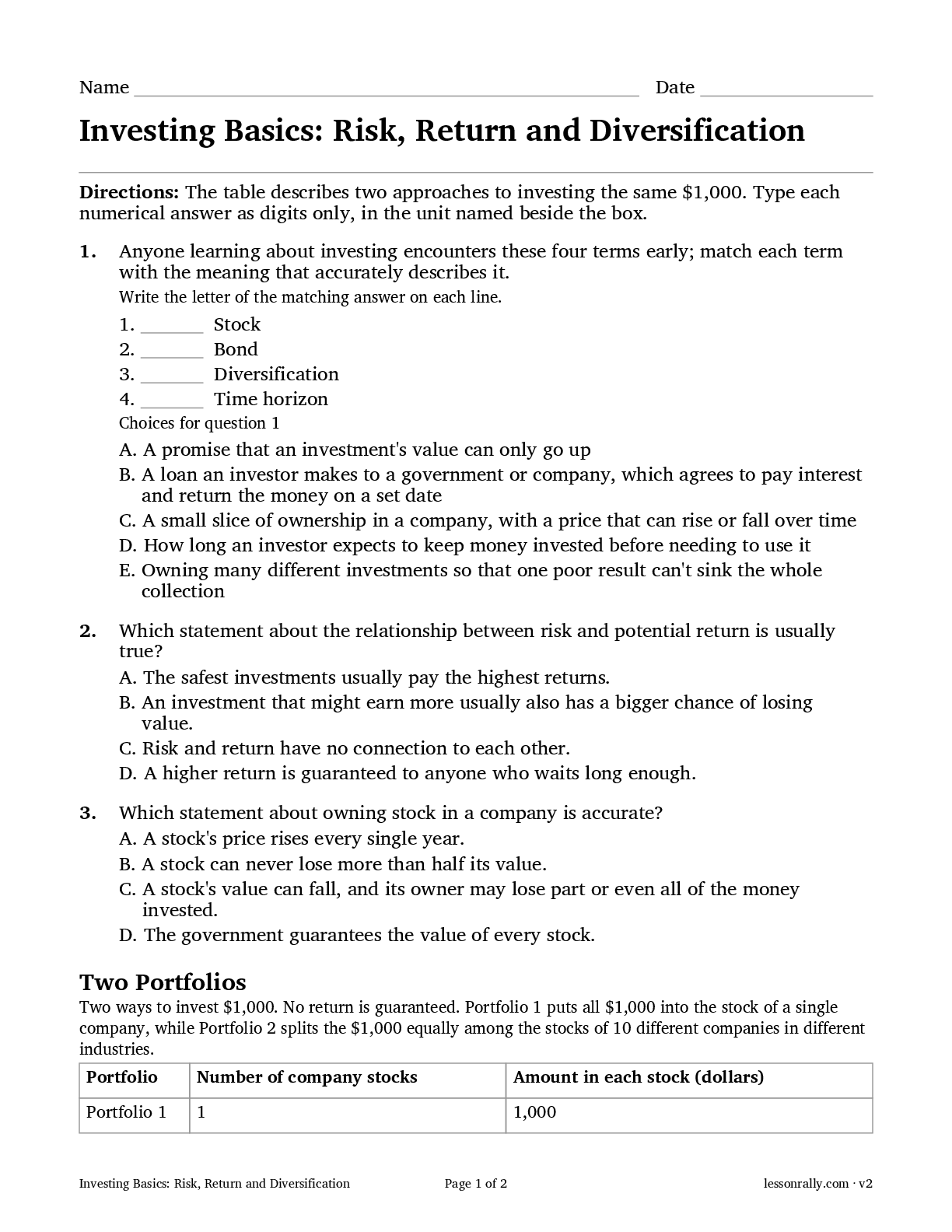
The table describes two approaches to investing the same $1,000. Type each numerical answer as digits only, in the unit named beside the box.
Anyone learning about investing encounters these four terms early; match each term with the meaning that accurately describes it.
Match each item to an option.
Items
Options
Which statement about the relationship between risk and potential return is usually true?
Choose one answer.
Which statement about owning stock in a company is accurate?
Choose one answer.
| Portfolio | Number of company stocks | Amount in each stock (dollars) |
|---|---|---|
| Portfolio 1 | 1 | 1,000 |
| Portfolio 2 | 10 | 100 |
In Portfolio 2, if one of the 10 stocks loses half its value while the other nine remain unchanged, how many dollars does the entire portfolio lose?
Enter a number.
dollars
Suppose the single company in Portfolio 1 fails and its stock loses all its value, and in Portfolio 2 one of the 10 companies fails the same way while the other nine remain unchanged; which portfolio loses less, and by how much?
Choose one answer.
Since Portfolio 2 is diversified across 10 companies, which statement accurately describes what that diversification can and cannot accomplish?
Choose one answer.
If an economic downturn affects the entire economy, why might Portfolio 2 still lose value even though it holds stock in 10 different companies?
Choose one answer.
If a $500 investment is worth $560 exactly one year later, what was its return for that year, expressed as a percent?
Enter a number.
percent
A different investment begins the year at $800 and then loses 15% of its value; what is it worth at the end of the year?
Enter a number.
dollars
Why might someone saving for a goal one year away keep that money in lower-risk places than someone saving for a goal 30 years away?
Choose one answer.
No reviews yet.
Reviews come from teachers who assigned this activity to a class.
Have a topic of your own? Make a printable worksheet and online quiz, free.
Create an activityMade by Greg Ostlund · LessonRally (AI-assisted)
Made by Greg Ostlund · LessonRally (AI-assisted)
Made by Greg Ostlund · LessonRally (AI-assisted)
Made by Greg Ostlund · LessonRally (AI-assisted)