Question 1
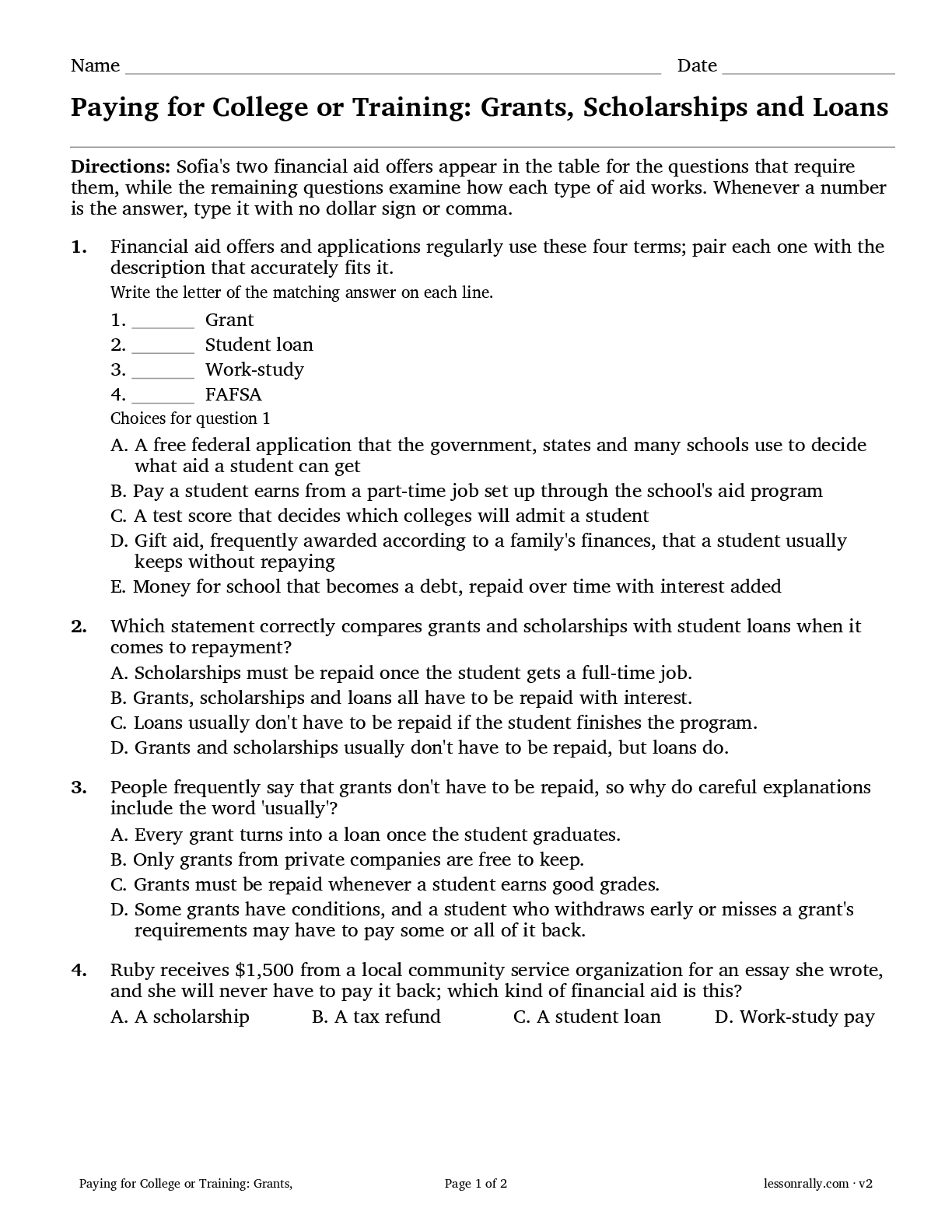
Financial aid offers and applications regularly use these four terms; pair each one with the description that accurately fits it.
Match each item to an option.
Items
- Grant
- Student loan
- Work-study
- FAFSA
Options


Teachers who sign in can assign LessonRally activities to their Google Classroom classes: students open them in Classroom and answer online, and their grades go to the teacher's Classroom gradebook. Practice lets you try it first, the way students see it.
Free for teachers. Sign in to assign activities to your Google Classroom classes.
 (opens in a new tab)
2 pages · Student copy, no answers
Print worksheet (opens in a new tab)Answer keyPremiumStudents match the main kinds of student aid, learn why grants and scholarships usually don't have to be repaid while loans do, and see what the FAFSA is for. Using two aid offers, they find a school's net price, compare two schools by what each would really cost, and see how much more one offer would have them borrow.
Learning goal: Distinguish grants, scholarships, work-study and student loans, explain which usually must be repaid, and compare aid offers by net price and amount borrowed.
The estimate is halfway between the two middle scores of four readability formulas. Their scores run from 9.6 to 12.2.
Adapted from common readability formulas (Flesch-Kincaid, Gunning Fog, Coleman-Liau and ARI, plus SMOG for long texts), which look at sentence length and word length. Answer choices count toward word length only. Grades below the estimate will likely find the text harder, grades above it easier. It does not measure ideas, background knowledge or images.
Topic: Personal Finance Chosen by LessonRally
Question types: matching, multiple choice, number answer.
The questions as students see them, without the answers.
Sofia's two financial aid offers appear in the table for the questions that require them, while the remaining questions examine how each type of aid works. Whenever a number is the answer, type it with no dollar sign or comma.
Financial aid offers and applications regularly use these four terms; pair each one with the description that accurately fits it.
Match each item to an option.
Items
Options
Which statement correctly compares grants and scholarships with student loans when it comes to repayment?
Choose one answer.
People frequently say that grants don't have to be repaid, so why do careful explanations include the word 'usually'?
Choose one answer.
Ruby receives $1,500 from a local community service organization for an essay she wrote, and she will never have to pay it back; which kind of financial aid is this?
Choose one answer.
| Item | School A | School B |
|---|---|---|
| Cost of attendance for one year (dollars) | 24,000 | 18,000 |
| Grants (dollars) | 9,000 | 2,500 |
| Scholarships (dollars) | 4,000 | 2,500 |
| Student loan offered (dollars) | 4,000 | 7,000 |
Using the definition provided in the caption, what is Sofia's net price at School A for the academic year? Type your answer without a comma.
Enter a number.
dollars
Comparing the two net prices rather than the published costs of attendance, which school would cost Sofia less for the year, and by how much?
Choose one answer.
If Sofia accepts the full student loan offered at each school, how much more money would she borrow at School B than at School A? Type your answer without a comma.
Enter a number.
dollars
Why will repaying a student loan usually end up costing more than the original amount that was borrowed?
Choose one answer.
Jamal plans to enroll in a year-long electrician training program at a career school instead of a four-year college; which statement about filing the FAFSA is accurate for him?
Choose one answer.
Elijah uses a federal student loan to pay for a nine-month welding certificate program at a community college, but he withdraws during the final month without completing it; what happens to his loan?
Choose one answer.
No reviews yet.
Reviews come from teachers who assigned this activity to a class.
Have a topic of your own? Make a printable worksheet and online quiz, free.
Create an activityMade by Greg Ostlund · LessonRally (AI-assisted)
Made by Greg Ostlund · LessonRally (AI-assisted)
Made by Greg Ostlund · LessonRally (AI-assisted)
Made by Greg Ostlund · LessonRally (AI-assisted)