Question 1
Drivers shopping for car insurance meet these four terms again and again; connect each term with the meaning that explains it.
Match each item to an option.
Items
- Premium
- Deductible
- Claim
- Coverage
Options


Teachers who sign in can assign LessonRally activities to their Google Classroom classes: students open them in Classroom and answer online, and their grades go to the teacher's Classroom gradebook. Practice lets you try it first, the way students see it.
Free for teachers. Sign in to assign activities to your Google Classroom classes.
 (opens in a new tab)
2 pages · Student copy, no answers
Print worksheet (opens in a new tab)Answer keyPremiumStudents match insurance terms such as premium, deductible, claim and coverage, then use two car insurance plans to find what the policyholder and the plan each pay for covered repairs. They compare a year of premiums and repair costs, see why a higher deductible usually comes with a lower premium, and learn that real coverage varies by policy and state.
Learning goal: Explain premiums, deductibles, claims and coverage, and calculate what a policyholder and an insurer each pay for covered costs under example plan rules.
The estimate is halfway between the two middle scores of four readability formulas. Their scores run from 9.2 to 12.5.
Adapted from common readability formulas (Flesch-Kincaid, Gunning Fog, Coleman-Liau and ARI, plus SMOG for long texts), which look at sentence length and word length. Answer choices count toward word length only. Grades below the estimate will likely find the text harder, grades above it easier. It does not measure ideas, background knowledge or images.
Topic: Personal Finance Chosen by LessonRally
Question types: matching, number answer, multiple choice, select all that apply.
The questions as students see them, without the answers.
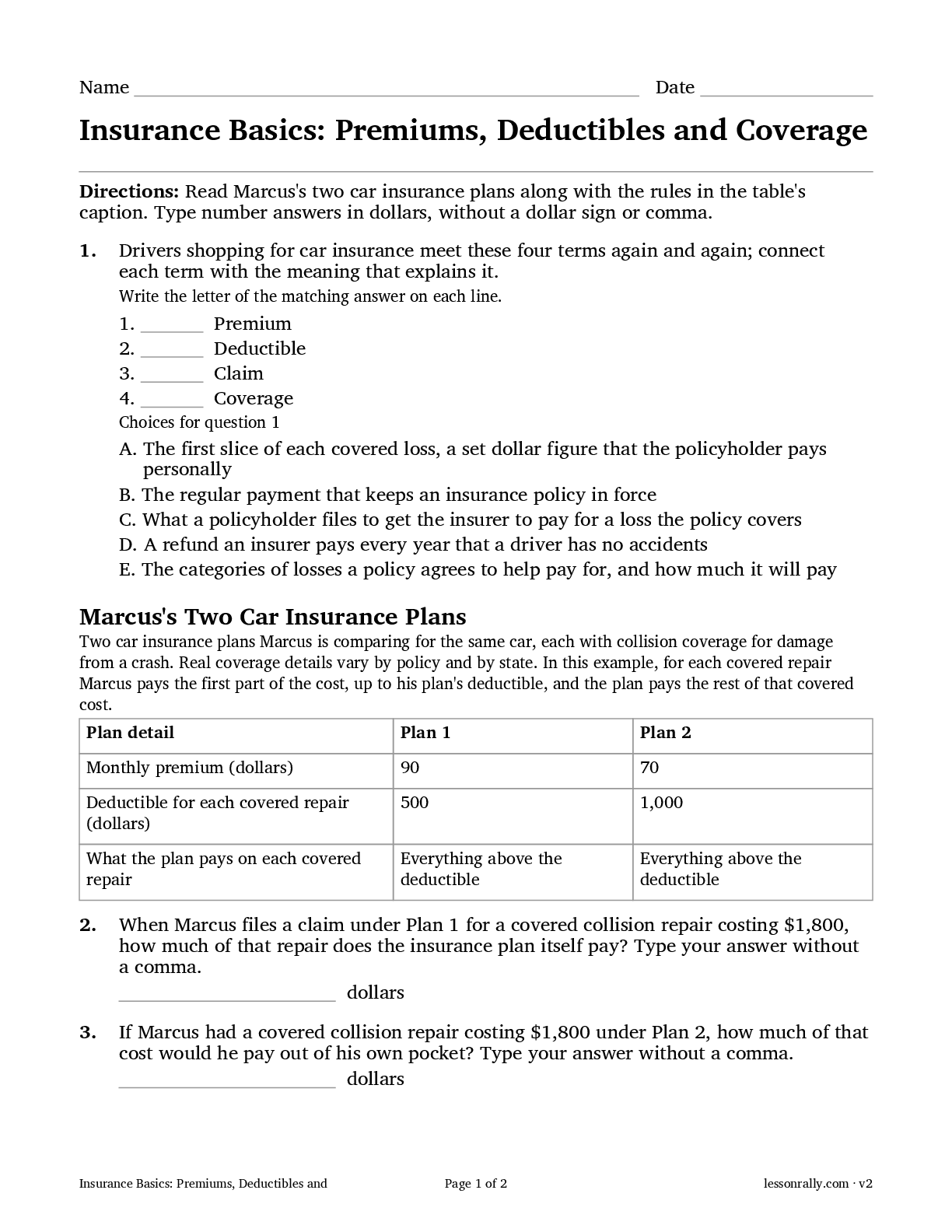
Read Marcus's two car insurance plans along with the rules in the table's caption. Type number answers in dollars, without a dollar sign or comma.
Drivers shopping for car insurance meet these four terms again and again; connect each term with the meaning that explains it.
Match each item to an option.
Items
Options
| Plan detail | Plan 1 | Plan 2 |
|---|---|---|
| Monthly premium (dollars) | 90 | 70 |
| Deductible for each covered repair (dollars) | 500 | 1,000 |
| What the plan pays on each covered repair | Everything above the deductible | Everything above the deductible |
When Marcus files a claim under Plan 1 for a covered collision repair costing $1,800, how much of that repair does the insurance plan itself pay? Type your answer without a comma.
Enter a number.
dollars
If Marcus had a covered collision repair costing $1,800 under Plan 2, how much of that cost would he pay out of his own pocket? Type your answer without a comma.
Enter a number.
dollars
Under Plan 1, a covered repair costs only $350, which is less than the deductible; how much does the plan contribute toward that repair?
Enter a number.
dollars
Considering only the premiums, how much more would Marcus pay altogether over 12 consecutive months for Plan 1 than for Plan 2?
Enter a number.
dollars
Suppose Marcus has exactly one covered repair this year, costing $1,800. Counting 12 months of premiums plus his own share of the repair, which plan costs him less for the entire year, and by how much?
Choose one answer.
Plan 2 combines the higher deductible with the lower premium; which statement about the relationship between deductibles and premiums is usually true?
Choose one answer.
Following the rules of these plans, which two situations would leave Marcus paying the entire repair cost by himself?
Choose 2 answers.
Plan 1's deductible applies separately to each covered repair. If Marcus has two covered repairs in one year, one for $700 and one for $1,500, how much does he pay out of pocket for the two? Type your answer without a comma.
Enter a number.
dollars
Because Marcus wants to understand what a real policy would cover, which statement about actual insurance coverage is accurate?
Choose one answer.
No reviews yet.
Reviews come from teachers who assigned this activity to a class.
Have a topic of your own? Make a printable worksheet and online quiz, free.
Create an activityMade by Greg Ostlund · LessonRally (AI-assisted)
Made by Greg Ostlund · LessonRally (AI-assisted)
Made by Greg Ostlund · LessonRally (AI-assisted)
Made by Greg Ostlund · LessonRally (AI-assisted)