Local, State and National Government: Who Does What?

9 questions · 13 points · Grade 4 · English · Preview the 9 questions

Made by Carmen Valdoria · LessonRally (AI-assisted)

Digital classroom activity

What is a digital classroom activity?

Teachers who sign in can assign LessonRally activities to their Google Classroom classes: students open them in Classroom and answer online, and their grades go to the teacher's Classroom gradebook. Practice lets you try it first, the way students see it.

Free for teachers. Sign in to assign activities to your Google Classroom classes.

Printable worksheet

Students read a short passage about the three levels of government in the United States: local, state and national (federal). They decide which level does everyday jobs, such as fixing a city park, giving out driver's licenses, printing money and running the mail, explain why using the passage, and match the mayor, governor and president to their jobs.

Learning goal: Tell which level of government (local, state or national) does an everyday job, match leaders such as the mayor, governor and president to their jobs, and explain why using details from a passage.

Estimated reading level 7.3

  1. Grade 5Hard
  2. Grade 6Stretch
  3. Grade 7On level
  4. Grade 8Easier
  5. Grade 9Easy
About this estimate

The estimate is the middle score of five readability formulas. Their scores run from 4.6 to 8.5.

  • Flesch-Kincaid GradeSentence length and syllables per word4.9
  • Gunning FogSentence length and words of three or more syllables8.0
  • Coleman-Liau Middle scoreLetters per word and sentences per 100 words7.3
  • Automated Readability IndexCharacters per word and words per sentence4.6
  • SMOGWords of three or more syllables, for texts of 30 sentences or more8.5
Flesch Reading Ease
78.8 on a 0 to 100 scale where higher is easier: fairly easy. Not part of the estimate.
Text measured
624 words, 39 sentences

Adapted from common readability formulas (Flesch-Kincaid, Gunning Fog, Coleman-Liau and ARI, plus SMOG for long texts), which look at sentence length and word length. Answer choices count toward word length only. Grades below the estimate will likely find the text harder, grades above it easier. It does not measure ideas, background knowledge or images.

Common Core

Closest anchor: CCRA.R.1 Read closely to determine what the text says explicitly and to make logical inferences from it; cite specific textual evidence when writing or speaking to support conclusions drawn from the text.Anchor Standards for ReadingShow 2 matched standardsHide matched standards

Matched standards

  • RI.4.1

    Refer to details and examples in a text when explaining what the text says explicitly and when drawing inferences from the text.

    Student preview questions 1, 4, 5

  • RI.4.4

    Determine the meaning of general academic and domain-specific words or phrases in a text relevant to a grade 4 topic or subject area.

    Student preview question 8

Matched independently by two AI models from this activity's questions.

© Copyright 2010. National Governors Association Center for Best Practices and Council of Chief State School Officers. All rights reserved.

Topic: Government and Citizenship Chosen by LessonRally

Question types: multiple choice, matching, fill in the blank.

Student preview

The questions as students see them, without the answers.

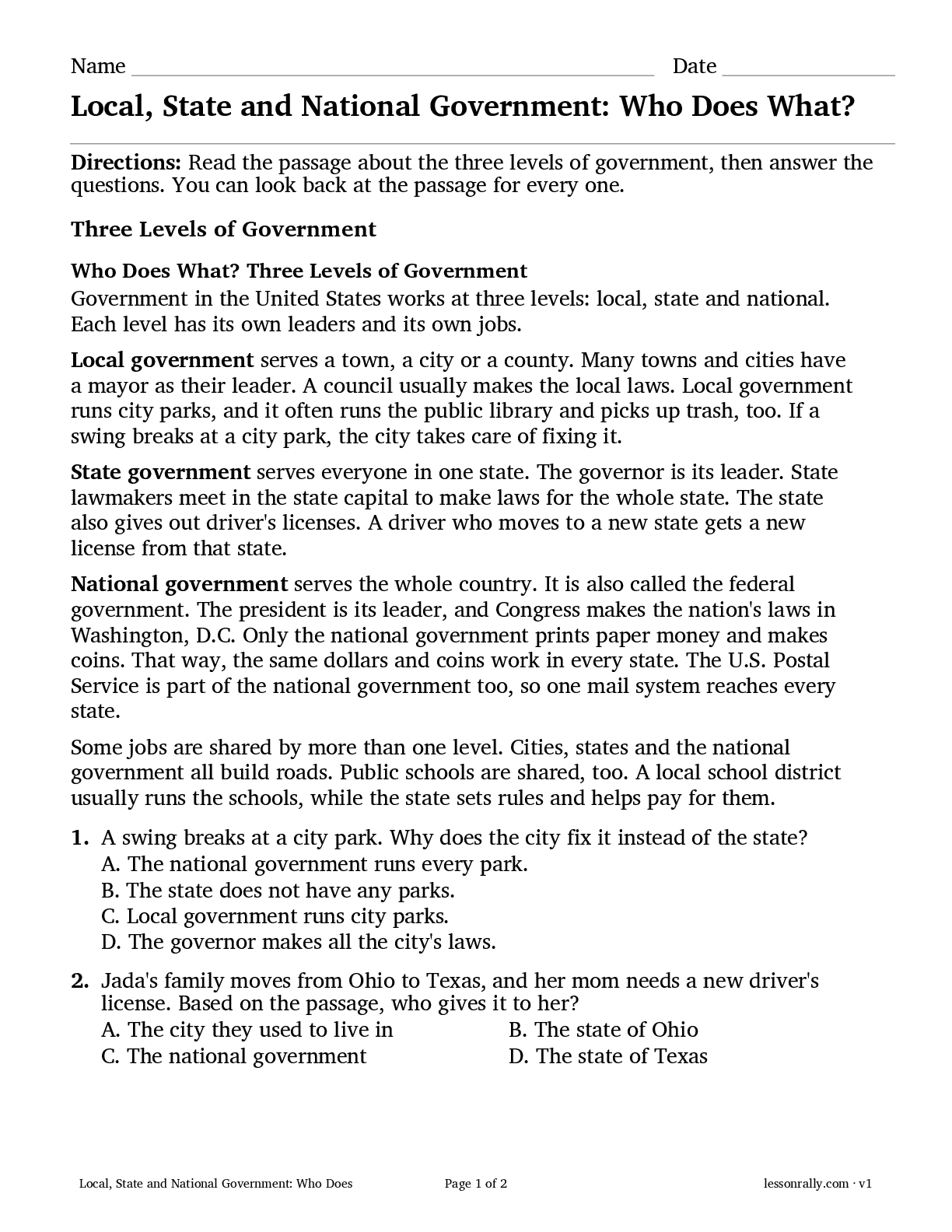
Read the passage about the three levels of government, then answer the questions. You can look back at the passage for every one.

Three Levels of Government

Who Does What? Three Levels of Government

Government in the United States works at three levels: local, state and national. Each level has its own leaders and its own jobs.

Local government serves a town, a city or a county. Many towns and cities have a mayor as their leader. A council usually makes the local laws. Local government runs city parks, and it often runs the public library and picks up trash, too. If a swing breaks at a city park, the city takes care of fixing it.

State government serves everyone in one state. The governor is its leader. State lawmakers meet in the state capital to make laws for the whole state. The state also gives out driver's licenses. A driver who moves to a new state gets a new license from that state.

National government serves the whole country. It is also called the federal government. The president is its leader, and Congress makes the nation's laws in Washington, D.C. Only the national government prints paper money and makes coins. That way, the same dollars and coins work in every state. The U.S. Postal Service is part of the national government too, so one mail system reaches every state.

Some jobs are shared by more than one level. Cities, states and the national government all build roads. Public schools are shared, too. A local school district usually runs the schools, while the state sets rules and helps pay for them.


Question 1

A swing breaks at a city park. Why does the city fix it instead of the state?

Choose one answer.

  • The national government runs every park.
  • The state does not have any parks.
  • The governor makes all the city's laws.
  • Local government runs city parks.

Question 2

Jada's family moves from Ohio to Texas, and her mom needs a new driver's license. Based on the passage, who gives it to her?

Choose one answer.

  • The city they used to live in
  • The state of Ohio
  • The national government
  • The state of Texas

Question 3

According to the passage, where do state lawmakers meet to make laws for the whole state?

Choose one answer.

  • In every county
  • In Washington, D.C.
  • In the state capital
  • In a city hall

Question 4

According to the passage, why does only the national government print paper money and make coins?

Choose one answer.

  • So cities can pay to fix their parks
  • So each state can make its own kind of money
  • So the same dollars and coins work in every state
  • So the mail can carry money to every state

Question 5

Lena lives in Maine. She mails a birthday card to her grandpa in Hawaii. Why can one mail system carry it all that way?

Choose one answer.

  • Her town council made a law about mail.
  • The national Postal Service reaches every state.
  • Maine and Hawaii share one governor.
  • Each state runs its own mail system.

Question 6

Congress makes laws for the whole nation. Which city is its home?

Choose one answer.

  • Philadelphia
  • Each state's capital city
  • Washington, D.C.
  • New York City

Question 7

Match each leader or group from the passage to the job it does.

Match each item to an option.

Items

  1. Mayor
  2. Governor
  3. President
  4. City or town council

Options

  1. Makes local laws
  2. Leads a state
  3. Makes laws for the whole nation
  4. Leads the national government
  5. Makes laws for one state
  6. Leads a town or city

Question 8

The passage says some jobs are shared. What does shared mean in this passage?

Choose one answer.

  • More than one level of government works on the job.
  • People take turns doing the job each year.
  • Only the national government does the job.
  • No level of government is in charge of the job.

Question 9

Use the word bank to finish the sentence about what local government often does.

Fill in each blank.

Local government often runs the public blank 1 and picks up the blank 2.

Word bank

  • library
  • mail
  • coins
  • trash

Reviews

No reviews yet.

Reviews come from teachers who assigned this activity to a class.

Sign in to write a review

Have a topic of your own? Make a printable worksheet and online quiz, free.

Create an activity

Answer key

Answer keys come with Premium

Print this worksheet with the correct answers marked. The key includes any explanations, sample answers, and rubrics supplied with the activity.

Answer keys aren't public: only teachers with Premium and the people who can edit an activity can download one, so students can't get a ready-to-print key from this page.

Premium includes:

  • No ads for you, and no ads for your students on the assignments you post.
  • Answer keys for printable worksheets, with the correct answers marked and any explanations, sample answers, and rubrics.
  • Create with AI: up to 100 activities a year (5 during the free trial), with every answer checked before you see the draft.

$29 a year, plus sales tax where it applies.

New Premium teachers can try it free for 7 days. A card or other payment method is needed to start. Unless you cancel before the trial ends, you are charged then and the plan renews every year.

Already have Premium or edit this activity? Sign in