Question 1
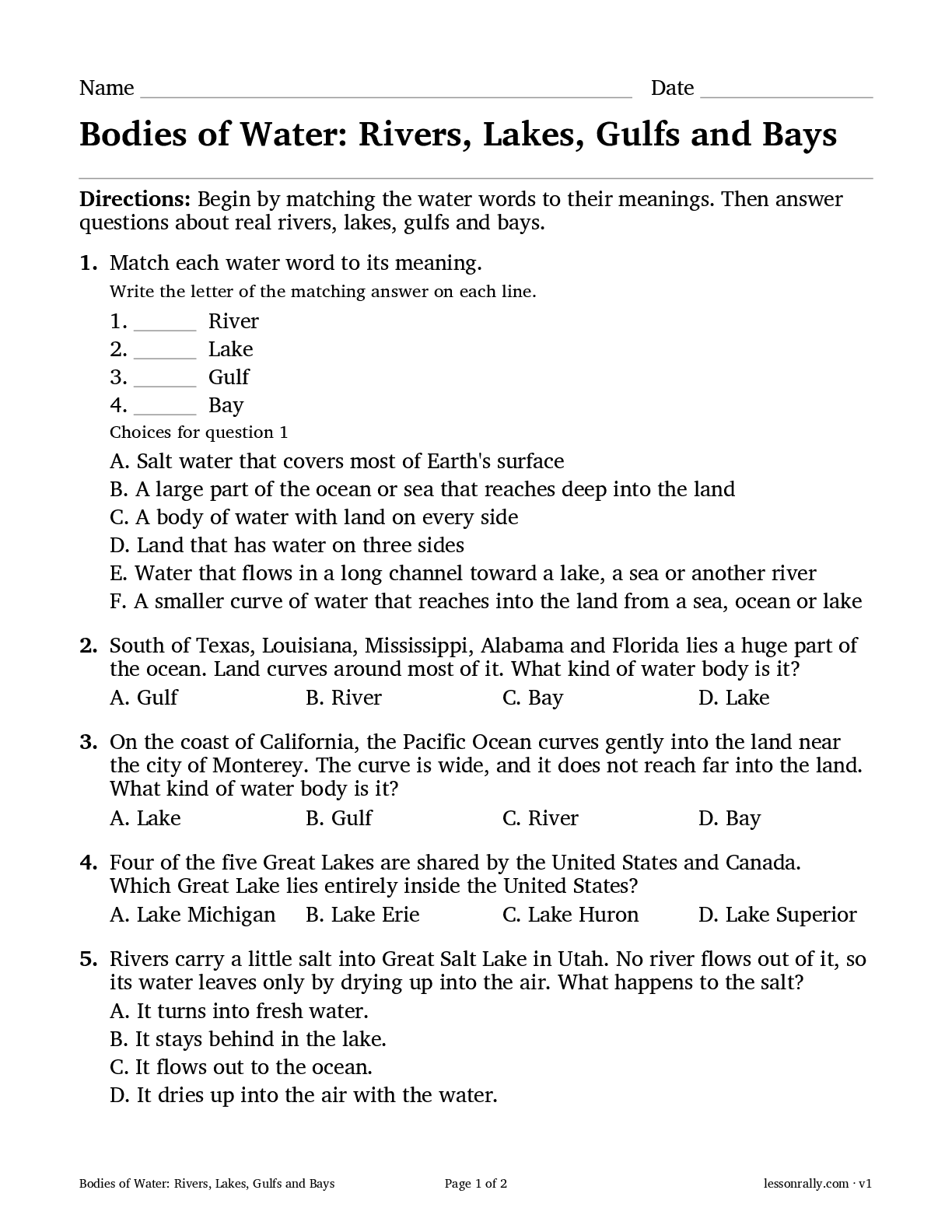
Match each water word to its meaning.
Match each item to an option.
Items
- River
- Lake
- Gulf
- Bay
Options


Teachers who sign in can assign LessonRally activities to their Google Classroom classes: students open them in Classroom and answer online, and their grades go to the teacher's Classroom gradebook. Practice lets you try it first, the way students see it.
Free for teachers. Sign in to assign activities to your Google Classroom classes.
 (opens in a new tab)
2 pages · Student copy, no answers
Print worksheet (opens in a new tab)Answer keyPremiumStudents match the water words river, lake, gulf and bay to their meanings, then answer questions about real bodies of water in the United States, using river words such as mouth and tributary.
Learning goal: Tell rivers, lakes, gulfs and bays apart and use words such as mouth and tributary to describe real bodies of water in the United States.
The estimate is halfway between the two middle scores of four readability formulas. Their scores run from 3.7 to 7.3.
Adapted from common readability formulas (Flesch-Kincaid, Gunning Fog, Coleman-Liau and ARI, plus SMOG for long texts), which look at sentence length and word length. Answer choices count toward word length only. Grades below the estimate will likely find the text harder, grades above it easier. It does not measure ideas, background knowledge or images.
Acquire and use accurately grade-appropriate general academic and domain-specific words and phrases, including those that signal precise actions, emotions, or states of being (e.g., quizzed, whined, stammered) and that are basic to a particular topic (e.g., wildlife, conservation, and endangered when discussing animal preservation).
Student preview question 8
Matched independently by two AI models from this activity's questions.
© Copyright 2010. National Governors Association Center for Best Practices and Council of Chief State School Officers. All rights reserved.
Question types: matching, multiple choice, fill in the blank.
The questions as students see them, without the answers.
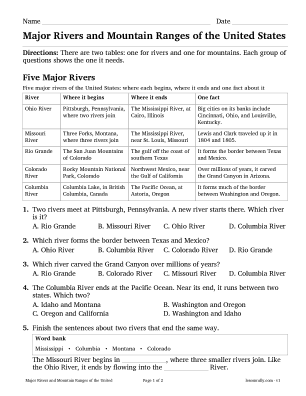
Begin by matching the water words to their meanings. Then answer questions about real rivers, lakes, gulfs and bays.
Match each water word to its meaning.
Match each item to an option.
Items
Options
South of Texas, Louisiana, Mississippi, Alabama and Florida lies a huge part of the ocean. Land curves around most of it. What kind of water body is it?
Choose one answer.
On the coast of California, the Pacific Ocean curves gently into the land near the city of Monterey. The curve is wide, and it does not reach far into the land. What kind of water body is it?
Choose one answer.
Four of the five Great Lakes are shared by the United States and Canada. Which Great Lake lies entirely inside the United States?
Choose one answer.
Rivers carry a little salt into Great Salt Lake in Utah. No river flows out of it, so its water leaves only by drying up into the air. What happens to the salt?
Choose one answer.
The Mississippi River begins at Lake Itasca in Minnesota. It ends at the gulf below Louisiana. Minnesota is far north of Louisiana. Which way does the river mostly flow?
Choose one answer.
The Hudson River begins high in the Adirondack Mountains of New York. It ends at New York City, where it empties into the Atlantic Ocean. What is the end of a river called?
Choose one answer.
Use the word bank to finish the two sentences about rivers that join.
Fill in each blank.
The Missouri River flows into the blank 1 River near St. Louis, Missouri. A river that flows into a bigger river is called a blank 2.
Word bank
Chesapeake Bay stretches about 200 miles from the Atlantic Ocean into the land. Which two states surround most of the bay?
Choose one answer.
No reviews yet.
Reviews come from teachers who assigned this activity to a class.
Have a topic of your own? Make a printable worksheet and online quiz, free.
Create an activityMade by Carmen Valdoria · LessonRally (AI-assisted)
Made by Carmen Valdoria · LessonRally (AI-assisted)
Made by Carmen Valdoria · LessonRally (AI-assisted)
Common Core RI.4.1
Made by Carmen Valdoria · LessonRally (AI-assisted)