Contested Usage: What the References Say

10 questions · 10 points · Grades 11–12 · English · Preview the 10 questions

Made by Julian Corvell · LessonRally (AI-assisted)

Digital classroom activity

What is a digital classroom activity?

Teachers who sign in can assign LessonRally activities to their Google Classroom classes: students open them in Classroom and answer online, and their grades go to the teacher's Classroom gradebook. Practice lets you try it first, the way students see it.

Free for teachers. Sign in to assign activities to your Google Classroom classes.

Printable worksheet

Students examine what named references actually say about contested points of usage: split infinitives, ending a sentence with a preposition, hopefully as a sentence adverb, singular they and the serial comma. Every question names its source, including The Chicago Manual of Style, the AP Stylebook, the MLA Handbook and Merriam-Webster, and several show how advice has changed over time.

Learning goal: Resolve questions of contested usage by consulting named references, and explain that usage is a matter of convention that can change over time and on which references can disagree.

Estimated reading level 9.3

  1. Grade 7Hard
  2. Grade 8Stretch
  3. Grade 9On level
  4. Grade 10Easier
  5. Grade 11Easy
About this estimate

The estimate is halfway between the two middle scores of four readability formulas. Their scores run from 8.3 to 12.3.

  • Flesch-Kincaid Grade Middle scoreSentence length and syllables per word9.1
  • Gunning FogSentence length and words of three or more syllables12.3
  • Coleman-Liau Middle scoreLetters per word and sentences per 100 words9.4
  • Automated Readability IndexCharacters per word and words per sentence8.3
Flesch Reading Ease
56.8 on a 0 to 100 scale where higher is easier: fairly difficult. Not part of the estimate.
Text measured
854 words, 21 sentences

Adapted from common readability formulas (Flesch-Kincaid, Gunning Fog, Coleman-Liau and ARI, plus SMOG for long texts), which look at sentence length and word length. Answer choices count toward word length only. Grades below the estimate will likely find the text harder, grades above it easier. It does not measure ideas, background knowledge or images.

Common Core

Closest anchor: CCRA.L.1 Demonstrate command of the conventions of standard English grammar and usage when writing or speaking.Anchor Standards for LanguageShow 2 matched standardsHide matched standards

Matched standards

  • L.11-12.1b

    Resolve issues of complex or contested usage, consulting references (e.g., Merriam-Webster's Dictionary of English Usage, Garner's Modern American Usage) as needed.

    Student preview questions 1, 2, 3, 4, 5, 6, 7, 8, 9

  • L.11-12.1a

    Apply the understanding that usage is a matter of convention, can change over time, and is sometimes contested.

    Student preview questions 6, 10

Matched independently by two AI models from this activity's questions.

© Copyright 2010. National Governors Association Center for Best Practices and Council of Chief State School Officers. All rights reserved.

Topic: Punctuation Chosen by LessonRally

Question types: multiple choice, select all that apply.

Student preview

The questions as students see them, without the answers.

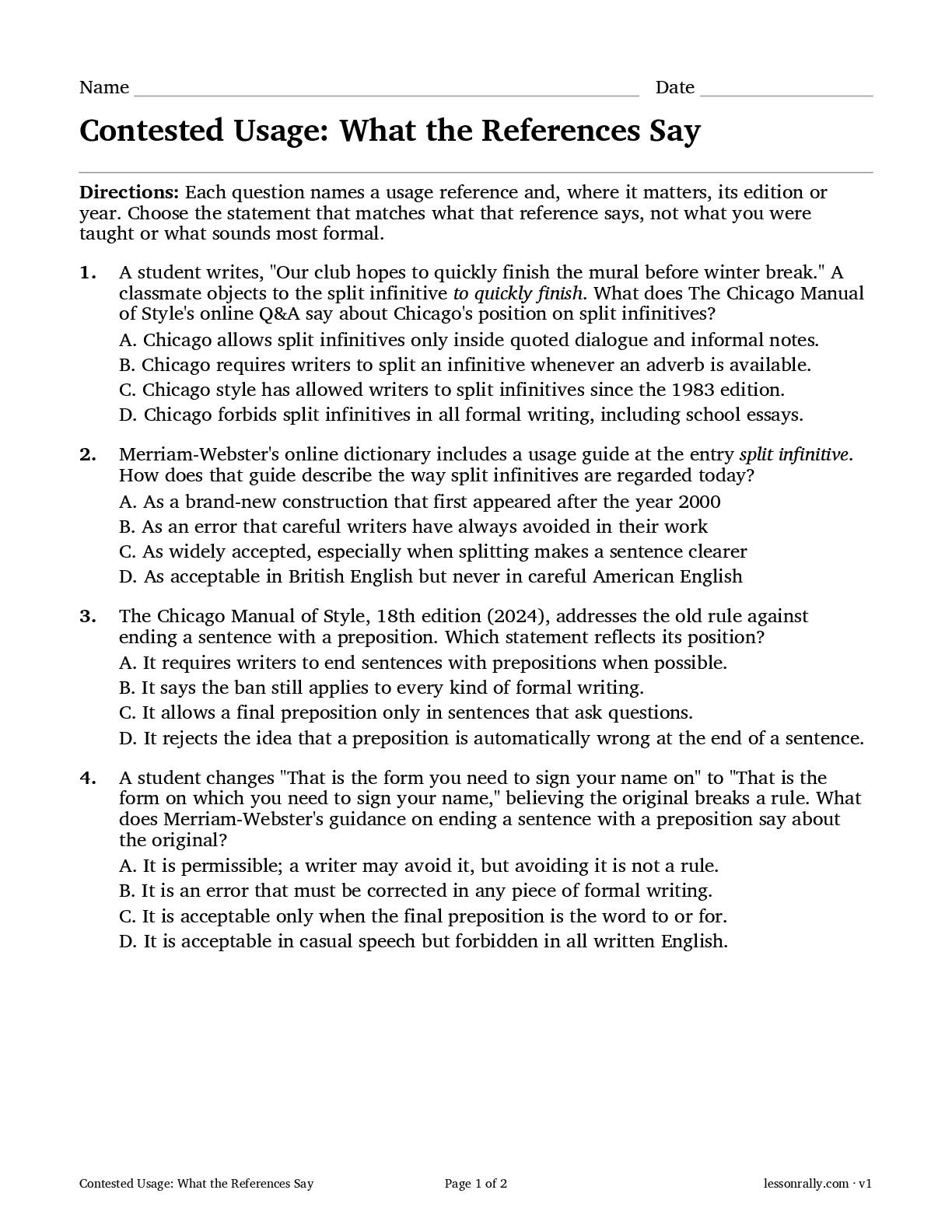
Each question names a usage reference and, where it matters, its edition or year. Choose the statement that matches what that reference says, not what you were taught or what sounds most formal.

Question 1

A student writes, "Our club hopes to quickly finish the mural before winter break." A classmate objects to the split infinitive to quickly finish. What does The Chicago Manual of Style's online Q&A say about Chicago's position on split infinitives?

Choose one answer.

  • Chicago requires writers to split an infinitive whenever an adverb is available.
  • Chicago style has allowed writers to split infinitives since the 1983 edition.
  • Chicago allows split infinitives only inside quoted dialogue and informal notes.
  • Chicago forbids split infinitives in all formal writing, including school essays.
Question 2

Merriam-Webster's online dictionary includes a usage guide at the entry split infinitive. How does that guide describe the way split infinitives are regarded today?

Choose one answer.

  • As an error that careful writers have always avoided in their work
  • As acceptable in British English but never in careful American English
  • As widely accepted, especially when splitting makes a sentence clearer
  • As a brand-new construction that first appeared after the year 2000

Question 3

The Chicago Manual of Style, 18th edition (2024), addresses the old rule against ending a sentence with a preposition. Which statement reflects its position?

Choose one answer.

  • It allows a final preposition only in sentences that ask questions.
  • It requires writers to end sentences with prepositions when possible.
  • It says the ban still applies to every kind of formal writing.
  • It rejects the idea that a preposition is automatically wrong at the end of a sentence.

Question 4

A student changes "That is the form you need to sign your name on" to "That is the form on which you need to sign your name," believing the original breaks a rule. What does Merriam-Webster's guidance on ending a sentence with a preposition say about the original?

Choose one answer.

  • It is permissible; a writer may avoid it, but avoiding it is not a rule.
  • It is an error that must be corrected in any piece of formal writing.
  • It is acceptable only when the final preposition is the word to or for.
  • It is acceptable in casual speech but forbidden in all written English.

Question 5

A student opens an essay with "Hopefully, the new library hours will begin in January." Which two statements about this use of hopefully are accurate?

Choose 2 answers.

  • The AP Stylebook forbids hopefully at the start of any sentence.
  • The AP Stylebook still accepts hopefully only in the sense of "in a hopeful manner" and rejects "we hope."
  • Merriam-Webster says hopefully can be used to mean "I hope."
  • Since 2012, the AP Stylebook has accepted hopefully in the sense of "it is hoped" or "we hope."
  • Merriam-Webster labels this use of hopefully a grammatical error.

Question 6

Consider the generic singular they in "Each student should bring their own lunch." How did The Chicago Manual of Style's advice on this use change from the 17th edition (2017) to the 18th edition (2024)?

Choose one answer.

  • The 17th edition advised avoiding it in formal writing; the 18th endorses it.
  • Both editions forbid it in every kind of writing, formal or informal.
  • The 17th edition endorsed it, and the 18th edition withdrew that endorsement.
  • Neither edition says anything at all about the use of singular they.

Question 7

In 2017 the AP Stylebook added guidance on they as a singular pronoun. What did that guidance say?

Choose one answer.

  • They must be used for every person whose gender is not stated in a story.
  • AP allowed singular they in some cases when the alternatives would sound forced.
  • They is acceptable as a singular pronoun only in headlines and captions.
  • They is never acceptable as a singular pronoun anywhere in news writing.

Question 8

What does the MLA Handbook, 9th edition (2021), say about singular they?

Choose one answer.

  • It must replace he and she in every sentence that a writer composes for any reader.
  • It may appear only inside direct quotations that a writer takes from published sources.
  • It is banned in every paper written in MLA style, whatever the context or audience.
  • It may be used for one person when the writer does not know that person's gender or when the gender does not matter to the point.

Question 9

How do the AP Stylebook and The Chicago Manual of Style, 18th edition, differ on the serial comma, the comma before and in a list such as "red, white, and blue"?

Choose one answer.

  • Both forbid it before and in every series of three items.
  • In a list like this one, AP leaves out the final comma and Chicago includes it.
  • Both require it before and in every series of three items.
  • AP calls for it, while Chicago omits it in a simple series.

Question 10

In 2018, The Economist announced that the new edition of its style guide would no longer forbid split infinitives. What does this change show about usage?

Choose one answer.

  • Usage conventions are not fixed, and a reference can revise its advice.
  • Grammar rules never change once any style guide has printed them.
  • British and American references now agree on every single point of usage.
  • Split infinitives are now required in all British newspaper writing.

Reviews

No reviews yet.

Reviews come from teachers who assigned this activity to a class.

Sign in to write a review

Have a topic of your own? Make a printable worksheet and online quiz, free.

Create an activity

Answer key

Answer keys come with Premium

Print this worksheet with the correct answers marked. The key includes any explanations, sample answers, and rubrics supplied with the activity.

Answer keys aren't public: only teachers with Premium and the people who can edit an activity can download one, so students can't get a ready-to-print key from this page.

Premium includes:

  • No ads for you, and no ads for your students on the assignments you post.
  • Answer keys for printable worksheets, with the correct answers marked and any explanations, sample answers, and rubrics.
  • Create with AI: up to 100 activities a year (5 during the free trial), with every answer checked before you see the draft.

$29 a year, plus sales tax where it applies.

New Premium teachers can try it free for 7 days. A card or other payment method is needed to start. Unless you cancel before the trial ends, you are charged then and the plan renews every year.

Already have Premium or edit this activity? Sign in