Credit Scores: What Helps and What Hurts

9 questions · 15 points · Grades 11–12 · English · Preview the 9 questions

Made by Greg Ostlund · LessonRally (AI-assisted)

Digital classroom activity

What is a digital classroom activity?

Teachers who sign in can assign LessonRally activities to their Google Classroom classes: students open them in Classroom and answer online, and their grades go to the teacher's Classroom gradebook. Practice lets you try it first, the way students see it.

Free for teachers. Sign in to assign activities to your Google Classroom classes.
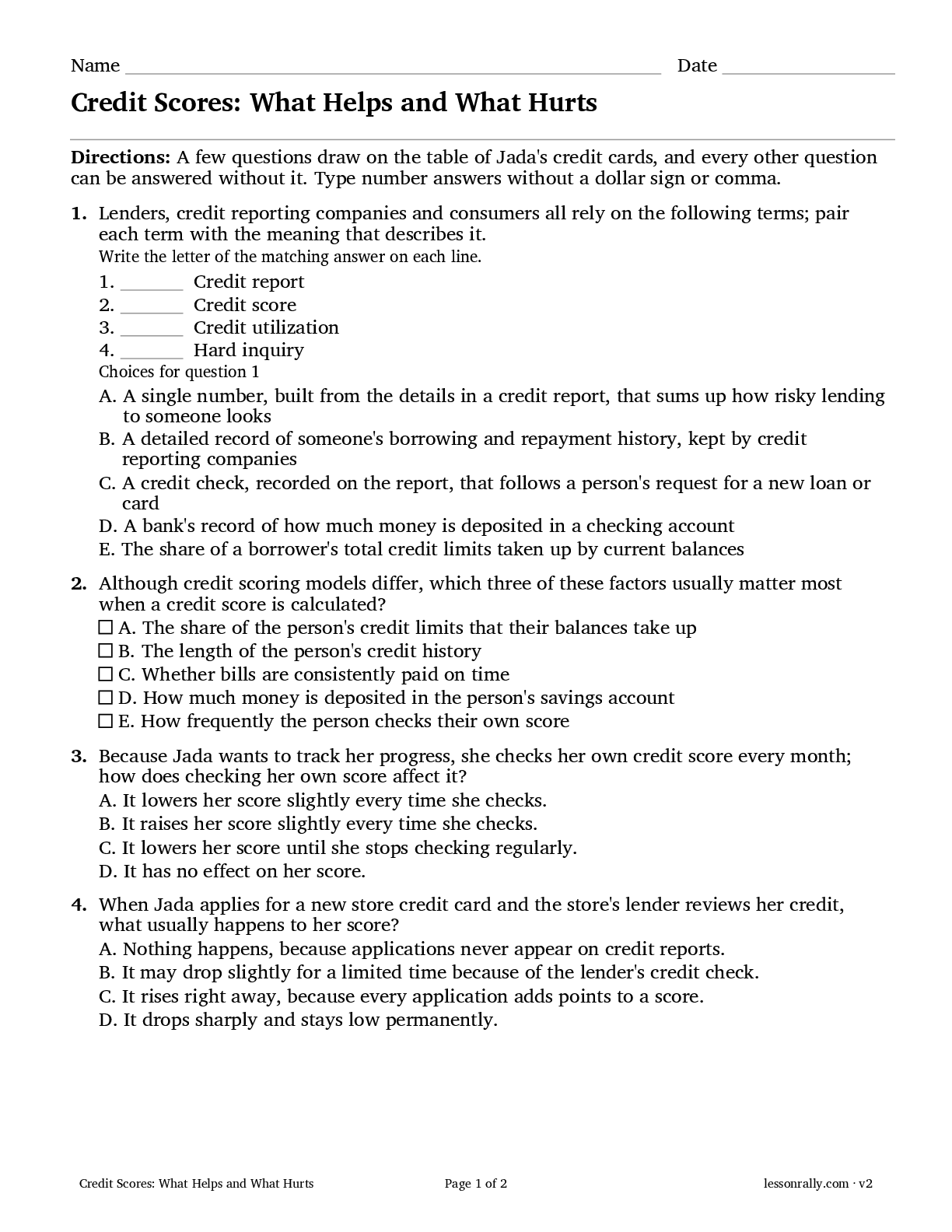
Printable worksheet

Students match credit report and credit score terms, sort habits by the effect they usually have on a score, and see that checking your own score does not lower it while applying for new credit can lower it a little for a time. A table of two credit cards lets them compare paying down a balance with closing an old card, using the numbers.

Learning goal: Explain what usually helps and hurts a credit score, including payment history, credit use and length of credit history, and use numbers to compare how two moves change available credit.

Estimated reading level 10.2

  1. Grade 8Hard
  2. Grade 9Stretch
  3. Grade 10On level
  4. Grade 11Easier
  5. Grade 12Easy
About this estimate

The estimate is halfway between the two middle scores of four readability formulas. Their scores run from 9.5 to 11.6.

  • Flesch-Kincaid Grade Middle scoreSentence length and syllables per word10.1
  • Gunning FogSentence length and words of three or more syllables11.6
  • Coleman-LiauLetters per word and sentences per 100 words9.5
  • Automated Readability Index Middle scoreCharacters per word and words per sentence10.3
Flesch Reading Ease
59.2 on a 0 to 100 scale where higher is easier: fairly difficult. Not part of the estimate.
Text measured
655 words, 13 sentences

Adapted from common readability formulas (Flesch-Kincaid, Gunning Fog, Coleman-Liau and ARI, plus SMOG for long texts), which look at sentence length and word length. Answer choices count toward word length only. Grades below the estimate will likely find the text harder, grades above it easier. It does not measure ideas, background knowledge or images.

Topic: Personal Finance Chosen by LessonRally

Question types: matching, select all that apply, multiple choice, number answer.

Student preview

The questions as students see them, without the answers.

A few questions draw on the table of Jada's credit cards, and every other question can be answered without it. Type number answers without a dollar sign or comma.

Question 1

Lenders, credit reporting companies and consumers all rely on the following terms; pair each term with the meaning that describes it.

Match each item to an option.

Items

  1. Credit report
  2. Credit score
  3. Credit utilization
  4. Hard inquiry

Options

  1. The share of a borrower's total credit limits taken up by current balances
  2. A single number, built from the details in a credit report, that sums up how risky lending to someone looks
  3. A credit check, recorded on the report, that follows a person's request for a new loan or card
  4. A bank's record of how much money is deposited in a checking account
  5. A detailed record of someone's borrowing and repayment history, kept by credit reporting companies

Question 2

Although credit scoring models differ, which three of these factors usually matter most when a credit score is calculated?

Choose 3 answers.

  • Whether bills are consistently paid on time
  • The share of the person's credit limits that their balances take up
  • How frequently the person checks their own score
  • The length of the person's credit history
  • How much money is deposited in the person's savings account

Question 3

Because Jada wants to track her progress, she checks her own credit score every month; how does checking her own score affect it?

Choose one answer.

  • It has no effect on her score.
  • It lowers her score slightly every time she checks.
  • It raises her score slightly every time she checks.
  • It lowers her score until she stops checking regularly.

Question 4

When Jada applies for a new store credit card and the store's lender reviews her credit, what usually happens to her score?

Choose one answer.

  • It may drop slightly for a limited time because of the lender's credit check.
  • It drops sharply and stays low permanently.
  • It rises right away, because every application adds points to a score.
  • Nothing happens, because applications never appear on credit reports.

Question 5

Credit habits can help a score, hurt it or leave it unchanged; match each habit with the effect it usually has.

Match each item to an option.

Items

  1. Paying every bill on time
  2. Missing loan or card payments
  3. Checking your own score
  4. Applying for a new credit card

Options

  1. If reported as late, can hurt a score for years through the payment history
  2. Raises a score immediately and keeps it high permanently
  3. Can lead to a hard inquiry that lowers a score slightly for a limited time
  4. Has no effect on a score whatsoever
  5. Usually strengthens a score gradually over time

Jada's Two Credit Cards

Jada's two credit cards, showing each card's credit limit, current balance and how many years it has been open. Credit scoring models differ from one another, so this activity names none of them and describes only what usually helps or hurts a score.
CardCredit limit (dollars)Current balance (dollars)Years open
Card 1, her first card3,00006
Card 22,0001,6001

Question 6

Adding together both of Jada's cards, how much of her combined credit limit is she not currently using? Type your answer without a comma.

Enter a number.

dollars

Question 7

Jada is choosing between two moves: Move A is paying $1,000 toward Card 2's balance, and Move B is closing Card 1, her oldest card, which has a $0 balance. Assuming she makes no new purchases, which move would leave her more unused credit across her remaining open cards, and by how much?

Choose one answer.

  • Move A, by $1,000
  • The two moves would leave the same amount of unused credit
  • Move B, by $4,000
  • Move A, by $4,000

Question 8

After discovering a late payment on her credit report for a bill she actually paid on time, what can Jada do to get the mistake corrected?

Choose one answer.

  • Pay a fee to have her entire credit history erased
  • Close every one of her accounts so the error disappears
  • Dispute the error with the credit reporting company and with the company that reported it
  • Nothing, because information on a credit report can never be changed

Question 9

Since Leo has never had a credit card or a loan of any kind, why might a lender have trouble finding a credit score for him?

Choose one answer.

  • Only people with savings accounts can have credit scores.
  • His score is automatically zero until he applies for credit.
  • A score is calculated from credit history, and he has little or none yet.
  • Credit scores are given only to people older than 30.

Reviews

No reviews yet.

Reviews come from teachers who assigned this activity to a class.

Sign in to write a review

Have a topic of your own? Make a printable worksheet and online quiz, free.

Create an activity

Answer key

Answer keys come with Premium

Print this worksheet with the correct answers marked. The key includes any explanations, sample answers, and rubrics supplied with the activity.

Answer keys aren't public: only teachers with Premium and the people who can edit an activity can download one, so students can't get a ready-to-print key from this page.

Premium includes:

  • No ads for you, and no ads for your students on the assignments you post.
  • Answer keys for printable worksheets, with the correct answers marked and any explanations, sample answers, and rubrics.
  • Create with AI: up to 100 activities a year (5 during the free trial), with every answer checked before you see the draft.

$29 a year, plus sales tax where it applies.

New Premium teachers can try it free for 7 days. A card or other payment method is needed to start. Unless you cancel before the trial ends, you are charged then and the plan renews every year.

Already have Premium or edit this activity? Sign in