Question 1
Monthly credit card statements display all of these terms; match each term to the definition that explains it.
Match each item to an option.
Items
- Statement balance
- Minimum payment
- Payment due date
- Credit limit
Options


Teachers who sign in can assign LessonRally activities to their Google Classroom classes: students open them in Classroom and answer online, and their grades go to the teacher's Classroom gradebook. Practice lets you try it first, the way students see it.
Free for teachers. Sign in to assign activities to your Google Classroom classes.
 (opens in a new tab)
2 pages · Student copy, no answers
Print worksheet (opens in a new tab)Answer keyPremiumStudents read a credit card statement to find available credit, then follow what happens when the cardholder pays in full, pays only the minimum payment or misses the payment, using an example interest rule of 2% of the unpaid balance each month. They match statement terms and card fees, and compare two payment amounts by the interest each one leads to.
Learning goal: Read a credit card statement and calculate how payment choices affect interest, fees and the next balance under an example monthly interest rule, and explain why paying only the minimum costs more.
The estimate is halfway between the two middle scores of four readability formulas. Their scores run from 7.7 to 10.8.
Adapted from common readability formulas (Flesch-Kincaid, Gunning Fog, Coleman-Liau and ARI, plus SMOG for long texts), which look at sentence length and word length. Answer choices count toward word length only. Grades below the estimate will likely find the text harder, grades above it easier. It does not measure ideas, background knowledge or images.
Topic: Personal Finance Chosen by LessonRally
Question types: matching, number answer, multiple choice, select all that apply.
The questions as students see them, without the answers.
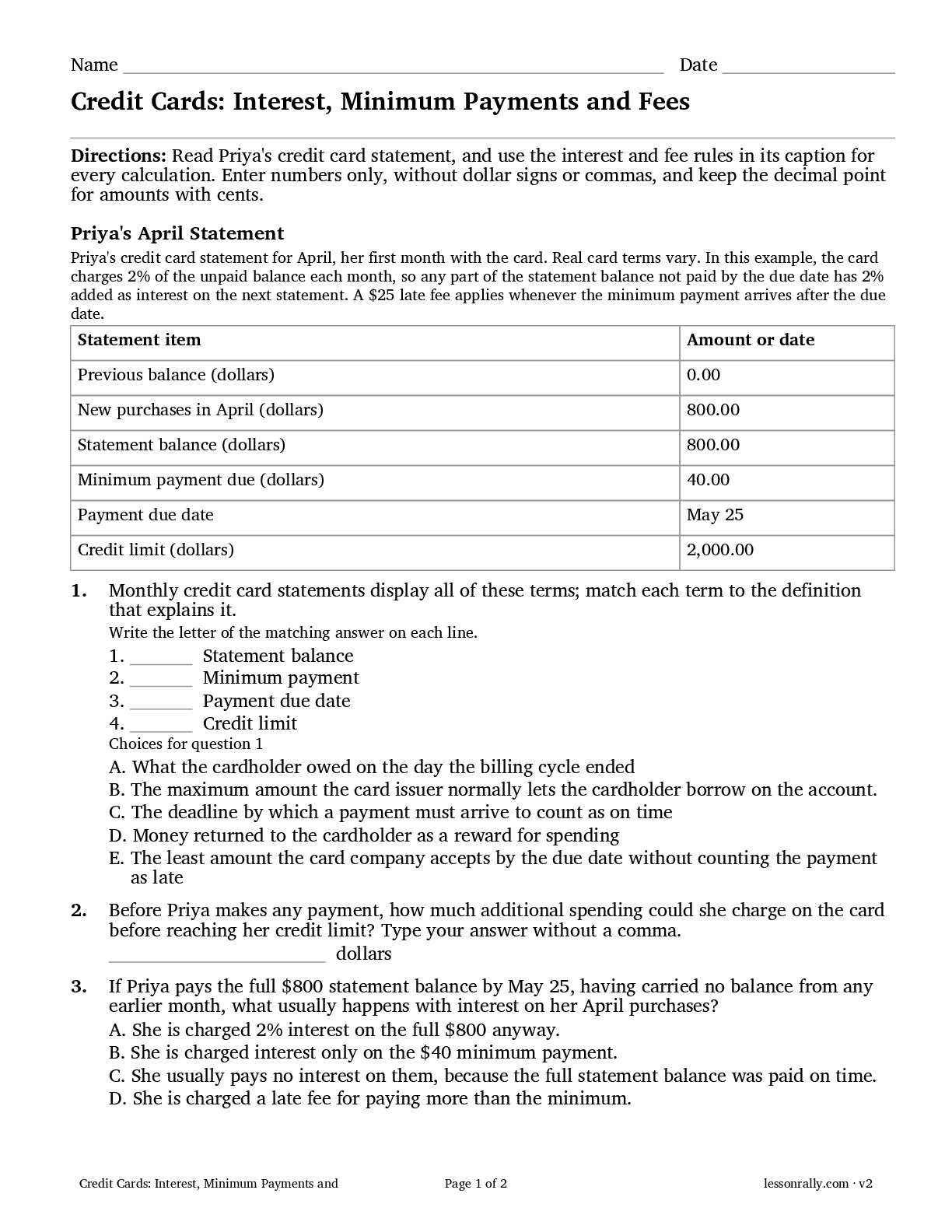
Read Priya's credit card statement, and use the interest and fee rules in its caption for every calculation. Enter numbers only, without dollar signs or commas, and keep the decimal point for amounts with cents.
| Statement item | Amount or date |
|---|---|
| Previous balance (dollars) | 0.00 |
| New purchases in April (dollars) | 800.00 |
| Statement balance (dollars) | 800.00 |
| Minimum payment due (dollars) | 40.00 |
| Payment due date | May 25 |
| Credit limit (dollars) | 2,000.00 |
Monthly credit card statements display all of these terms; match each term to the definition that explains it.
Match each item to an option.
Items
Options
Before Priya makes any payment, how much additional spending could she charge on the card before reaching her credit limit? Type your answer without a comma.
Enter a number.
dollars
If Priya pays the full $800 statement balance by May 25, having carried no balance from any earlier month, what usually happens with interest on her April purchases?
Choose one answer.
Suppose instead that Priya pays only the $40 minimum by May 25; which two results follow under the terms described in the statement's caption?
Choose 2 answers.
Priya pays the $40 minimum by May 25. How much of her $800 statement balance is still unpaid when the deadline passes?
Enter a number.
dollars
Priya pays only the $40 minimum by May 25. Under the card’s rule of 2% of the unpaid balance each month, how much interest will the card add?
Enter a number.
dollars
Priya pays the $40 minimum by May 25. She makes no other payments or new purchases before her next statement closes. What will her next statement balance be after interest is added?
Enter a number.
dollars
Credit card agreements describe several different charges, so connect each charge with the explanation of what it is.
Match each item to an option.
Items
Options
Priya makes no payments or new purchases before her next statement closes. She misses the May 25 deadline, so the card adds 2% interest on the full $800 and a $25 late fee. What is her next statement balance?
Enter a number.
dollars
Priya is deciding whether to pay $400 or just the $40 minimum by May 25. Under the example rule of 2% of the unpaid balance each month, which payment leads to the smaller interest charge on her next statement, and by how much?
Choose one answer.
No reviews yet.
Reviews come from teachers who assigned this activity to a class.
Have a topic of your own? Make a printable worksheet and online quiz, free.
Create an activityMade by Greg Ostlund · LessonRally (AI-assisted)
Made by Greg Ostlund · LessonRally (AI-assisted)
Made by Greg Ostlund · LessonRally (AI-assisted)
Made by Greg Ostlund · LessonRally (AI-assisted)