Question 1
Once the first year's interest has been added to her balance, how much will Amara's account hold at the end of its first year? Type your answer without a comma.
Enter a number.
dollars


Teachers who sign in can assign LessonRally activities to their Google Classroom classes: students open them in Classroom and answer online, and their grades go to the teacher's Classroom gradebook. Practice lets you try it first, the way students see it.
Free for teachers. Sign in to assign activities to your Google Classroom classes.
 (opens in a new tab)
2 pages · Student copy, no answers
Print worksheet (opens in a new tab)Answer keyPremiumStudents follow three savings accounts that compound interest once a year, finding each year's interest, ending balances and total interest over two or three years. They compare simple and compound interest on the same deposit and rate, match terms such as compounding period and principal, and see how rate and time affect growth.
Learning goal: Calculate balances and interest for savings that compound once a year over up to three years, and compare compound interest with simple interest on the same numbers.
© Copyright 2010. National Governors Association Center for Best Practices and Council of Chief State School Officers. All rights reserved.
Topics: Exponential Growth and Decay, Percents Chosen by LessonRally
Question types: number answer, multiple choice, matching, select all that apply.
The questions as students see them, without the answers.
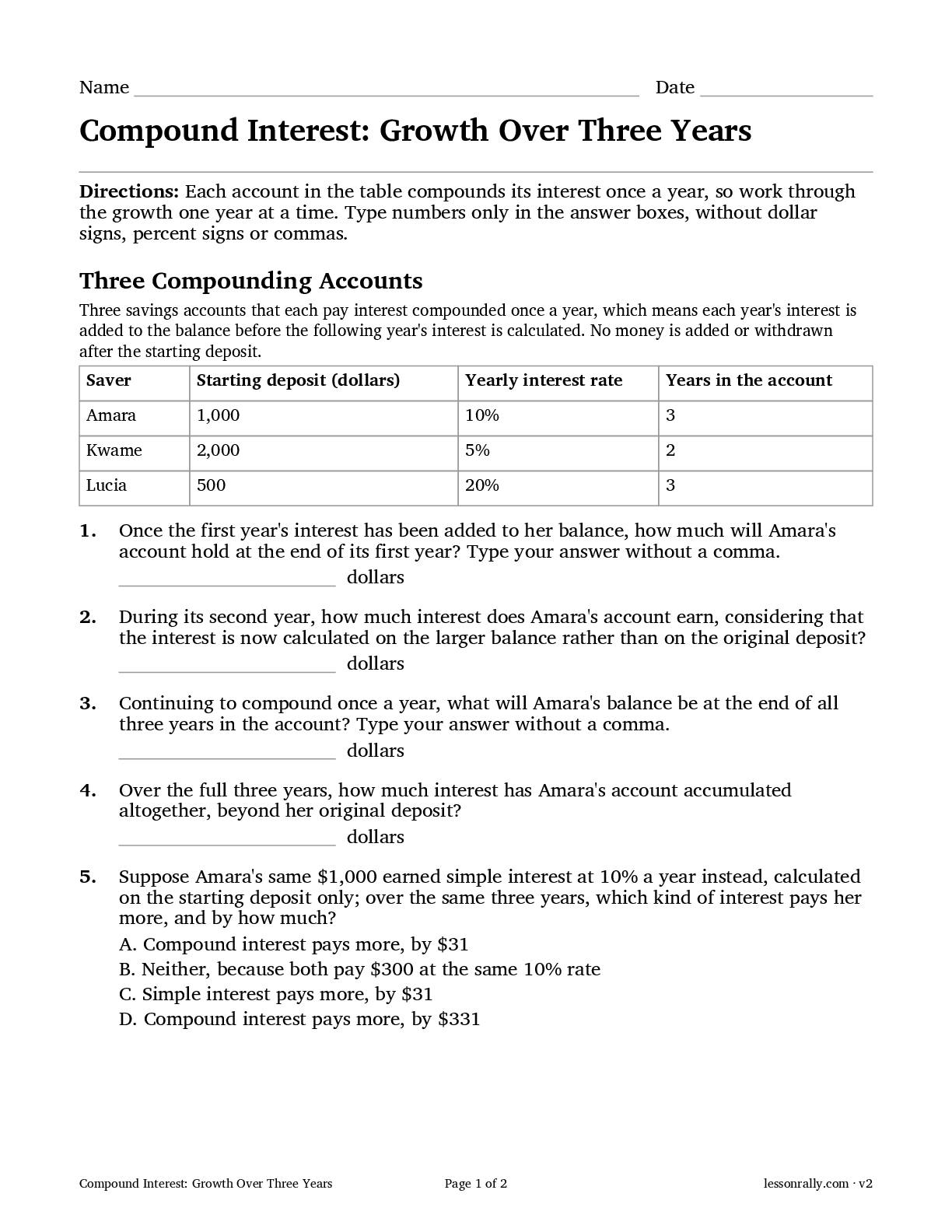
Each account in the table compounds its interest once a year, so work through the growth one year at a time. Type numbers only in the answer boxes, without dollar signs, percent signs or commas.
| Saver | Starting deposit (dollars) | Yearly interest rate | Years in the account |
|---|---|---|---|
| Amara | 1,000 | 10% | 3 |
| Kwame | 2,000 | 5% | 2 |
| Lucia | 500 | 20% | 3 |
Once the first year's interest has been added to her balance, how much will Amara's account hold at the end of its first year? Type your answer without a comma.
Enter a number.
dollars
During its second year, how much interest does Amara's account earn, considering that the interest is now calculated on the larger balance rather than on the original deposit?
Enter a number.
dollars
Continuing to compound once a year, what will Amara's balance be at the end of all three years in the account? Type your answer without a comma.
Enter a number.
dollars
Over the full three years, how much interest has Amara's account accumulated altogether, beyond her original deposit?
Enter a number.
dollars
Suppose Amara's same $1,000 earned simple interest at 10% a year instead, calculated on the starting deposit only; over the same three years, which kind of interest pays her more, and by how much?
Choose one answer.
Pair each term that describes how savings accounts grow with the definition that matches it.
Match each item to an option.
Items
Options
Which two statements describe how Amara's account compounds during the three years shown?
Choose 2 answers.
Kwame's account compounds once a year for its two years, so what will his balance be when those two years are finished? Type your answer without a comma.
Enter a number.
dollars
Although Lucia's deposit is the smallest, it earns a considerably higher rate; what will her balance be after three years of compounding once a year?
Enter a number.
dollars
Allowing each account to grow for its own number of years shown in the table, whose account earns the most interest in total among the three savers?
Choose one answer.
No reviews yet.
Reviews come from teachers who assigned this activity to a class.
Have a topic of your own? Make a printable worksheet and online quiz, free.
Create an activityMade by Greg Ostlund · LessonRally (AI-assisted)