Question 1
Match each word from the passage to its meaning.
Match each item to an option.
Items
- Right
- Responsibility
- Citizen
- Jury
Options


Teachers who sign in can assign LessonRally activities to their Google Classroom classes: students open them in Classroom and answer online, and their grades go to the teacher's Classroom gradebook. Practice lets you try it first, the way students see it.
Free for teachers. Sign in to assign activities to your Google Classroom classes.
 (opens in a new tab)
2 pages · Student copy, no answers
Print worksheet (opens in a new tab)Answer keyPremiumStudents read a short passage about rights and responsibilities in the United States. They tell which rights belong to everyone who lives in the country and which belong only to citizens, apply the rule for voting for president, and name responsibilities for grown-ups and kids.
Learning goal: Tell the difference between a right and a responsibility, name rights that belong to everyone and a right that belongs only to citizens, and give examples of responsibilities.
The estimate is the middle score of five readability formulas. Their scores run from 2.5 to 8.1.
Adapted from common readability formulas (Flesch-Kincaid, Gunning Fog, Coleman-Liau and ARI, plus SMOG for long texts), which look at sentence length and word length. Answer choices count toward word length only. Grades below the estimate will likely find the text harder, grades above it easier. It does not measure ideas, background knowledge or images.
Ask and answer questions to demonstrate understanding of a text, referring explicitly to the text as the basis for the answers.
Determine the meaning of general academic and domain-specific words and phrases in a text relevant to a grade 3 topic or subject area.
Student preview question 1
Matched independently by two AI models from this activity's questions.
© Copyright 2010. National Governors Association Center for Best Practices and Council of Chief State School Officers. All rights reserved.
Topic: Government and Citizenship Chosen by LessonRally
Question types: matching, multiple choice, fill in the blank.
The questions as students see them, without the answers.
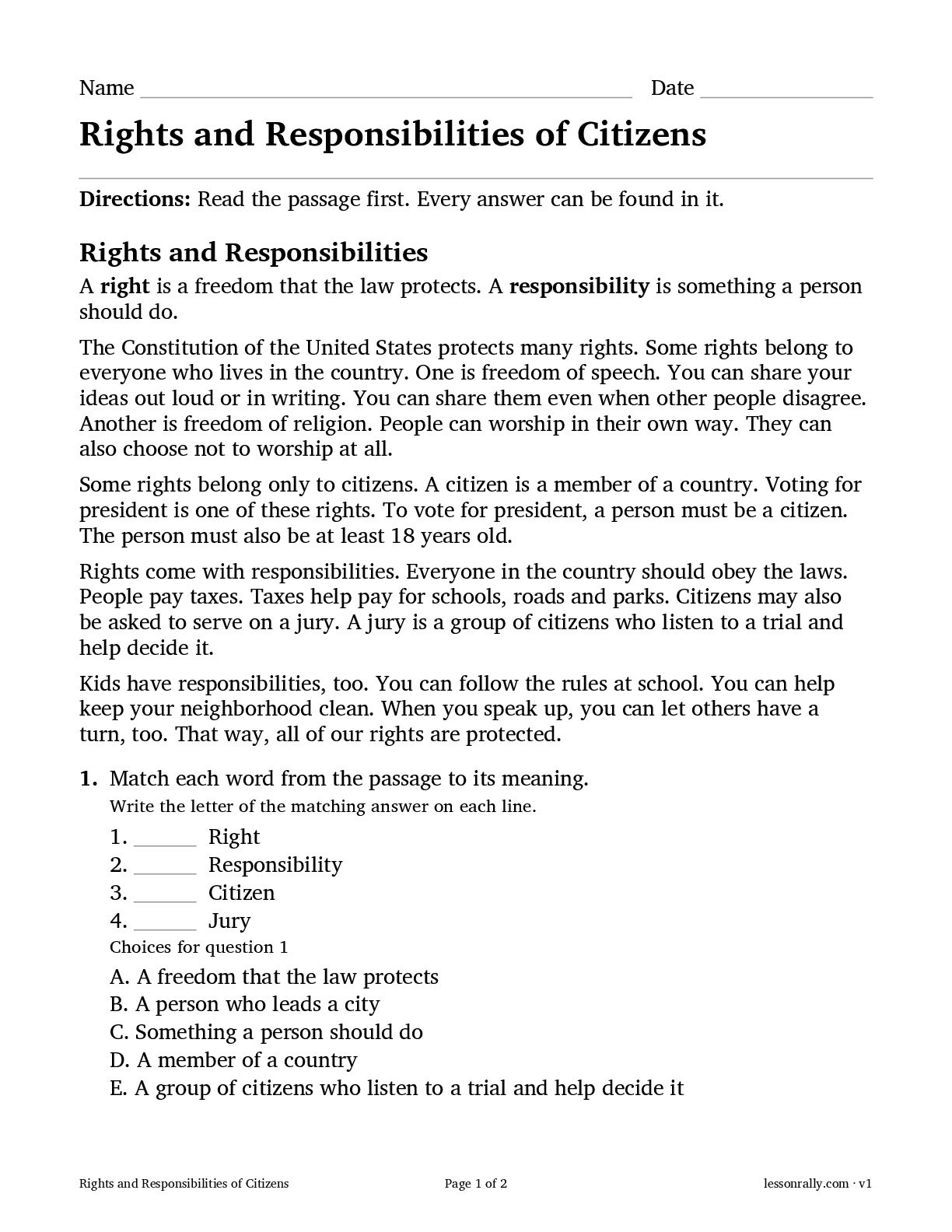
Read the passage first. Every answer can be found in it.
A right is a freedom that the law protects. A responsibility is something a person should do.
The Constitution of the United States protects many rights. Some rights belong to everyone who lives in the country. One is freedom of speech. You can share your ideas out loud or in writing. You can share them even when other people disagree. Another is freedom of religion. People can worship in their own way. They can also choose not to worship at all.
Some rights belong only to citizens. A citizen is a member of a country. Voting for president is one of these rights. To vote for president, a person must be a citizen. The person must also be at least 18 years old.
Rights come with responsibilities. Everyone in the country should obey the laws. People pay taxes. Taxes help pay for schools, roads and parks. Citizens may also be asked to serve on a jury. A jury is a group of citizens who listen to a trial and help decide it.
Kids have responsibilities, too. You can follow the rules at school. You can help keep your neighborhood clean. When you speak up, you can let others have a turn, too. That way, all of our rights are protected.
Match each word from the passage to its meaning.
Match each item to an option.
Items
Options
Which right belongs to everyone who lives in the country?
Choose one answer.
What does freedom of religion let people do?
Choose one answer.
Ben does not like his friend's idea for a class project. Can his friend still share the idea?
Choose one answer.
Maya is a citizen of the United States. She is 9 years old. Why can't she vote for president yet?
Choose one answer.
Which responsibility belongs to everyone in the country?
Choose one answer.
Use words from the passage to fill in the blanks.
Fill in each blank.
People pay blank 1 to help pay for schools, roads and parks. At school, kids can show responsibility by following the blank 2.
Word bank
According to the passage, what is one way kids can help their neighborhood?
Choose one answer.
The passage says that when you speak up, you can let others have a turn, too. Why does that matter?
Choose one answer.
No reviews yet.
Reviews come from teachers who assigned this activity to a class.
Have a topic of your own? Make a printable worksheet and online quiz, free.
Create an activityMade by Carmen Valdoria · LessonRally (AI-assisted)
Made by Carmen Valdoria · LessonRally (AI-assisted)
Made by Carmen Valdoria · LessonRally (AI-assisted)
Made by Carmen Valdoria · LessonRally (AI-assisted)