Question 1
Match each item to its job or purpose.
Match each item to an option.
Items
- Legislative branch
- Executive branch
- Judicial branch
- The Constitution
Options


Teachers who sign in can assign LessonRally activities to their Google Classroom classes: students open them in Classroom and answer online, and their grades go to the teacher's Classroom gradebook. Practice lets you try it first, the way students see it.
Free for teachers. Sign in to assign activities to your Google Classroom classes.
 (opens in a new tab)
2 pages · Student copy, no answers
Print worksheet (opens in a new tab)Answer keyPremiumStudents use two tables, one on the three branches of the national government and one on ways each branch can check another. They match each branch to its job, follow a bill through a veto and an override, and explain why the Constitution divides power among three branches.
Learning goal: Name the three branches of the national government and their jobs, and explain how checks and balances keep any one branch from becoming too powerful.
The estimate is halfway between the two middle scores of four readability formulas. Their scores run from 3.6 to 7.0.
Adapted from common readability formulas (Flesch-Kincaid, Gunning Fog, Coleman-Liau and ARI, plus SMOG for long texts), which look at sentence length and word length. Answer choices count toward word length only. Grades below the estimate will likely find the text harder, grades above it easier. It does not measure ideas, background knowledge or images.
Explain the relationships or interactions between two or more individuals, events, ideas, or concepts in a historical, scientific, or technical text based on specific information in the text.
Matched independently by two AI models from this activity's questions.
© Copyright 2010. National Governors Association Center for Best Practices and Council of Chief State School Officers. All rights reserved.
Topic: Government and Citizenship Chosen by LessonRally
Question types: matching, multiple choice, fill in the blank.
The questions as students see them, without the answers.
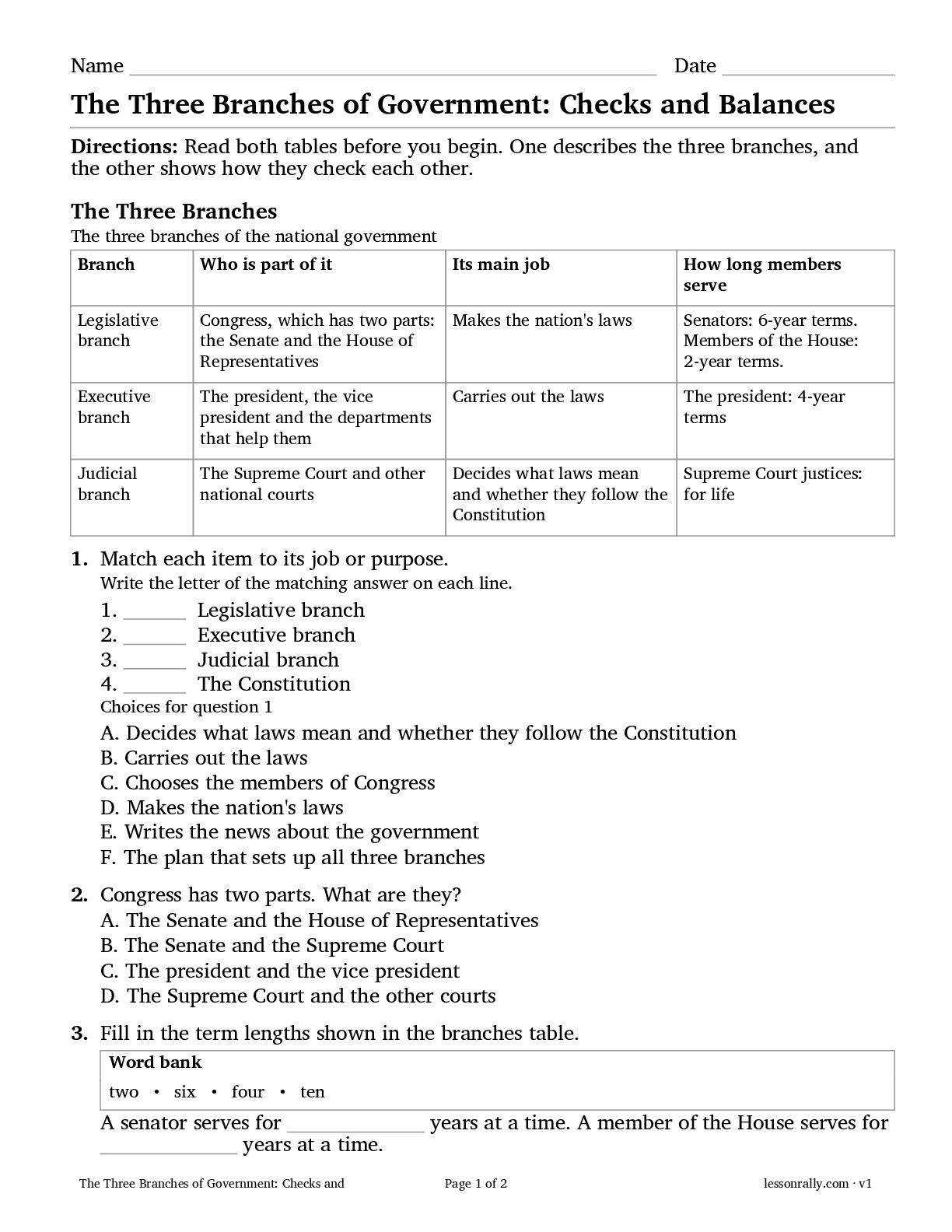
Read both tables before you begin. One describes the three branches, and the other shows how they check each other.
| Branch | Who is part of it | Its main job | How long members serve |
|---|---|---|---|
| Legislative branch | Congress, which has two parts: the Senate and the House of Representatives | Makes the nation's laws | Senators: 6-year terms. Members of the House: 2-year terms. |
| Executive branch | The president, the vice president and the departments that help them | Carries out the laws | The president: 4-year terms |
| Judicial branch | The Supreme Court and other national courts | Decides what laws mean and whether they follow the Constitution | Supreme Court justices: for life |
Match each item to its job or purpose.
Match each item to an option.
Items
Options
Congress has two parts. What are they?
Choose one answer.
Fill in the term lengths shown in the branches table.
Fill in each blank.
A senator serves for blank 1 years at a time. A member of the House serves for blank 2 years at a time.
Word bank
Supreme Court justices can serve for life. Which branch are they part of?
Choose one answer.
| Branch | A way it can check another branch |
|---|---|
| Executive branch | The president can veto, or reject, a bill that Congress passes. |
| Legislative branch | Congress can override a veto. If two-thirds of the Senate and two-thirds of the House vote for the bill, it becomes a law anyway. |
| Legislative branch | The Senate votes on whether to approve the people the president chooses to be judges. |
| Judicial branch | Courts can decide that a law does not follow the Constitution. |
Congress passes a bill, and the president vetoes it. What does veto mean?
Choose one answer.
The president vetoes a bill. How can the bill still become a law?
Choose one answer.
The president chooses a person to be a judge. Which group votes on whether to approve that choice?
Choose one answer.
A court decides that a law made by Congress does not follow the Constitution. Who is checking whom?
Choose one answer.
Why does the Constitution divide power among three branches?
Choose one answer.
No reviews yet.
Reviews come from teachers who assigned this activity to a class.
Have a topic of your own? Make a printable worksheet and online quiz, free.
Create an activityMade by Carmen Valdoria · LessonRally (AI-assisted)