Question 1
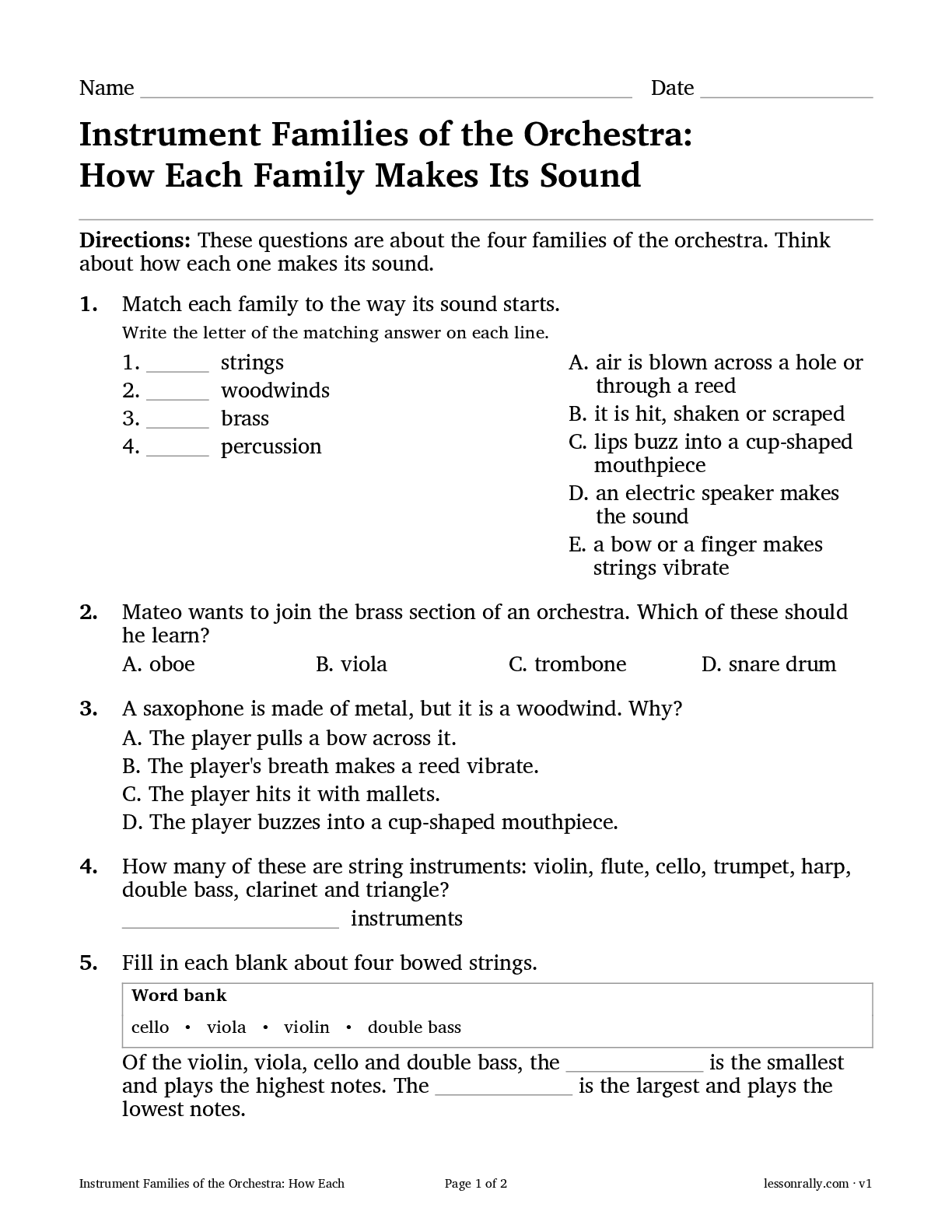
Match each family to the way its sound starts.
Match each item to an option.
Items
- strings
- woodwinds
- brass
- percussion
Options


Teachers who sign in can assign LessonRally activities to their Google Classroom classes: students open them in Classroom and answer online, and their grades go to the teacher's Classroom gradebook. Practice lets you try it first, the way students see it.
Free for teachers. Sign in to assign activities to your Google Classroom classes.
 (opens in a new tab)
2 pages · Student copy, no answers
Print worksheet (opens in a new tab)Answer keyPremiumStudents sort instruments into the four families of the orchestra (strings, woodwinds, brass and percussion) by how each instrument starts its sound. They count the string instruments in a list, compare sizes and pitches within a family, and find out why a metal saxophone is a woodwind and a wooden alphorn is brass.
Learning goal: Sort instruments into the string, woodwind, brass and percussion families by how each one starts its sound.
The estimate is halfway between the two middle scores of four readability formulas. Their scores run from 4.2 to 8.4.
Adapted from common readability formulas (Flesch-Kincaid, Gunning Fog, Coleman-Liau and ARI, plus SMOG for long texts), which look at sentence length and word length. Answer choices count toward word length only. Grades below the estimate will likely find the text harder, grades above it easier. It does not measure ideas, background knowledge or images.
Topic: Music Chosen by LessonRally
Question types: matching, multiple choice, number answer, fill in the blank.
The questions as students see them, without the answers.
These questions are about the four families of the orchestra. Think about how each one makes its sound.
Match each family to the way its sound starts.
Match each item to an option.
Items
Options
Mateo wants to join the brass section of an orchestra. Which of these should he learn?
Choose one answer.
A saxophone is made of metal, but it is a woodwind. Why?
Choose one answer.
How many of these are string instruments: violin, flute, cello, trumpet, harp, double bass, clarinet and triangle?
Enter a number.
instruments
Fill in each blank about four bowed strings.
Fill in each blank.
Of the violin, viola, cello and double bass, the blank 1 is the smallest and plays the highest notes. The blank 2 is the largest and plays the lowest notes.
Word bank
Which of these belongs in the percussion section?
Choose one answer.
Choose the words that show how two brass players change notes.
Fill in each blank.
A trombone player moves a long blank 1 in and out to change notes. A trumpet player presses blank 2 to change notes.
Word bank
Which of these brass instruments is the biggest and plays the lowest notes?
Choose one answer.
Some percussion instruments can play a tune, but others cannot. Which of these can play a tune?
Choose one answer.
The alphorn is a very long wooden horn from Switzerland. Players buzz their lips into its cup-shaped mouthpiece. Which family is it in?
Choose one answer.
No reviews yet.
Reviews come from teachers who assigned this activity to a class.
Have a topic of your own? Make a printable worksheet and online quiz, free.
Create an activityMade by Miles Penhallow · LessonRally (AI-assisted)
Made by Miles Penhallow · LessonRally (AI-assisted)
Made by Miles Penhallow · LessonRally (AI-assisted)
Made by Miles Penhallow · LessonRally (AI-assisted)