Made by Darius Pembrook · LessonRally (AI-assisted)
Digital classroom activity
What is a digital classroom activity?
Teachers who sign in can assign LessonRally activities to their Google Classroom classes: students open them in Classroom and answer online, and their grades go to the teacher's Classroom gradebook. Practice lets you try it first, the way students see it.
An 8-question exit ticket on deciding whether a relationship is proportional. Students test each table for equivalent ratios, check whether an equation has the form y = kx, fix or complete a table so it shows a proportional relationship, and find the mistake in a student's ratio check.
Learning goal: Decide whether two quantities are in a proportional relationship by testing a table for equivalent ratios or checking an equation.
Common Core
Press Ctrl+C or Command+C to copy.
Closest cluster:7.RP.AAnalyze proportional relationships and use them to solve real-world and mathematical problems.Ratios and Proportional RelationshipsShow 2 matched standardsHide matched standards
Decide whether two quantities are in a proportional relationship, e.g., by testing for equivalent ratios in a table or graphing on a coordinate plane and observing whether the graph is a straight line through the origin.
Question types: multiple choice, number answer, select all that apply.
Student preview
The questions as students see them, without the answers.
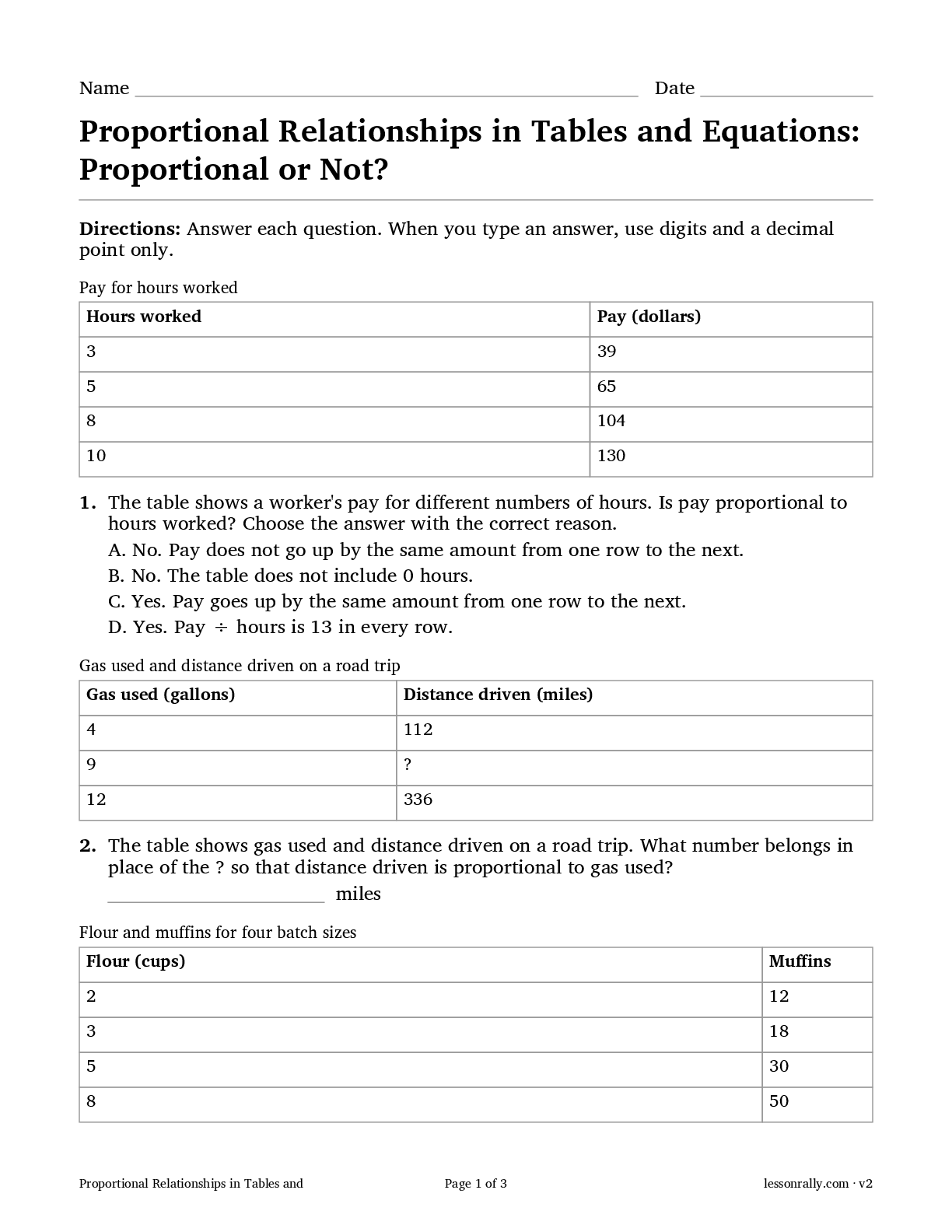
Answer each question. When you type an answer, use digits and a decimal point only.
Question 1
Pay for hours worked
Hours worked
Pay (dollars)
3
39
5
65
8
104
10
130
The table shows a worker's pay for different numbers of hours. Is pay proportional to hours worked? Choose the answer with the correct reason.
Choose one answer.
Yes. Pay goes up by the same amount from one row to the next.
No. Pay does not go up by the same amount from one row to the next.
Yes. Pay ÷ hours is 13 in every row.
No. The table does not include 0 hours.
Question 2
Gas used and distance driven on a road trip
Gas used (gallons)
Distance driven (miles)
4
112
9
?
12
336
The table shows gas used and distance driven on a road trip. What number belongs in place of the ? so that distance driven is proportional to gas used?
Enter a number.
miles
Question 3
Flour and muffins for four batch sizes
Flour (cups)
Muffins
2
12
3
18
5
30
8
50
One row of the table keeps muffins from being proportional to cups of flour. How many muffins should that row show for the relationship to be proportional?
Enter a number.
muffins
Question 4
At a bowling alley, the cost C, in dollars, for a party of p players is C = 8p + 6. Which statement about the cost is true?
Choose one answer.
Cost is proportional to players, because the cost goes up $8 for each player.
Cost is proportional to players, with a constant of proportionality of 8.
Cost is not proportional to players, because the cost goes up by a different amount for each player.
Cost is not proportional to players, because cost ÷ players changes as p changes.
Question 5
Which equations show y proportional to x? Select the 2 that apply.
Choose 2 answers.
y = 2x − 2
y = 0.5x
y = x + 6
y = 6x
y = 6x + 1
Question 6
Monthly cost of three phone plans
Minutes used
Plan A cost (dollars)
Plan B cost (dollars)
Plan C cost (dollars)
100
13
10
12
200
21
10
24
300
29
10
36
The table shows the monthly cost of three phone plans for different numbers of minutes. Only one plan's cost is proportional to the minutes used. What is that plan's cost per minute, in dollars?
Enter a number.
dollars per minute
Question 7
Owen's total savings
Week
Total saved (dollars)
1
35
2
55
3
75
4
95
In the table, Owen's total saved is not proportional to the number of weeks. Which change to every total would make total saved proportional to weeks?
Choose one answer.
Subtract 20 from every total.
Add 15 to every total.
Subtract 15 from every total.
Divide every total by 5.
Question 8
Cost of concert tickets
Tickets
Cost (dollars)
2
18
5
45
7
56
Ava used the table to decide whether cost is proportional to the number of tickets. Her work is shown.
18 ÷ 2 = 9
45 ÷ 5 = 9
56 ÷ 7 = 8
Two of the three ratios are 9, so cost is proportional to the number of tickets.
Which step has the first mistake?
Choose one answer.
There is no mistake.
56 ÷ 7 = 8
Two of the three ratios are 9, so cost is proportional to the number of tickets.