Question 1
Two whole numbers that multiply to make 36 are a factor pair of 36. In one factor pair of 36, one of the numbers is 4. What is the other number?
Enter a number.


Teachers who sign in can assign LessonRally activities to their Google Classroom classes: students open them in Classroom and answer online, and their grades go to the teacher's Classroom gradebook. Practice lets you try it first, the way students see it.
Free for teachers. Sign in to assign activities to your Google Classroom classes.
 (opens in a new tab)
1 page · Student copy, no answers
Print worksheet (opens in a new tab)Answer keyPremiumStudents work with factors and multiples of whole numbers up to 100. They complete factor pairs, choose the full list of the factors of a number, find a multiple of a one-digit number, and tell prime numbers from composite numbers. A seating problem uses a factor, and the choir problem gives two clues about multiples.
Learning goal: Find factor pairs for whole numbers up to 100, decide whether a number is a multiple of a one-digit number, and tell whether a number is prime or composite.
Find all factor pairs for a whole number in the range 1-100. Recognize that a whole number is a multiple of each of its factors. Determine whether a given whole number in the range 1-100 is a multiple of a given one-digit number. Determine whether a given whole number in the range 1-100 is prime or composite.
Matched independently by two AI models from this activity's questions.
© Copyright 2010. National Governors Association Center for Best Practices and Council of Chief State School Officers. All rights reserved.
Topic: Factors and Multiples Chosen by LessonRally
Question types: number answer, fill in the blank, multiple choice.
The questions as students see them, without the answers.
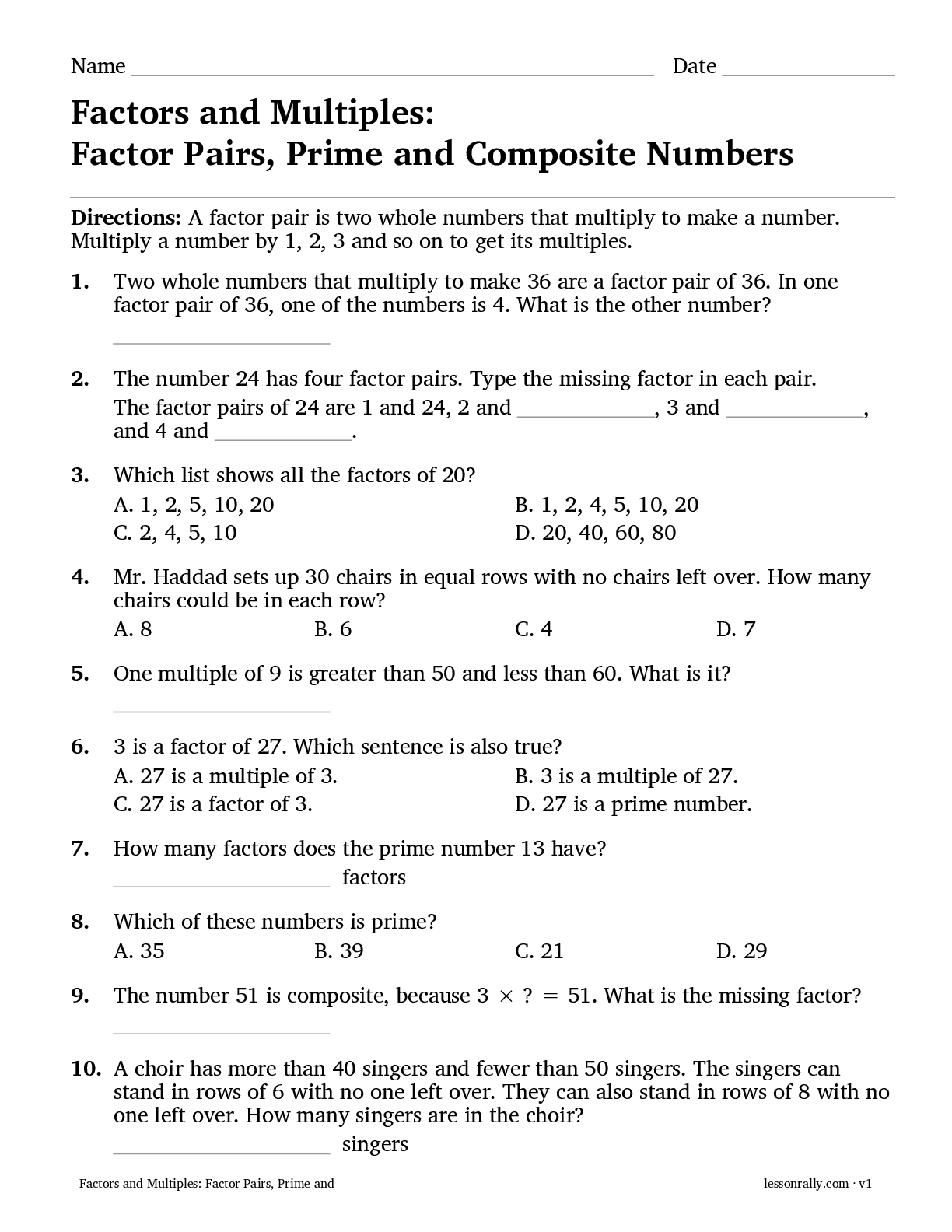
A factor pair is two whole numbers that multiply to make a number. Multiply a number by 1, 2, 3 and so on to get its multiples.
Two whole numbers that multiply to make 36 are a factor pair of 36. In one factor pair of 36, one of the numbers is 4. What is the other number?
Enter a number.
The number 24 has four factor pairs. Type the missing factor in each pair.
Fill in each blank.
The factor pairs of 24 are 1 and 24, 2 and blank 1, 3 and blank 2, and 4 and blank 3.
Which list shows all the factors of 20?
Choose one answer.
Mr. Haddad sets up 30 chairs in equal rows with no chairs left over. How many chairs could be in each row?
Choose one answer.
One multiple of 9 is greater than 50 and less than 60. What is it?
Enter a number.
3 is a factor of 27. Which sentence is also true?
Choose one answer.
How many factors does the prime number 13 have?
Enter a number.
factors
Which of these numbers is prime?
Choose one answer.
The number 51 is composite, because 3 × ? = 51. What is the missing factor?
Enter a number.
A choir has more than 40 singers and fewer than 50 singers. The singers can stand in rows of 6 with no one left over. They can also stand in rows of 8 with no one left over. How many singers are in the choir?
Enter a number.
singers
No reviews yet.
Reviews come from teachers who assigned this activity to a class.
Have a topic of your own? Make a printable worksheet and online quiz, free.
Create an activityCommon Core 4.NF.B.4c
Made by Luis Carmona · LessonRally (AI-assisted)
Common Core 4.NF.A.2
Made by Luis Carmona · LessonRally (AI-assisted)
Common Core 4.NBT.B.5
Made by Luis Carmona · LessonRally (AI-assisted)
Common Core 4.OA.A.2
Made by Luis Carmona · LessonRally (AI-assisted)